Quick answer
Self-locking corrugated mailers printed inside and out. The go-to box for DTC brands and subscriptions. Estimated prices start around $0.72 per unit at 10,000 units and $3.16 at 100 units for a 9×6×3" box. Typical turnaround is 10–14 business days after proof approval.
Mailer Boxes: specifications
| Construction | Roll End Tuck Front (RETF), FEFCO 0427 style |
|---|---|
| Board | E-flute (1/16") standard; B-flute (1/8") for heavier items |
| Strength | 32 ECT single-wall; 44 ECT on request |
| CMYK digital or offset, 1–2 color flexo, inside print | |
| Finishes | Matte/gloss coating, lamination, spot UV, foil, embossing |
| Size range | 4×3×1" up to 24×18×8" |
| Minimum order | 100 units |
| Turnaround | 10–14 business days after proof |
Mailer Boxes: price breaks
How the estimated unit price of a 9×6×3" mailer box in E-flute corrugated, white changes with quantity. Setup costs are spread over more boxes as the run gets longer, so the per-box price drops sharply in the first few tiers.
| Quantity | Est. unit price | Est. total | Saving vs. first tier |
|---|---|---|---|
| 100 | $3.16 | $316 | — |
| 250 | $1.82 | $454 | −42% |
| 500 | $1.33 | $664 | −58% |
| 1,000 | $1.06 | $1,057 | −66% |
| 2,500 | $0.86 | $2,158 | −73% |
| 5,000 | $0.78 | $3,898 | −75% |
| 10,000 | $0.72 | $7,239 | −77% |
Estimates from our published pricing model, full-color print, no finishes, delivered to the contiguous US. Your written quote confirms the exact price. Get an exact quote →
Popular sizes for mailer boxes
Sizes are inside dimensions (length × width × height) in inches. Any custom size is available at no extra cost; these are simply the sizes brands order most.
| Size (L×W×H) | Typical use | Est. @ 500 | Est. @ 1,000 | Quote |
|---|---|---|---|---|
| 6 × 4 × 2" | Serums, candles, soaps, single small products | $0.91 | $0.67 | Quote |
| 8 × 6 × 2" | Gift sets, apparel accessories, small electronics | $1.07 | $0.82 | Quote |
| 9 × 6 × 3" | T-shirts, subscription kits, books, multi-item orders | $1.33 | $1.06 | Quote |
| 10 × 8 × 4" | T-shirts, subscription kits, books, multi-item orders | $1.80 | $1.50 | Quote |
| 12 × 9 × 4" | Shoes, hoodies, bundles, home goods | $1.99 | $1.67 | Quote |
| 14 × 10 × 4" | Shoes, hoodies, bundles, home goods | $2.19 | $1.85 | Quote |
| 16 × 12 × 6" | Bulk orders, small appliances, wholesale packs | $3.37 | $2.94 | Quote |
Material options and how they affect price
Estimated unit price at 1,000 units for a 9×6×3" mailer box with full-color printing, by material. Material choice changes look, strength and recyclability as well as cost.
| Material | What it’s like | Est. unit price |
|---|---|---|
| E-flute corrugated, white | E-flute corrugated (about 1/16 in) with a white liner: crisp print with real cushioning and parcel strength. | $1.06 |
| E-flute corrugated, kraft | E-flute corrugated with a natural kraft liner: thin, strong and economical, with a natural look. | $1.00 |
| B-flute corrugated, kraft | B-flute corrugated (about 1/8 in) with a kraft liner: more crush resistance for heavier or larger contents. | $1.03 |
Printing options compared
How the print specification changes the estimated unit price of a 9×6×3" mailer box in E-flute corrugated, white. One- and two-color printing carries a small plate charge that matters less as quantities grow; full-color digital and offset printing have no plate charge in our model.
| Printing | 500 units | 1,000 units | 5,000 units |
|---|---|---|---|
| Plain (no print) | $1.06 | $0.81 | $0.56 |
| 1 color | $1.27 | $0.95 | $0.65 |
| 2 colors | $1.39 | $1.04 | $0.70 |
| Full color outside | $1.33 | $1.06 | $0.78 |
| Full color outside + inside | $1.57 | $1.28 | $0.97 |
What is a custom mailer box?
A mailer box is a one-piece, die-cut corrugated box that folds into a rigid tray with an attached hinged lid. The lid has a tuck flap that slides into the front wall, and the side walls are double thickness, folding over themselves and locking into slots in the base. Because the structure locks itself, a mailer box closes without tape and opens cleanly, which is exactly why it became the default box for direct-to-consumer brands, subscription programs and gift kits.
In the packaging industry this structure is usually called a roll end tuck front (RETF) box, and it corresponds closely to FEFCO style 0427 in the European corrugated code. You will also hear it called a literature mailer, e-commerce mailer, subscription box or simply a tuck top mailer. They all describe the same idea: a strong shipping box that doubles as a presentation box.
Mailer boxes sit in a sweet spot between plain brown shipping cartons and expensive rigid gift boxes. They are strong enough to go through UPS, FedEx and USPS parcel networks on their own, yet they print beautifully on the outside and the inside, so the moment a customer lifts the lid becomes part of your brand.
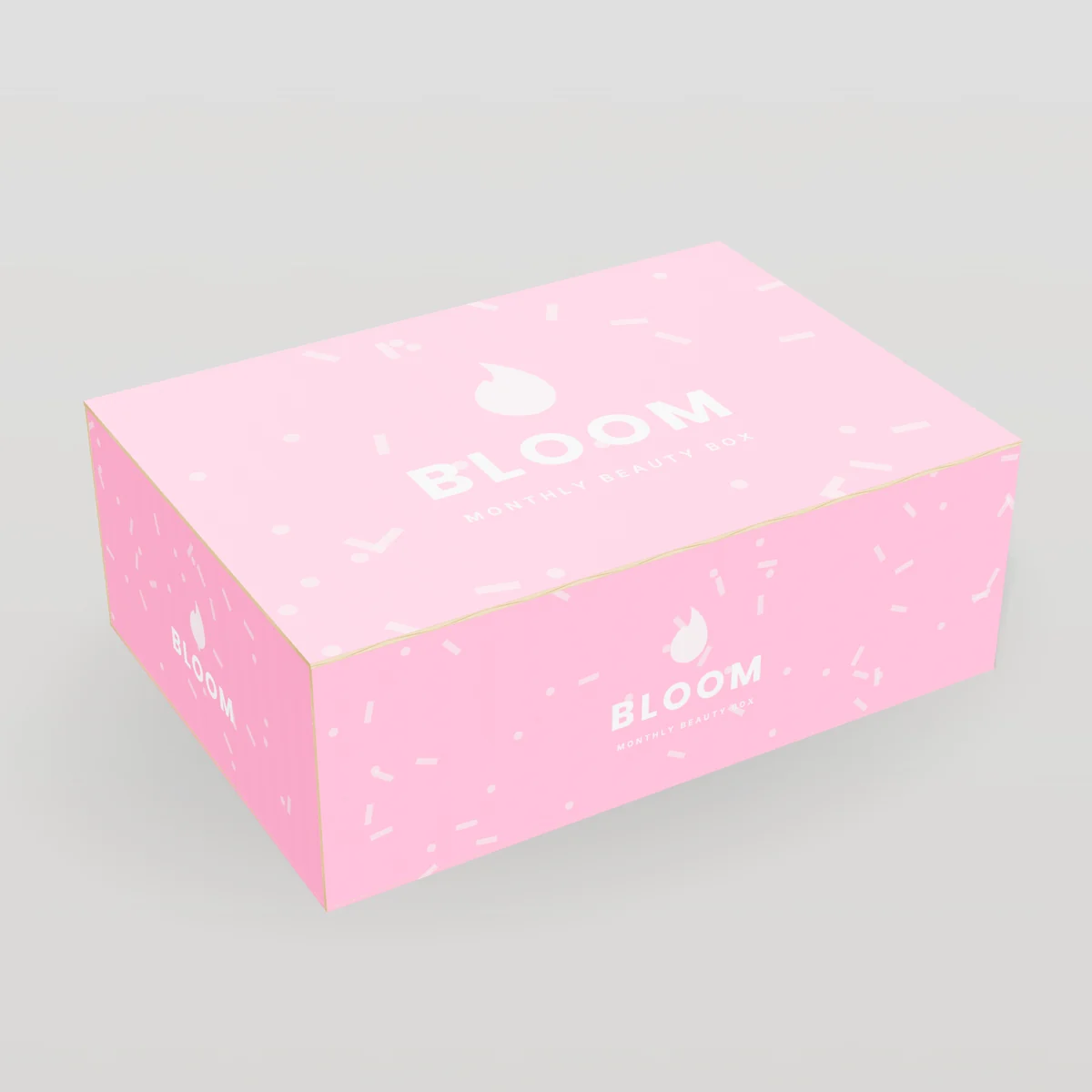
Why brands choose mailer boxes
- No tape, no clutter. The self-locking design means a cleaner unboxing and faster packing on your line.
- Two print surfaces. The outside sells the brand on the doorstep; the inside delivers the surprise when the lid opens.
- Parcel-ready strength. E-flute and B-flute corrugated board survives typical parcel handling for products up to roughly 10–15 lb when sized correctly.
- Reusable and giftable. Customers keep good mailers for storage and gifting, which keeps your brand in their home.
- Ships flat. Mailers arrive flat-packed, so a thousand boxes take up a fraction of the space of assembled cartons.
Anatomy of a mailer box
Understanding the parts helps you brief your designer and read a dieline correctly. A standard roll end tuck front mailer has eight main panels:
| Part | What it does | Design tip |
|---|---|---|
| Lid (top panel) | The main branded surface customers see first | Put your logo here, centered or in a bold corner layout |
| Front tuck flap | Slides into the front wall to close the box | Keep text off the fold line; a small message here is a nice touch |
| Lid front lip | Short panel between lid and tuck flap | Often a solid color band or a short tagline |
| Back wall | Hinge between base and lid | Good spot for a website URL or social handle |
| Front wall | Double layer that receives the tuck | The inner layer is visible when opened |
| Side walls (double) | Fold over themselves for strength | The rolled edge is what makes mailers feel sturdy |
| Dust flaps / ears | Small flaps on the lid that tuck inside the sides | Usually left unprinted or flood-coated |
| Base | Bottom of the box | Print care instructions or a barcode on the outside |
When you open the free Dieline Generator and choose Mailer box, you will see each of these panels labeled on the flat layout. The double side walls are the reason a mailer's flat blank is much larger than the finished box: a 9 × 6 × 3 in mailer needs a blank of roughly 22 × 22 inches before it is folded.
Materials and board grades
Almost all mailer boxes are made from corrugated board, a fluted paper medium glued between two flat liners. Two things matter: the flute size (thickness) and the liner (the printable surface).
Flute options
- E-flute (about 1/16 in thick). The standard for mailers. It is thin enough to fold crisply and print sharply, but has enough cushioning and stacking strength for most DTC products under 10 lb. If you are unsure, start here.
- B-flute (about 1/8 in thick). Roughly twice as thick as E-flute. Choose it for heavier products (candles in glass, ceramics, books, multi-item kits), larger boxes over about 14 in long, or anything that will be stacked in a warehouse for weeks.
- F-flute / micro-flute (about 1/32 in). Very thin and smooth. It is used for small premium mailers and retail cartons where print detail matters more than crush strength.
Liner options
- White (bleached) liner. The brightest surface for full-color printing. Colors look clean and photography reproduces accurately. Most branded mailers use a white outside liner.
- Kraft (brown) liner. Unbleached, naturally brown, and slightly cheaper. It signals natural or eco-minded brands and looks excellent with one or two dark ink colors. Bright colors look muted on kraft because the brown shows through.
- White outside, kraft inside. A common compromise: a bright printed exterior with a natural interior.
Board strength for mailers is normally specified as 32 ECT (edge crush test) for single-wall board. That rating is plenty for parcel shipping of typical consumer products. Read our corrugated cardboard guide for how ECT, Mullen burst and caliper relate to each other.
Tip: Board thickness changes the inside dimensions. If you switch from E-flute to B-flute after your dieline is made, the box needs to be resized, otherwise your insert or product may no longer fit.
Printing options for mailer boxes
Mailer boxes can be printed with three main methods. The right one depends on quantity, design complexity and budget.
| Method | Best for | Strengths | Trade-offs |
|---|---|---|---|
| Digital printing | 100 to about 1,000 units, multiple designs, photo-rich art | No plates, quick setup, full color, easy design changes | Higher unit cost at large volumes |
| Offset litho-lamination | 1,000+ units with premium full-color graphics | Sharpest detail, accurate Pantone color, glossy or matte finish | Plates and lamination add setup cost |
| Flexographic printing | Simple 1–3 color logos at volume, kraft mailers | Lowest cost at scale, fast, water-based inks | Less detail, not ideal for photos or gradients |
Inside printing
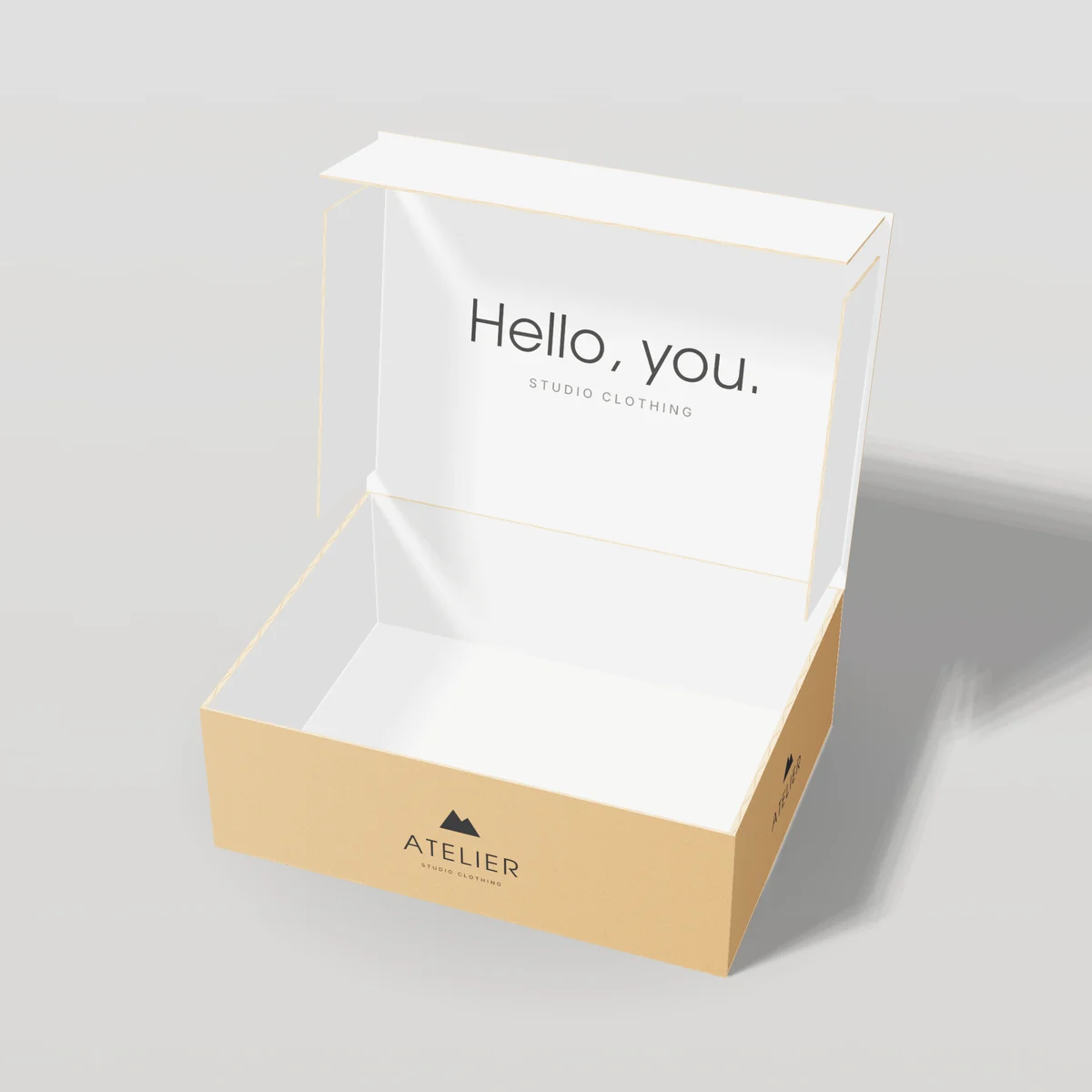
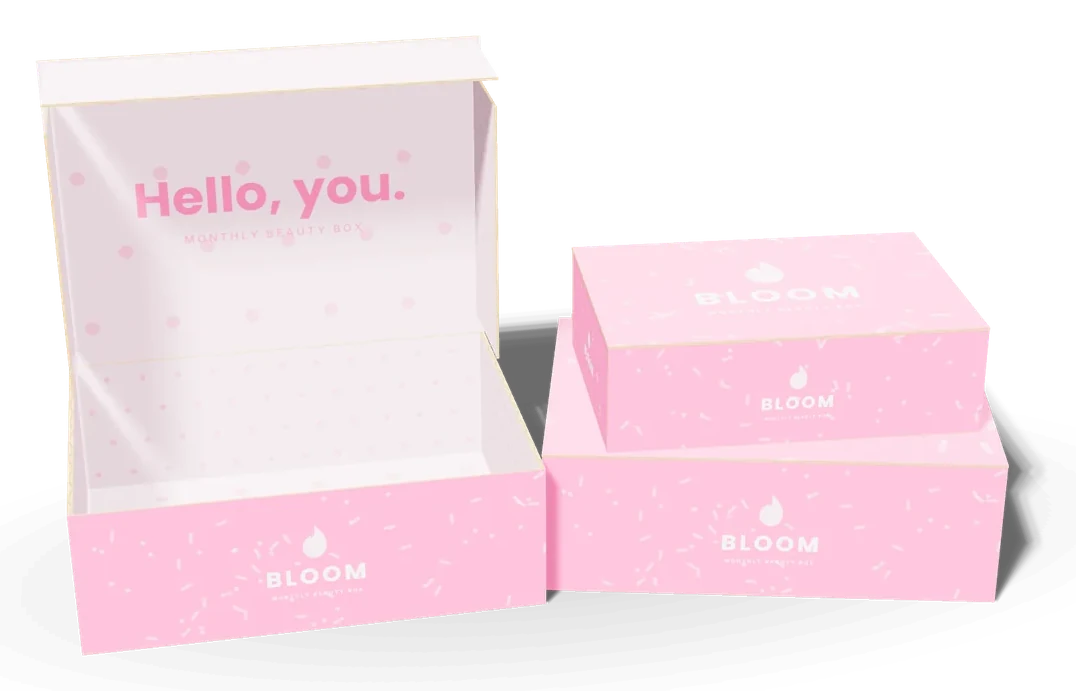
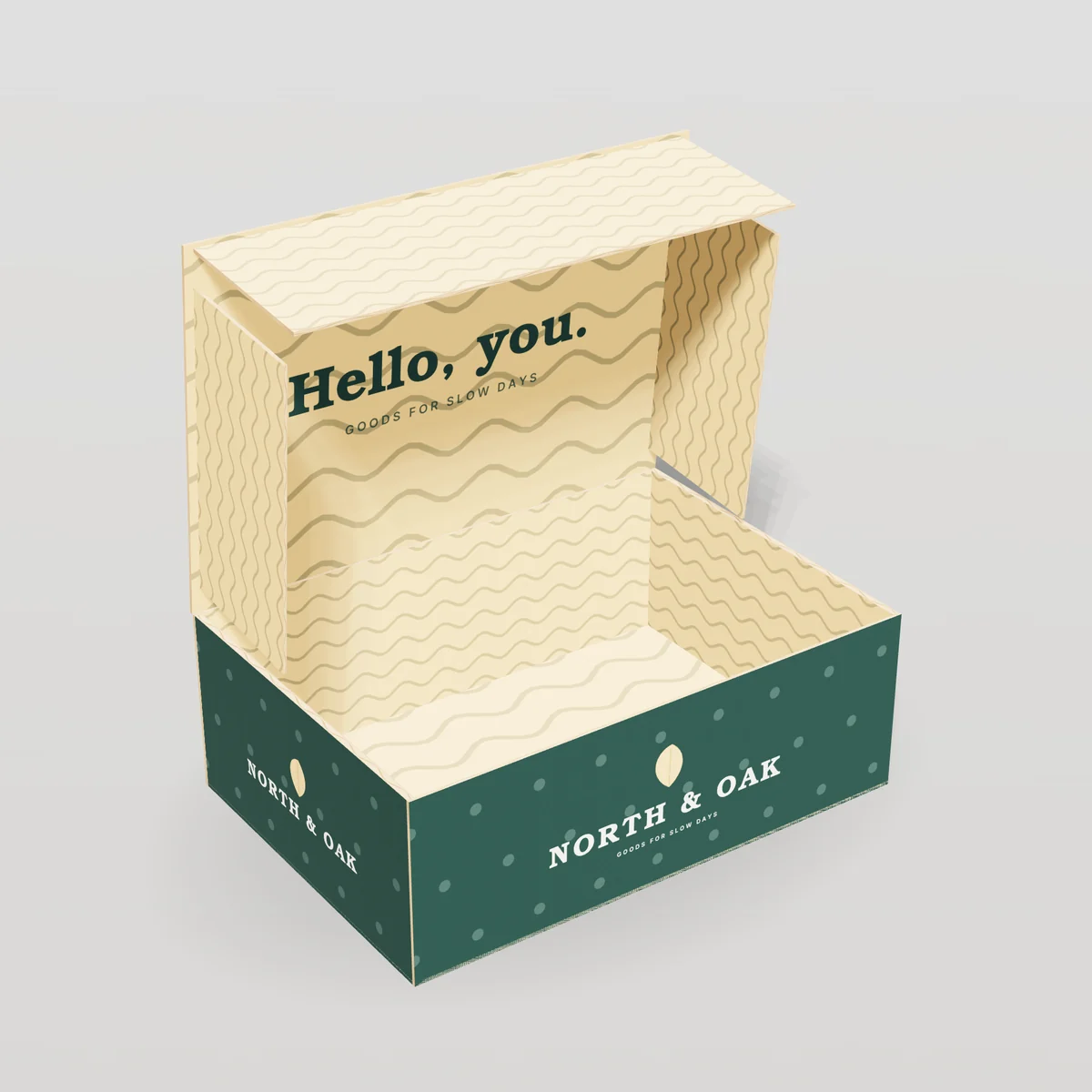
Printing the inside of a mailer is what turns a box into an experience. A bold interior color, a pattern, a thank-you message on the inside lid or simple usage instructions all cost far less than outside finishes like foil, yet they create the "wow" moment customers film and share. Most brands print full color outside and one or two colors inside, or a single flood color inside to keep costs down. See interior printing for ideas.
Color accuracy
If your brand color matters, give us a Pantone (PMS) reference. Digital and CMYK presses simulate Pantone colors very closely on white board; offset printing can run a true spot color. On kraft board colors shift darker and warmer, so ask for a printed sample if color is critical. Our printing guide explains CMYK, Pantone and rich black in detail.
Finishes and add-ons
Mailers are mostly corrugated, so not every luxury finish suits them. These work well:
- Matte or gloss aqueous coating. A clear water-based coat that protects print from scuffs in transit. Usually included.
- Matte or gloss lamination. A thin film that adds rub resistance and a premium feel, common on litho-laminated mailers.
- Soft-touch lamination. Velvety and premium on high-end mailers. It can show scuffs in rough shipping, so we suggest it for boxes that go inside an outer shipper.
- Spot UV. A glossy highlight on your logo against a matte background. Works best on laminated board.
- Foil stamping. Gold, silver or holographic foil for logos. It needs a smooth laminated surface on corrugated.
- Custom inserts. Die-cut paperboard or corrugated inserts that hold products in place. Essential for glass, multi-item kits and anything that should not rattle. See custom inserts.
- Tear strip or zipper. A perforated strip that makes opening easy and tamper-evident, useful for subscriptions.
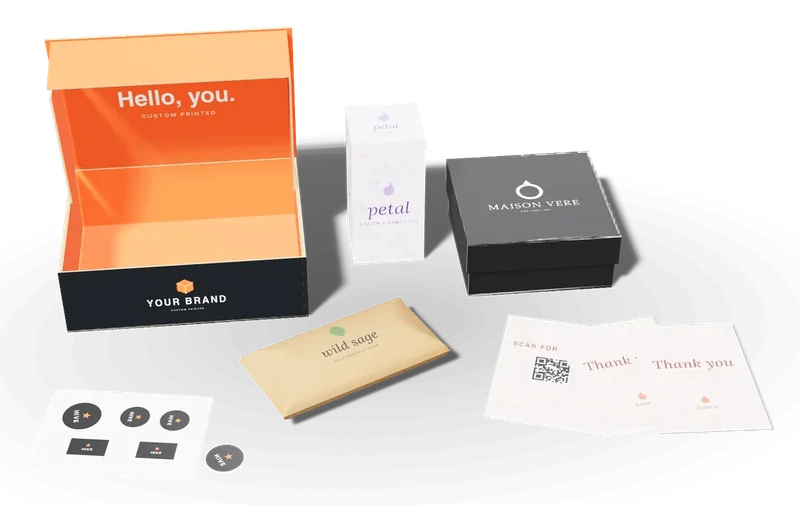
- Branded tissue, stickers and cards. Low-cost accessories that complete the unboxing. Browse packaging accessories.
How to size a mailer box correctly
Box size drives cost, product safety and shipping fees. Mailer boxes are always quoted by inside dimensions: Length × Width × Height, where length and width are measured across the opening and height is the depth of the base.
- Measure your product (or packed kit) at its largest points. Include any inner packaging: a jar plus its carton, or several products plus tissue.
- Add clearance. Add about 1/8 in to each dimension for a snug fit, 1/4 to 1/2 in if you use tissue or crinkle paper, and 1 to 2 in all around if you need cushioning for fragile items.
- Check the height. Mailers look best when they are shallow relative to their footprint. Very tall mailers (height greater than width) are harder to fold and less stable; consider a shipping box instead.
- Check carrier dimensional weight. UPS and FedEx charge by dimensional weight when a package is light for its size. Trimming even half an inch from each side can lower shipping costs on every order.
Popular mailer box sizes and what fits
- 6 × 4 × 2 in: jewelry, cosmetics, small accessories, sample kits.
- 8 × 6 × 2 in: skincare sets, socks, small candles, phone accessories.
- 9 × 6 × 3 in: the most popular all-rounder: candles, small apparel, beauty kits, gift sets.
- 10 × 8 × 4 in: T-shirts, books, subscription kits, larger candle sets.
- 12 × 9 × 4 in: hoodies, multi-product bundles, monthly boxes.
- 14 × 10 × 4 in and up: shoes (low profile), larger apparel bundles, home goods.
Any custom size is available. We do not charge extra for a non-standard size because every mailer is die-cut to order anyway.
Mailer box pricing: what drives the cost
Every mailer box price is built from the same handful of factors. The price table near the top of this page shows how quantity alone changes the unit price; here is what else moves it.
- Quantity. Setup work (plates, dies, machine make-ready, proofing) is spread across the run, so the per-box price falls quickly up to about 1,000 units and keeps falling more slowly after that.
- Size (board area). A mailer's flat blank grows with every inch, and the double side walls make height especially expensive. Reducing height by an inch often saves more than reducing length.
- Board grade. B-flute costs more than E-flute; white liner costs more than kraft.
- Print coverage and sides. Printing outside only is cheapest. Inside printing adds a second print pass.
- Finishes. Lamination, spot UV, foil and inserts each add a per-unit cost and, for foil and embossing, a one-time die charge.
- Shipping. Mailers ship flat, but freight still depends on total weight and destination.
Here are estimated prices for a larger 12 × 9 × 4 in mailer in B-flute kraft with printing inside and out, for comparison with the standard size above:
| Quantity | Est. unit price | Est. total | Saving vs. first tier |
|---|---|---|---|
| 100 | $4.48 | $448 | — |
| 250 | $2.97 | $741 | −34% |
| 500 | $2.38 | $1,189 | −47% |
| 1,000 | $2.03 | $2,027 | −55% |
| 2,500 | $1.75 | $4,374 | −61% |
| 5,000 | $1.62 | $8,081 | −64% |
| 10,000 | $1.52 | $15,202 | −66% |
Estimates from our published pricing model, full-color print, no finishes, delivered to the contiguous US. Your written quote confirms the exact price. Get an exact quote →
Seven ways to lower your mailer box price
- Order 500 to 1,000 units instead of 100 to 250 if you have the storage. The per-unit saving is usually 30–50%.
- Right-size the box. Every square inch of board you remove reduces material cost and dimensional weight.
- Use one hero finish. A great structure with one finish beats three competing finishes.
- Print the inside in one color instead of full color.
- Choose kraft for a natural look at a lower board cost.
- Standardize across products. One mailer size for several products means larger runs and simpler packing.
- Plan ahead. Rush production costs more; standard lead times keep your price lower.
Our packaging cost guide and the Packaging Cost Calculator let you compare options side by side.
Designing artwork for mailer boxes
A great mailer design is planned around how the box is opened, not just how it looks closed. Think in sequence: the doorstep, the lift of the lid, the inside reveal, then the product.
Design principles that work
- One dominant element outside. A large logo, a bold pattern or a single word reads instantly from across a room and in social media photos.
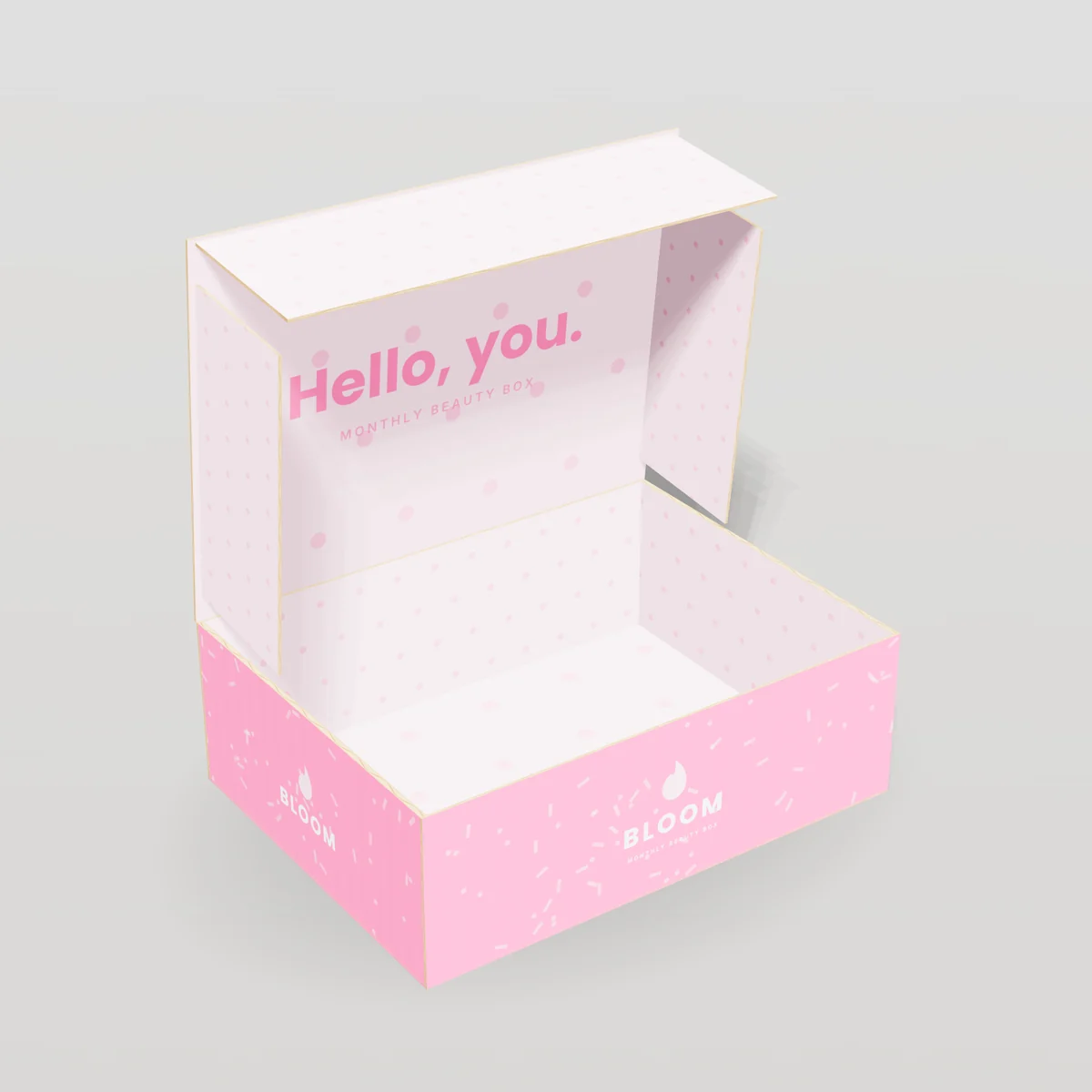
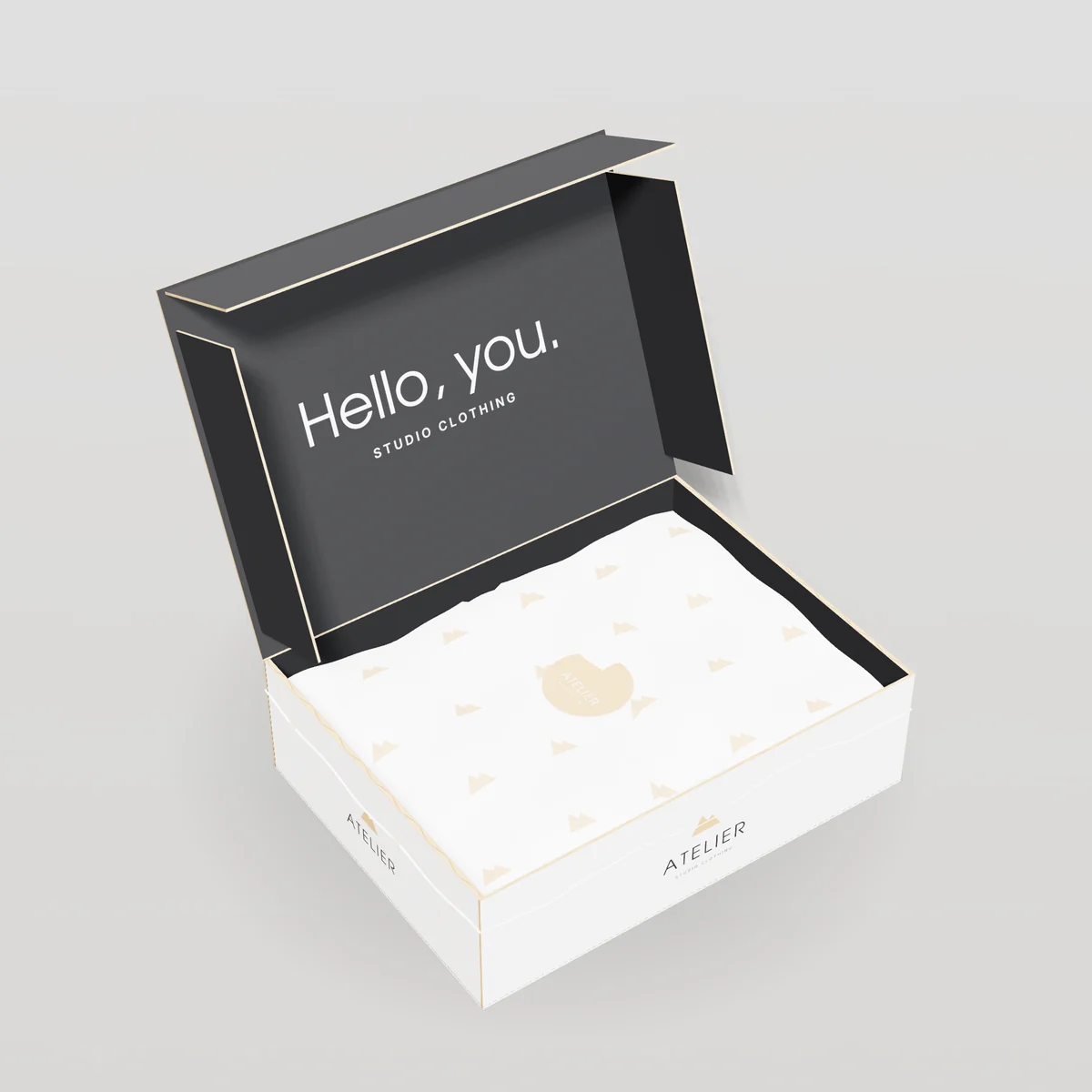
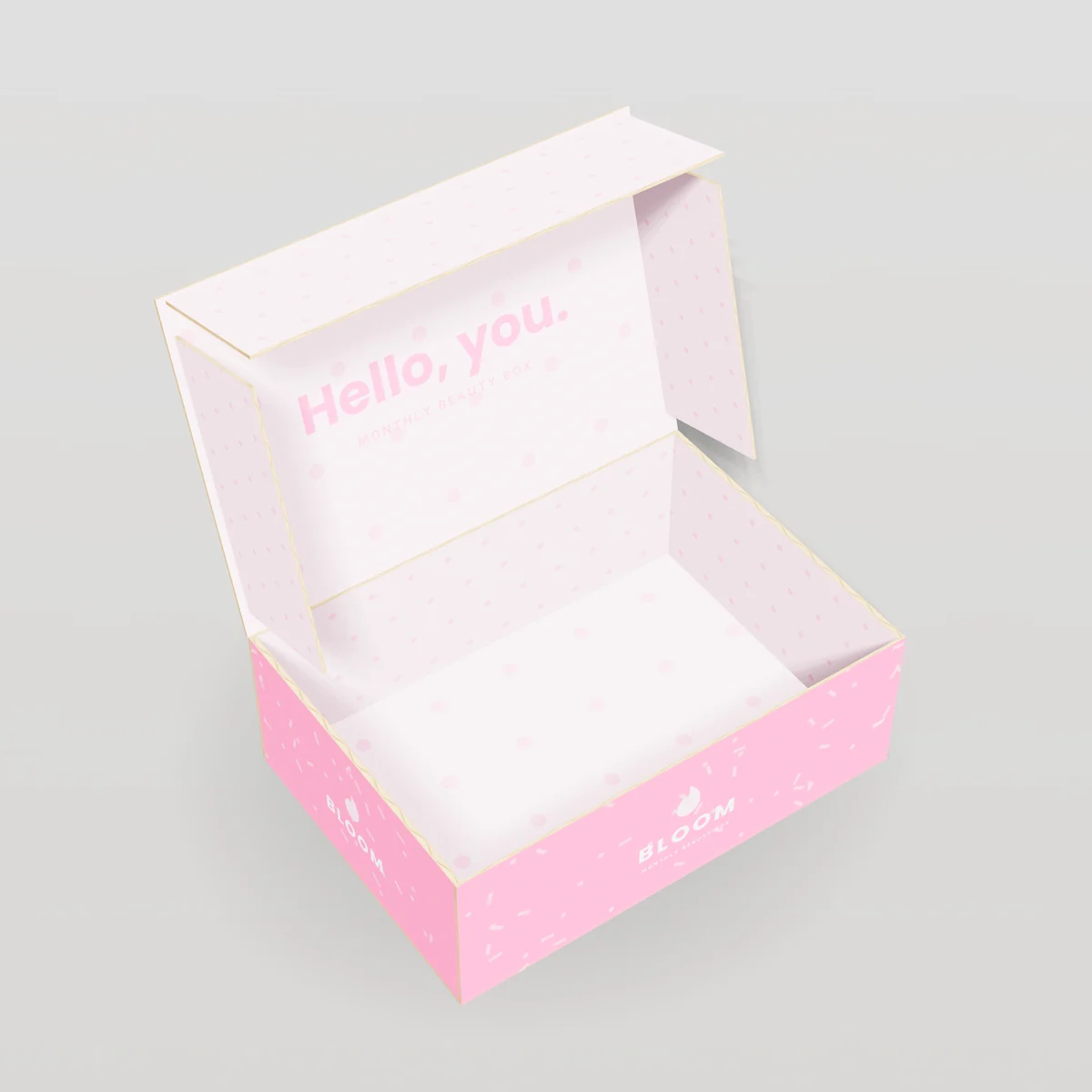
- Save the surprise for the inside. A contrasting color or a short message on the inside lid ("Hello, you." or "Made for you") delights for very little cost.
- Respect the folds. Keep critical text and logos at least 1/8 in away from crease lines and 1/8 in inside cut lines. Extend background colors 1/8 in past the cut line (bleed).
- Mind the rolled edges. The double side walls mean the inside face of the side wall is printed on the outside artwork. Your dieline shows which panels flip.
- Plan the shipping label. If boxes ship without an outer carton, leave a clean area on the lid or base for the carrier label so it does not cover your logo.
Note: If your mailer will ship as-is (no outer carton), carriers will scuff it. Matte coatings hide scuffs better than gloss; dark full-coverage colors show scuffs more than light ones.
File setup checklist
- Design on the dieline for your exact size and board thickness.
- Use CMYK color mode (or name Pantone spot colors).
- Keep images at 300 ppi at final size; vector logos are best.
- Convert fonts to outlines or include them.
- Put special finishes (spot UV, foil) on separate layers as 100% spot colors.
- Export a print-ready PDF with bleed.
Not sure your files are ready? Send what you have. Free artwork checks come with every quote, and our artwork guidelines cover everything in detail. You can also test a logo's resolution instantly with the Artwork Checker.
Mailer boxes by industry
Mailers are versatile, but each category has its own priorities:
- Apparel and fashion: shallow, wide mailers with tissue paper and a sticker seal. B-flute for hoodies and bundles. See apparel boxes.
- Beauty and skincare: compact E-flute mailers with a die-cut insert to stop bottles moving. See cosmetic boxes.
- Candles: B-flute with a snug insert around the glass jar; avoid big air gaps. See candle boxes.
- Subscription boxes: consistent outside design, a rotating inside print or insert card each month. See subscription boxes.
- Food and coffee: mailers for gift sets and samplers, with food-safe coatings if product contacts board. See coffee and tea boxes.
- Electronics and gadgets: E-flute mailer with a fitted insert and a clear opening direction. See electronics boxes.
- Corporate gifting and PR kits: premium print inside and out, often with a foil logo and an insert. Compare with magnetic closure boxes for the top tier.
Mailer boxes and sustainability
A corrugated mailer box is one of the most recyclable packaging formats available. Corrugated board is accepted in curbside recycling across nearly all of the United States, and the industry reports some of the highest recovery rates of any packaging material. To keep your mailers easy to recycle:
- Prefer paper-based finishes. Aqueous coatings recycle easily. Heavy plastic laminations and large foil areas can complicate recycling in some facilities.
- Use paper inserts (paperboard or corrugated) rather than foam where possible.
- Choose recycled-content board when available, and right-size to use less material overall.
- Make claims carefully. Statements like "recyclable" should follow the FTC Green Guides. Our sustainable packaging guide explains how to word them.
Mailer box variations
The classic roll end tuck front is only the starting point. These variations are all made from the same family of dielines and can be quoted the same way:
- Front tuck with dust flaps (standard). The version on this page. Ears on the lid tuck inside the side walls to keep dust out and make the lid sit flat.
- Double tuck mailer. Tuck flaps on both the front and the sides of the lid for extra security on heavier contents. A good choice when boxes are handled roughly or reused for returns.
- Mailer with a tear strip. A perforated zipper strip runs around the front so the customer pulls a tab to open it. It doubles as tamper evidence and is popular for subscription and supplement programs.
- Mailer with handle. A die-cut handle in the back wall and lid turns the mailer into a carry box for bakery, gift and event kits.
- Window mailer. A die-cut window in the lid, optionally patched with clear film, shows off colorful contents. Windows reduce stacking strength slightly, so they suit lighter kits.
- Cereal-style or shoe-style mailer. A taller variation with a hinged lid and full-height side walls, used for footwear and bulkier apparel.
- Mailer with return features. A second adhesive strip on the tuck flap lets customers reseal the box for returns, which reduces packaging waste and support tickets.
If you have a reference box you like, send photos or measurements with your quote request and we will match the structure.
Packing and assembly tips
A mailer that is easy to assemble saves real money on your packing line. A trained packer can fold a standard mailer in a few seconds; these tips keep it that way:
- Pre-fold a batch. Folding 20 to 50 boxes in a row before packing is faster than folding each one as you go.
- Fold the side walls first, then lock them into the base slots. The double walls should sit flush; if they bulge, the inside dimensions or board grade may need adjusting.
- Place inserts before products. Drop the insert in, then seat each product so nothing moves when the box is tilted.
- Do the shake test. Close the lid and shake gently. If you hear movement, add a tissue wrap or adjust the insert.
- Store flat and dry. Keep flat-packed mailers off concrete floors and away from humidity. Damp corrugated board loses a large share of its compression strength and can warp.
- Rotate stock. Use older boxes first so colors and board stay consistent across shipments.
Mailer box vs. other box styles
| Compared with | Choose a mailer box when… | Choose the alternative when… |
|---|---|---|
| Shipping box (RSC) | You want a branded unboxing, tape-free closure and inside print | You need the lowest cost per cubic inch or ship heavy or tall items |
| Rigid box | You need parcel strength and a lower price | The box is a keepsake, retail gift or luxury product (ship it inside a shipper) |
| Magnetic closure box | Budget matters and the box ships on its own | You want the premium "snap" moment for high-value gifts |
| Poly mailer | Products need protection from crushing | Products are soft, unbreakable apparel and shipping cost is critical |
| Folding carton | The product ships direct to consumers | The product sits on a retail shelf and ships inside a case |
Ordering checklist for custom mailer boxes
Use this list to get an accurate quote on the first try:
- Inside dimensions (L × W × H) and what goes inside
- Board: E-flute or B-flute; white or kraft
- Printing: outside only, or outside and inside; number of colors or full color
- Finishes: coating, lamination, spot UV, foil, insert
- Quantities: ask for two or three price breaks (for example 500, 1,000 and 2,500)
- Delivery ZIP code and target date
- Artwork status: print-ready files, logo only, or design needed
Common mailer box mistakes to avoid
- Sizing to the product instead of the packed product. Tissue, inserts and cards take space. Measure the full kit.
- Ignoring board thickness. Inside dimensions shrink if the board gets thicker. Always confirm the dieline after changing material.
- Too much empty space. Oversized boxes cost more, ship at higher dimensional weight and let products move and break.
- Text on fold lines. Folds crack ink and distort text. Keep a safe margin.
- Bright colors on kraft. Kraft mutes color. Use white board for vivid brand colors.
- Skipping the proof. Always approve a 3D or physical proof. It is free with every order.
- Forgetting the label area. If boxes ship without an outer carton, plan where the shipping label goes.
Related guides
 GuideE-commerce shipping packagingHow to package e-commerce orders so they arrive intact: board strength, void fill, inserts, drop testing, Amazon FBA prep and branded unboxing on a budget.
 GuideUnboxing & brand designHow to design packaging that sells and gets shared: brand hierarchy, color, typography, the unboxing sequence, inserts and low-cost upgrades that matter.
 GuideBox sizing & DIM weightHow to measure inside vs outside box size, choose clearances, calculate UPS, FedEx and USPS dimensional weight, and right-size boxes to cut shipping costs.
 GuideHow much custom packaging costsRealistic 2026 price ranges for custom mailer, shipping, carton, rigid and pouch packaging, what drives cost, and proven ways to lower your unit price.
Not sure whether you need a mailer or a regular shipping box? Read mailer box vs shipping box.
What finishes and add-ons cost
Estimated extra cost per unit at 1,000 units when you add one finish to a 9×6×3" mailer box (base estimate $1.06). One-time tooling such as foil and embossing dies is already spread across the run in the per-unit figure and listed separately for reference.
| Finish | What it does | Adds per unit | One-time setup |
|---|---|---|---|
| Matte lamination | A thin film with a smooth, low-glare finish that protects print from scuffs. | +$0.06 | — |
| Soft-touch | A velvety, premium coating that invites customers to hold the box. | +$0.12 | — |
| Spot UV | Clear glossy varnish on selected areas for a sleek contrast against matte. | +$0.17 | $80.00 |
| Foil stamping | Gold, silver, rose gold or holographic foil for logos and accents. | +$0.24 | $120 |
| Embossing / debossing | Raised or recessed logo detail you can feel with your fingertips. | +$0.23 | $120 |
| Window | A die-cut window with clear film so the product sells itself. | +$0.14 | $60.00 |
| Custom insert | Paperboard, corrugated or foam inserts that hold products in place. | +$0.25 | $80.00 |
How mailer boxes compare with similar styles
Estimated unit prices at 1,000 units for each style at its most popular size, full-color print, delivered within the contiguous US, so you can weigh mailer boxes against the alternatives customers often consider.
| Style | Typical board | Minimum | 1,000 units | Ships | Best for |
|---|---|---|---|---|---|
| Mailer Boxes9 × 6 × 3" | E-flute corrugated, white | 100 units | $1.06 | Flat | Self-locking corrugated mailers printed inside and out. The go-to box for DTC brands and subscriptions. |
| Shipping Boxes12 × 10 × 6" | C-flute corrugated, kraft (32 ECT) | 100 units | $1.31 | Flat | Printed corrugated regular slotted cartons (RSC) for e-commerce, wholesale and freight. |
| Product Boxes4 × 4 × 4" | SBS white paperboard (18pt) | 250 units | $0.49 | Flat | Printed paperboard boxes for retail shelves, gift sets and everyday products. |
| Two-Piece Boxes8 × 8 × 3" | Rigid greyboard + printed wrap | 100 units | $3.10 | Flat | Lid-and-base boxes in rigid board or paperboard. A timeless gift and apparel format. |
| Magnetic Closure Boxes9 × 7 × 3" | Rigid greyboard + printed wrap | 100 units | $3.51 | Assembled | Book-style rigid boxes with hidden magnets for a satisfying, reclosable unboxing. |
| Display Boxes10 × 7 × 4" | E-flute corrugated, white | 100 units | $1.13 | Flat | Counter and shelf-ready displays that ship your product and sell it at the register. |
Learn about these materials
How to order mailer boxes
- 1Request a quote
Tell us the style, size, quantity and artwork you have. Use the form or the live estimator.
- 2Free design & dieline
We send a dieline for your exact size, check your artwork and help with layout at no charge.
- 3Approve your proof
Review a digital 3D proof (and an optional physical sample) before anything is printed.
- 4Production & QC
Your boxes are printed, finished, die-cut and inspected against the approved proof.
- 5Delivered to your door
Shipped flat-packed with tracking to any address in the contiguous US.
Key terms on this page
- Mailer box
- A self-locking corrugated box with a hinged lid and tuck front, widely used for e-commerce and subscriptions.
- Tray
- An open-topped box base, often used with a sleeve or lid.
- Lid
- The top part of a box, hinged or separate.
- Tuck flap
- A flap that folds over the opening of a box and tucks inside to close it.
- E-flute
- A thin corrugated flute about 1/16 inch thick. It prints sharply and folds crisply, making it the standard for mailer boxes.
- B-flute
- A corrugated flute about 1/8 inch thick. It offers good crush resistance and printability and is used for shipping boxes, heavier mailers and die-cut shippers.
- Corrugated board
- Board made of a fluted (wavy) paper medium glued between flat liners. It is strong, light and the main material for shipping boxes and mailers.
- Board
- A general term for thick paper materials used in packaging, including paperboard, corrugated board and greyboard.
- Dieline
- A flat template showing the exact shape of a box before folding, with cut, crease, bleed and safe zones. Artwork is designed on top of it.
- Panel
- A face of a box, such as the front, back, side, top or bottom panel.
- Flute
- The wavy middle layer of corrugated board. Flute size (A, B, C, E, F) determines thickness, cushioning and strength.
- Liner
- The flat paper faces of corrugated board. Can be kraft (brown) or bleached (white).
- BC double-wall
- Corrugated board with two fluted layers (B and C) and three liners. It is about 1/4 inch thick and used for heavy, fragile or long-stacked loads.
- Double-wall
- Corrugated board with two fluted layers, stronger than single-wall board.
- Cushioning
- Materials that absorb shock and vibration to protect products, such as paper void fill, molded pulp, foam or air pillows.
- Stacking strength
- How much weight a box can carry from boxes stacked on top of it.
- F-flute
- A very thin corrugated flute (micro-flute) about 1/32 inch thick, used for premium retail boxes needing extra strength.
- Micro-flute
- Very thin corrugated board (E, F or N flute) that combines paperboard-like print quality with extra strength.
- Kraft
- Paper or board made from unbleached wood pulp, naturally brown and strong.
- ECT (edge crush test)
- A test measuring how much force corrugated board can take on its edge before crushing, in pounds per inch. It predicts stacking strength.
- Single-wall
- Corrugated board with one fluted layer and two liners.
- Caliper
- The thickness of paper or board. Paperboard caliper is usually given in points, where 1 point equals 0.001 inch.
- Inside dimensions
- The usable space inside a box, the standard way to specify custom box sizes (L × W × H).
- Insert
- A component inside a box that holds products in place, such as die-cut paperboard, corrugated, foam or molded pulp.
- Digital printing
- Printing directly from a digital file without plates. Ideal for short runs, multiple designs and fast changes.
- Litho-lamination
- Printing a sheet by offset lithography and laminating it onto corrugated board for high-quality graphics on shipping and display boxes.
- Pantone (PMS)
- The Pantone Matching System, a standardized color reference used to specify exact spot colors.
- Matte finish
- A low-gloss surface that reduces glare and gives a modern, soft look.
More definitions in our packaging glossary.
Customer reviews
Reviews come only from verified customers. Ordered mailer boxes from us? Share your experience.
Discussed on Quora & X
Mailer Boxes FAQ
What is the minimum order for custom mailer boxes?
Our minimum order for printed mailer boxes is 100 units. Unit prices drop substantially at 500 and 1,000 units, so if you have storage space, a slightly larger first order often costs only a little more in total.
How long does it take to produce custom mailer boxes?
Typical production is 10–14 business days after you approve the proof, plus 3–7 business days for shipping within the contiguous United States. Proofs are usually ready within one to two business days of your quote approval.
Can you print on the inside of mailer boxes?
Yes. Inside printing is one of the most popular upgrades. You can print a flood color, a pattern, a message under the lid or full-color artwork. Many brands print full color outside and one or two colors inside to balance cost and impact.
What is the difference between E-flute and B-flute mailer boxes?
E-flute is about 1/16 inch thick and is the standard for most mailers: crisp folds, sharp print and good protection for products under about 10 lb. B-flute is about 1/8 inch thick and gives more crush resistance and cushioning for heavier, fragile or larger items.
Are mailer boxes strong enough to ship without an outer box?
Yes. Corrugated mailers are designed to ship on their own through UPS, FedEx and USPS when sized correctly. For very fragile items, heavy products or premium finishes like soft-touch lamination, we may recommend an insert or an outer shipper.
Do mailer boxes need tape?
No. The tuck front and locking side walls hold the box closed. Many brands add a branded sticker or a tear strip for tamper evidence and a finished look.
Can I get a sample before ordering?
Yes. You can order a sample kit with stock mailers and finishes, a plain structural sample in your exact size, or a custom printed pre-production sample of your design.
Do you provide a dieline for my mailer size?
Yes. We send a dieline for your exact size with every quote, free of charge. You can also create one instantly with our free Dieline Generator.
Are custom mailer boxes recyclable?
Corrugated mailer boxes are widely recyclable in US curbside programs. Paper-based coatings and inserts keep them easy to recycle. Large areas of plastic lamination or foil can make recycling harder in some facilities.
How do I measure a mailer box?
Mailer boxes are measured by inside dimensions in the order Length × Width × Height. Length is the longer side of the opening, width the shorter side, and height the depth of the base.