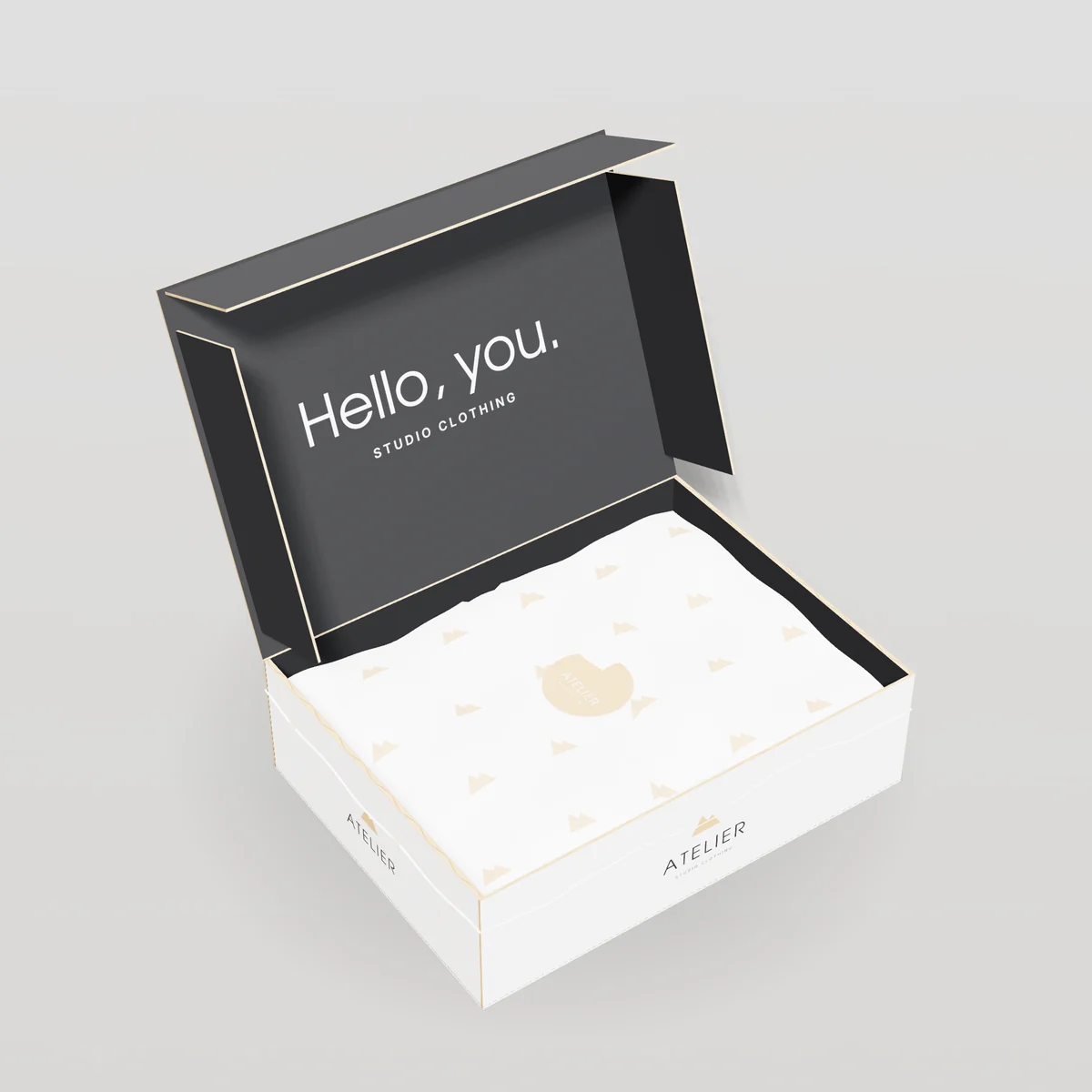
Quick answer
Branded tissue paper (17gsm) printed with your logo in one or two colors. Typical turnaround is 10–14 business days after proof approval.
What is custom tissue paper?
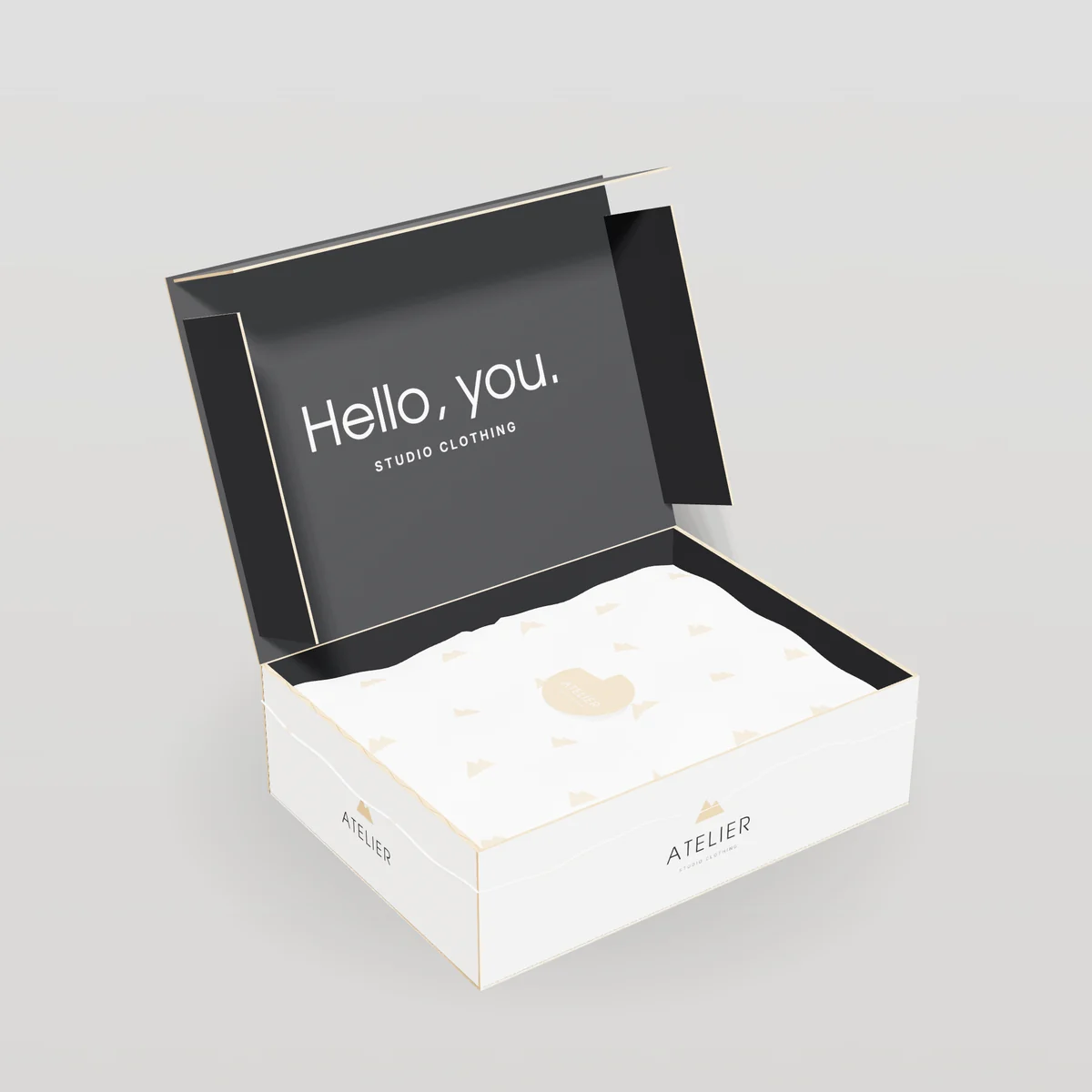
Custom tissue paper is thin, lightweight paper (typically around 17 gsm) printed with your logo, pattern or brand colors and used to wrap products inside a box or bag. It is one of the most affordable ways to transform an unboxing: a plain box with branded tissue sealed by a sticker instantly feels like a boutique purchase.
Tissue also does practical work. It protects products from scuffs and dust, fills small gaps, keeps folded garments neat and adds a layer of anticipation before the product is revealed.
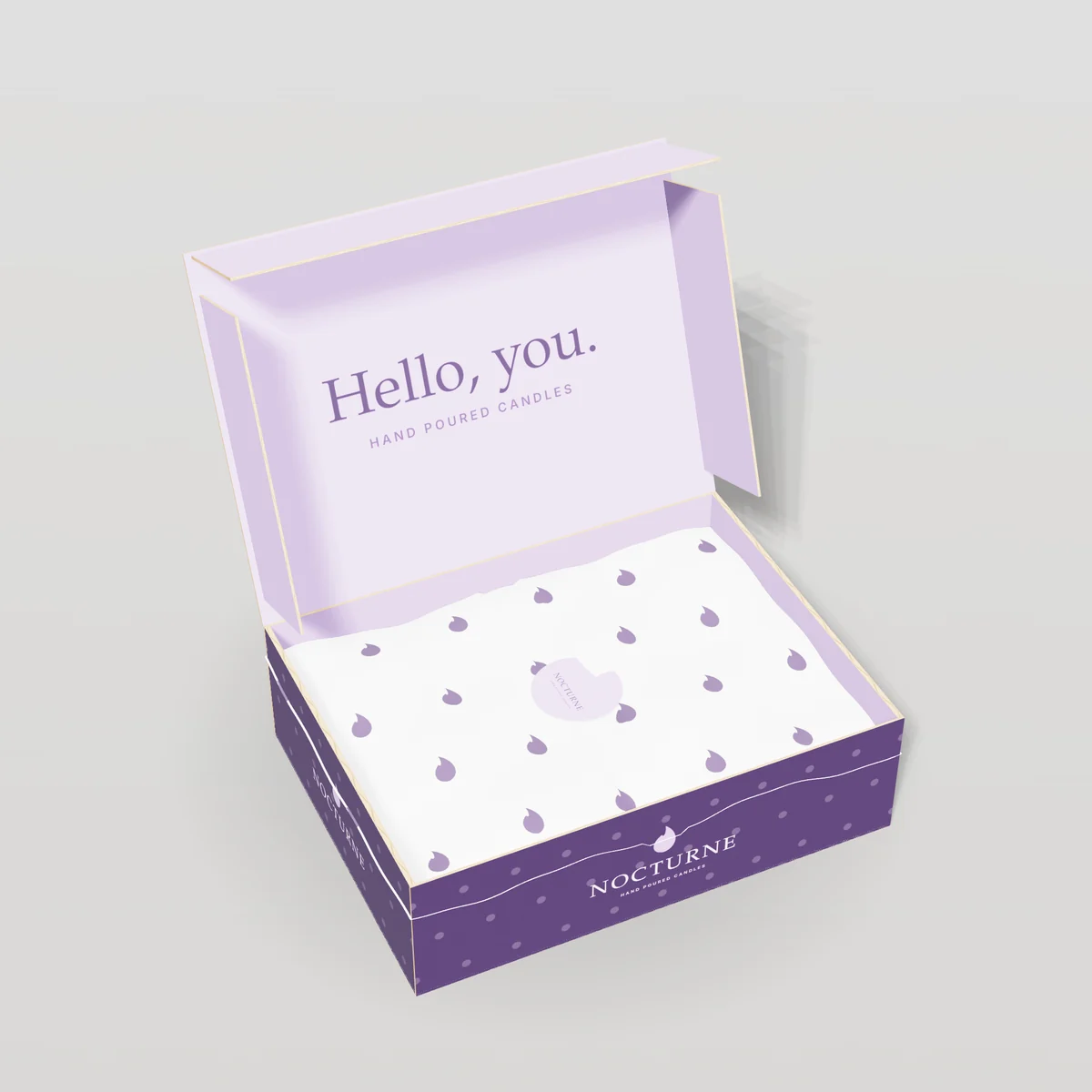
Tissue paper options
| Option | Details |
|---|---|
| Paper | Around 17 gsm acid-free tissue; white, kraft and colored base papers |
| Sheet sizes | Commonly 20 × 30 in; custom sizes available |
| Printing | One or two spot colors, repeated pattern or logo |
| Coverage | Spaced logo pattern, all-over pattern or solid flood |
| Inks | Water- or soy-based inks |
| Packing | Flat, folded or in reams |
Design ideas
- Logo repeat: your logo in a diagonal or offset grid
- Pattern: an illustration or icon pattern from your brand system
- Tone-on-tone: a light ink on white or a dark ink on colored tissue
- Seasonal designs for holidays and launches
Tip: Keep logos in the pattern fairly small (1–3 in). When tissue is folded and scrunched, smaller repeats stay recognizable from every angle.
How to use tissue in your unboxing
- Wrap the product or garment, folding neatly.
- Seal with a branded sticker. See custom stickers.
- Place in the box with the sticker facing up toward the lid.
- Add a thank-you card on top.
For apparel, two sheets crossed in an X in the box, with the garment in the center and the ends folded over, gives a classic boutique look.

Ordering
Our minimum for custom tissue is 500 sheets. Pricing depends on quantity, sheet size, number of ink colors and coverage. Request pricing using the form at the top of this page and we will reply with options.
What tissue paper does in a package
Tissue paper is light, inexpensive and remarkably effective. Wrapped around a product inside a box, it:
- Creates a reveal: customers unfold it to discover the product, adding a second moment after opening the lid.
- Signals care: wrapped products feel gifted rather than shipped.
- Protects surfaces: soft tissue prevents light scratches and keeps dust off garments and accessories.
- Fills small gaps: a little tissue stops light products sliding.
- Carries the brand: a printed pattern or logo extends your identity inside the box.
For apparel, accessories, cosmetics and gifts, branded tissue is one of the highest-impact upgrades per dollar.
Tissue specifications explained
| Specification | Common options | Notes |
|---|---|---|
| Paper weight | About 17–28 gsm | 17 gsm is classic tissue; heavier tissue feels more substantial |
| Sheet size | 20 × 30 in, 20 × 26 in, 15 × 20 in | Choose based on product size; one sheet should wrap the item |
| Paper color | White, kraft, colored-through | Colored tissue avoids heavy ink coverage |
| 1–2 colors (sometimes more) | Repeating logos or patterns | |
| Coverage | Spot logo, repeat pattern, full flood | Flood coverage on thin tissue can transfer; ask for advice |
| Finish | Uncoated; some acid-free or archival options | Acid-free tissue suits delicate textiles |
How to wrap with tissue
A consistent wrapping method makes every order look the same:
- Lay two sheets crossed in an X for larger items, or one sheet for small items.
- Place the product in the center, folded neatly.
- Fold the sides over the product, then the ends.
- Seal with a branded sticker at the center.
- Place in the box with the sticker facing up toward the customer.
See custom stickers for seal stickers.
Tissue paper for different products
| Product | Tissue approach |
|---|---|
| T-shirts and apparel | Full wrap with a sticker seal |
| Shoes | Wrap each shoe, or stuff toes with tissue |
| Jewelry | Small sheets around the jewelry box |
| Candles and glass | Tissue plus a protective insert |
| Cosmetics | Tissue nest around products in a mailer |
| Gift sets | Tissue lining the box with ends folded over |
| Bakery and food | Food-safe tissue or waxed tissue where food touches |
Ordering tissue paper
- Choose sheet size to suit your largest product.
- Pick paper color (white, kraft or a colored-through shade).
- Pick ink color(s) and send vector artwork for the repeat.
- Choose quantity: tissue is ordered in reams (typically 480–500 sheets) or by sheet count.
- Ask for samples if ink transfer onto products is a concern.
Lead times are typically shorter than boxes, usually 5–10 business days after proof approval.
Sustainability
Tissue is paper-based and widely recyclable when clean. Water-based inks keep it that way. Tissue is often made with recycled fiber, and certified fiber is available. Avoid metallic or glitter tissue if recyclability matters, and encourage customers to reuse tissue for gifts.
How tissue paper is printed
Custom tissue is usually printed by flexography, using flexible plates and fast-drying water-based or soy-based inks. Because tissue is very thin and absorbent, ink spreads slightly into the fibers, so fine lines and very small text soften. Designs with bold shapes, clear logos and moderate detail reproduce best. Most custom tissue uses one or two spot colors. Each color needs its own plate, so adding colors increases setup cost. Many brands find a single color on white, kraft or colored tissue delivers a strong, elegant result. Solid flood coverage, where ink covers most of the sheet, is possible but uses more ink and can make tissue slightly stiffer. A spaced logo pattern is the most common and economical choice.
Choosing a base color
The base tissue color sets the tone before any ink is added. White tissue is clean and versatile and makes printed colors look brightest. Kraft or natural tissue feels organic and pairs well with kraft boxes and earthy brands. Black tissue feels dramatic and premium, often printed with metallic or white inks. Colored tissue can match brand colors without heavy ink coverage, such as soft pink for beauty or deep green for wellness. Ask for color samples, because tissue colors can look slightly different from printed brand colors on paper or screen. If an exact match is critical, discuss options with your supplier early.
Ink choices and colorfastness
Water-based and soy-based inks are standard for tissue. They are low in odor and suitable for most packaging uses. Tissue inks are designed for dry use; if tissue gets wet, some inks can transfer color to products. For light-colored garments or products that might be exposed to moisture, choose lighter ink colors, ask about colorfast inks and test before ordering in volume. Metallic inks add shimmer and work well on dark tissue. They are more expensive than standard inks and can look less reflective than foil, but they give a premium effect at a reasonable cost.
Designing a tissue pattern
Tissue is rarely seen flat. It is folded, wrapped and crumpled, so patterns need to read from many angles. Some practical design tips:
- Use a repeating pattern. A logo or icon repeated in a grid, diagonal or offset arrangement stays visible however the tissue is folded.
- Keep elements modest in size. Logos of about one to three inches usually read well; very large logos are often cut off by folds.
- Balance spacing. Too dense and the pattern looks busy; too sparse and folds may hide it entirely.
- Consider tone-on-tone. A subtle pattern in a similar shade to the base tissue feels sophisticated.
- Check orientation. Patterns without a clear up or down look good from any direction.
- Mix elements. Combine a logo with simple icons or brand shapes for visual interest.
- Think about show-through. Thin tissue is semi-transparent; dark print can show through to the product.
- Consider ink transfer. On light fabrics, choose inks and coverage carefully, and test with your products.
Print a mockup on plain paper, fold it as you would wrap a product, and see how the pattern looks. This simple test catches spacing and sizing issues early.
Four wrapping techniques
A few wrapping techniques produce a consistent, attractive look:
The envelope wrap. Lay a sheet flat, place the folded item in the center, fold the sides in, then fold the bottom up and the top down. Seal with a sticker at the center.
The cross wrap. Lay two sheets in an X inside the box, place the item in the center, then fold each corner over the item in turn. Seal where the last corner meets the others.
The bundle. Gather tissue loosely around an item and seal at the top with a sticker or ribbon. This suits irregular shapes such as candles or bottles.
The nest. Line a box with crumpled tissue, place items on top and fold sheets over them. This cushions small or delicate products.
Train packing teams with photos or short videos showing the chosen technique, and keep tissue, stickers and cards within easy reach at the packing station.
Acid-free tissue and why it matters
Acid-free tissue is made and treated so that it does not contain acids that can yellow or weaken over time. For most e-commerce orders, tissue is in contact with products for days or weeks, and any paper will do. Acid-free tissue matters more for items that may be stored in tissue for long periods: heirloom clothing, wedding dresses, christening gowns, fine textiles, silver, leather goods, photographs and collectibles. Many brands that sell premium or keepsake products choose acid-free tissue as standard, because customers often store items in their original wrapping. If you describe your tissue as acid-free or archival, make sure your supplier's specification supports the claim.
Tissue, crinkle paper and paper shred compared
Tissue is one of several paper-based options for presentation and light cushioning. Each has a different role.
| Material | Look | Cushioning | Best use |
|---|---|---|---|
| Printed tissue | Elegant, branded | Light | Wrapping garments, gifts and accessories |
| Plain tissue | Clean, simple | Light | Wrapping and lining on a budget |
| Crinkle paper (zig-zag shred) | Festive, full | Moderate | Gift baskets, hampers, subscription boxes |
| Paper shred | Casual, rustic | Moderate | Filling gaps around bottles and jars |
| Honeycomb paper | Technical, textured | Good | Protecting fragile items in transit |
| Molded or paperboard insert | Structured, premium | Good to excellent | Holding products in fixed positions |
Tissue works best when the product is already protected by its structure, or when cushioning needs are light. For glass, ceramics or electronics, combine tissue with a proper insert or cushioning material, and use tissue for the final presentation layer.
Tissue for gift wrapping and retail stores
In stores, tissue turns a purchase into a gift. A sheet folded around a garment before it goes into a paper bag, sealed with a sticker, signals care and makes the customer's walk home feel special. Gift wrapping counters use tissue to fill gift bags and wrap delicate items. If you operate stores and an online shop, use the same tissue in both. Consistency across channels strengthens your brand and simplifies ordering because one design covers everything. Larger sheets suit bags and gift wrapping; smaller sheets or cut sizes suit small online orders.
Seasonal and limited-edition tissue
Tissue is one of the easiest pieces of packaging to change seasonally. A holiday pattern, a launch color or a collaboration design can refresh the unboxing without changing boxes or bags. Because tissue setup costs are moderate and minimums are relatively low, a seasonal run can be affordable for many brands. Order seasonal tissue with realistic quantities so it runs out with the season rather than lingering in storage. Keep core elements, such as your logo or brand color, consistent so seasonal tissue still feels recognizably yours.
Food-contact tissue
When tissue touches food directly, such as wrapping pastries, sandwiches or chocolates, the paper and inks should be suitable for food contact. Waxed tissue and grease-resistant tissue resist oils and keep foods presentable. Printed food-contact tissue usually uses inks and constructions suitable for food packaging. Tell your supplier how the tissue will be used. If tissue only wraps foods that are already sealed in their own packaging, standard tissue is typically fine.
Planning how much tissue you need
To estimate quantity, decide how many sheets go into each order. A small mailer might use one sheet; a large apparel box might use two crossed sheets; a gift box might use several. Multiply sheets per order by monthly orders, then multiply by the number of months you want to stock. Tissue is commonly sold in reams of about 480 to 500 sheets. Remember to include tissue for samples, photography, events and store use. Tissue stores compactly when flat, so ordering several months at a time is practical for many brands.
Cutting and folding tissue to size
If standard sheets are larger than you need, tissue can be cut or folded down. Ask your supplier about custom sheet sizes, which reduce waste and save packing time. Half sheets and quarter sheets are common for small products. Folded tissue arrives ready to use but may show crease lines; flat tissue looks smoother but needs more storage space. For packing efficiency, keep tissue in a dispenser or open box near the packing station so packers can grab sheets quickly without crumpling the stack.
Storing tissue
Store tissue flat, in a dry place, away from direct sunlight and moisture. Humidity can cause tissue to stick together or wrinkle, and sunlight can fade colored tissue and printed inks. Keep tissue in its original packaging until needed and handle it with clean, dry hands to avoid marks. Rotate stock so older tissue is used first.
Tissue in photos and social media
Unboxing photos and videos are often the most visible place your tissue appears. Customers film the moment they lift the lid, peel the sticker and fold back the tissue, so tissue is frequently what fills the frame. A few choices make that moment look its best on camera. Matte tissue photographs well under home lighting, while very glossy or metallic finishes can create glare. Mid-tone and darker tissues hide creases better than pure white. A pattern with a clear, repeated logo stays recognizable even in a quick video clip. Sealing the tissue with a single, centered sticker gives the shot a natural focal point. If you encourage customers to share, a small line on the sticker or card, such as "Show us your unboxing @custompacka", turns the reveal into an invitation.
Tissue for subscription boxes
Subscription boxes are opened every month by the same customers, which makes tissue a powerful way to keep the experience fresh. Some brands keep one signature tissue and change the sticker or card each month. Others alternate two or three tissue colors through the year. A theme-colored sheet for a special month, such as an anniversary box, can make an ordinary month feel like an event. Because subscription volumes are predictable, ordering tissue for several months at a time usually brings the unit cost down without the risk of unused seasonal stock.
Common tissue mistakes
Logos that are too large. A big logo is rarely seen whole once the tissue is folded. A repeating pattern of smaller logos works better.
Dark ink on light garments without testing. Ink transfer is rare with suitable inks, but test with your lightest fabrics, especially if parcels may get damp in transit.
Sheets that are too small. Tissue that barely covers the product looks rushed. Choose a sheet size that wraps your largest common item with a comfortable overlap.
Too many sheets. Piling in tissue to fill an oversized box wastes material and looks careless. Right-size the box and use tissue for presentation.
No sticker seal. Loosely folded tissue opens in transit. A small sticker keeps the wrap neat and adds a branded moment.
Ordering only once. Running out of custom tissue means falling back to plain sheets. Track usage and reorder before stock runs low.
Working with us on tissue paper
Tell us what you pack, the box sizes you use and the look you want. We will suggest a sheet size, base color, ink colors and pattern spacing, and send a proof showing the repeat at full scale. If ink transfer or color matching matters, we can send printed samples before the full run. Tissue can be ordered alongside stickers, cards and boxes, so the whole unboxing is planned together.
Tissue and gift wrapping services
Brands that offer gift wrapping at checkout often use tissue as the core of the service. A gift-wrapped order might include colored tissue, a ribbon, a sticker seal and a handwritten card. Branded tissue makes gift wrapping recognizable and turns gift recipients into potential customers. If you offer gift wrapping, design a simple, repeatable method so every gift looks consistent, and price the service to cover tissue, ribbon and packing time.
Comparing tissue weights
| Weight | Feel | Best for |
|---|---|---|
| Light (around 17 gsm) | Delicate, translucent | Classic wrapping, apparel, gifts |
| Medium (around 20–24 gsm) | Slightly more substantial | Heavier garments, frequent handling |
| Heavy (around 28 gsm and above) | Opaque, sturdy | Premium presentation, protecting surfaces |
Heavier tissue feels more substantial and hides contents better, but costs more and uses more material. Light tissue is the classic choice for most brands.
Tissue and inserts working together
Tissue and inserts do different jobs. Inserts hold products in place and protect them; tissue adds presentation and light surface protection. In a premium box, a product might sit in a paperboard cradle, wrapped in tissue, with a card on top. When combining them, make sure tissue does not interfere with how the insert holds the product, and that the insert leaves room for tissue to be folded neatly.
Tissue for retail packaging stations
In stores, tissue is often used at the counter to wrap purchases before they go into a bag. A tissue dispenser or drawer near the till keeps sheets flat and ready, and a supply of stickers makes sealing quick. Train staff on one simple wrapping method so every customer receives the same experience. Store tissue away from direct sunlight and moisture, which can fade colors or cause sheets to stick.
Worked example: an apparel brand's tissue upgrade
A small apparel brand shipped folded t-shirts in plain white tissue inside printed mailers. Customers rarely mentioned the packaging. The brand switched to a black tissue printed with a small repeating logo in white ink, sized at 20 × 30 in so a single sheet wrapped a folded shirt with a generous overlap. Each wrap was sealed with a round kraft sticker printed in black. Packers followed a single envelope-wrap method shown on a photo at the packing station, which kept every order consistent. The new tissue added little to the cost per order, but the wrapped shirt became the centerpiece of customers' unboxing photos, and the logo pattern stayed recognizable however the tissue was folded.
Specification checklist for custom tissue
- Sheet size, based on your largest common product.
- Base color: white, kraft, black or a colored tissue.
- Ink colors, with Pantone references, and coverage (spaced pattern, all-over or flood).
- Pattern spacing and logo size, tested on a folded mockup.
- Paper weight, from classic light tissue to heavier sheets.
- Special requirements: acid-free, food-contact, recycled content.
- Packing: flat reams, folded or custom counts.
- Quantity and delivery date, with a plan for reorders.
More tissue FAQ
Can tissue paper be used for wrapping food gifts?
Use food-contact suitable or waxed tissue when tissue touches food directly. If food is already sealed in its own packaging, standard tissue is fine as decoration.
Does printed tissue fade?
Printed tissue kept away from sunlight keeps its color well. Long exposure to strong light can fade both base colors and inks, so store tissue in closed boxes.
Can I order tissue in several designs at once?
Yes. Each design needs its own plates, so smaller quantities across several designs cost more per sheet than one design in larger quantity.
Quick decision guide for tissue
| If you need… | Choose… | Because… |
|---|---|---|
| Classic boutique look | White tissue, one-color logo pattern | Clean, versatile and economical |
| Natural, eco-minded look | Kraft or recycled tissue, dark ink | Matches kraft boxes and natural brands |
| Luxury feel | Black tissue with metallic or white ink | High contrast and dramatic reveal |
| Food gifts | Food-contact or waxed tissue | Safe where tissue touches food |
| Heirlooms and fine textiles | Acid-free tissue | Suitable for long-term storage |
| Seasonal campaigns | Short run of seasonal pattern | Refreshes the unboxing without new boxes |
How tissue fits into a packaging system
Tissue sits between the box and the product, so it connects both. A coordinated system might pair a kraft mailer with black interior print, black tissue with a white logo, a kraft sticker seal and a black card. Each element is simple on its own, but together they create a distinctive, recognizable experience. When planning tissue, look at the whole system rather than the tissue alone, and order matching pieces together where possible.
How to brief us on tissue paper
Tissue is simple to order once a few details are settled:
- Products you wrap. The largest common item sets the sheet size.
- Sheets per order and orders per month. So we can suggest a sensible quantity.
- Base color and ink colors. With Pantone references if you have them.
- Your logo or pattern. As a vector file; we can create a repeat for you.
- Special needs. Food contact, acid-free or recycled content.
- Timing. Especially before holidays and launches.
Send what you have, even if some answers are rough. Our specialists reply within one business day with recommendations, a price estimate and next steps, and every order includes free design help and a 3D proof before anything goes to production.
Custom tissue in one paragraph
Custom tissue is one of the most affordable ways to make an unboxing feel special. Choose a sheet size for your largest common product, a base color and one or two ink colors, and a small repeating pattern that stays visible when folded. Seal each wrap with a sticker, train packers on one method, and order enough to avoid running out.
How to order custom tissue paper
- 1Request a quote
Tell us the style, size, quantity and artwork you have. Use the form or the live estimator.
- 2Free design & dieline
We send a dieline for your exact size, check your artwork and help with layout at no charge.
- 3Approve your proof
Review a digital 3D proof (and an optional physical sample) before anything is printed.
- 4Production & QC
Your boxes are printed, finished, die-cut and inspected against the approved proof.
- 5Delivered to your door
Shipped flat-packed with tracking to any address in the contiguous US.
Key terms on this page
- Tissue paper
- Thin, light paper used to wrap products inside boxes, often printed with a brand pattern.
- Wrap
- The printed or specialty paper glued around the board of a rigid box or tube.
- Kraft
- Paper or board made from unbleached wood pulp, naturally brown and strong.
- Coverage
- The proportion of a surface covered by ink. Heavy coverage uses more ink and can affect drying and cracking.
- Lid
- The top part of a box, hinged or separate.
- Finish
- Any treatment applied after printing to change appearance or protect the surface, such as coatings, laminations, foil, embossing or spot UV.
- Insert
- A component inside a box that holds products in place, such as die-cut paperboard, corrugated, foam or molded pulp.
- Vector artwork
- Graphics made of mathematical paths rather than pixels, which scale to any size without losing quality. Preferred for logos.
- Artwork
- The final graphic files (logos, images, text and colors) placed on a dieline and used to make printing plates or digital print files.
- Proof
- A preview of the final package (digital PDF, 3D render or physical sample) that the customer approves before production.
- Plate
- A printing surface (metal for offset, polymer for flexo) that carries the image of one color.
- Setup cost
- One-time costs to prepare a job, such as plates, dies, make-ready and proofing, spread across the order quantity.
- Bundle
- A group of flat boxes tied or banded together for shipping and storage.
- Cushioning
- Materials that absorb shock and vibration to protect products, such as paper void fill, molded pulp, foam or air pillows.
- Paperboard
- Thick paper (usually 0.010 inch or more) used for folding cartons, such as SBS, kraft and recycled board.
- Crease (score)
- A line pressed into board so it folds cleanly in the right place. Shown as dashed lines on dielines.
- Point (pt)
- The unit of paperboard thickness: 1 point equals 0.001 inch. 18pt board is 0.018 inch thick.
- Pantone (PMS)
- The Pantone Matching System, a standardized color reference used to specify exact spot colors.
More definitions in our packaging glossary.
Customer reviews
Reviews come only from verified customers. Ordered custom tissue paper from us? Share your experience.
Discussed on Quora & X
Custom Tissue Paper FAQ
What is the minimum order for custom tissue paper?
Our minimum is 500 sheets.
What size is custom tissue paper?
A common size is 20 × 30 in, but custom sizes are available.
How many colors can I print on tissue?
Typically one or two spot colors.
Is custom tissue paper recyclable?
Paper tissue printed with water-based inks is generally recyclable or compostable where accepted.
Can tissue be printed in my brand color?
Yes, using Pantone references. Colors on thin tissue may look lighter than on board, so we recommend proofing.
How many sheets of tissue do I need per order?
Usually one or two sheets per product, depending on size. Multiply by your monthly orders and add a margin.
Will tissue ink rub onto clothes?
Properly printed tissue with suitable inks resists transfer in normal use. For white or delicate garments, ask for a sample and avoid heavy coverage.
What is acid-free tissue?
Tissue made without acid that can yellow or damage delicate items over time; often used for archival storage and fine textiles.
Can tissue paper be printed on both sides?
Most custom tissue is printed on one side. Because tissue is thin, a print on one side is usually visible from the other, so double-sided printing is rarely needed.
Is custom tissue paper safe for food?
Standard printed tissue is designed for wrapping products, not direct food contact. For foods that touch the tissue, ask for food-contact suitable tissue, waxed tissue or grease-resistant tissue.
Can I match tissue to my brand color exactly?
Tissue colors and printed inks can come close to brand colors, but thin, absorbent paper always shows color slightly differently from coated board or a screen. Ask for samples if an exact match matters.
How long does custom tissue take to produce?
Production usually takes one to two weeks after proof approval, plus shipping. Allow extra time before busy seasons.
Can I print my logo in gold on tissue?
Metallic inks can be printed on tissue for a gold or silver effect. They shimmer rather than shine like foil, and look best on dark tissue.
Is custom tissue more expensive than plain tissue?
Yes, because of printing setup, but the cost per sheet falls quickly with quantity and the branding impact is significant.
What is the most popular tissue size?
Sheets around 20 × 30 in are a common choice because they wrap most apparel and gifts with a comfortable overlap and can be cut or folded down for smaller items.
Can tissue be printed in two colors?
Yes. Two-color tissue adds richness, though each color needs its own plate and adds to the setup cost.