Quick answer
Printed thank-you cards, care cards and discount inserts that drive repeat orders. Typical turnaround is 10–14 business days after proof approval.
Why thank-you cards matter
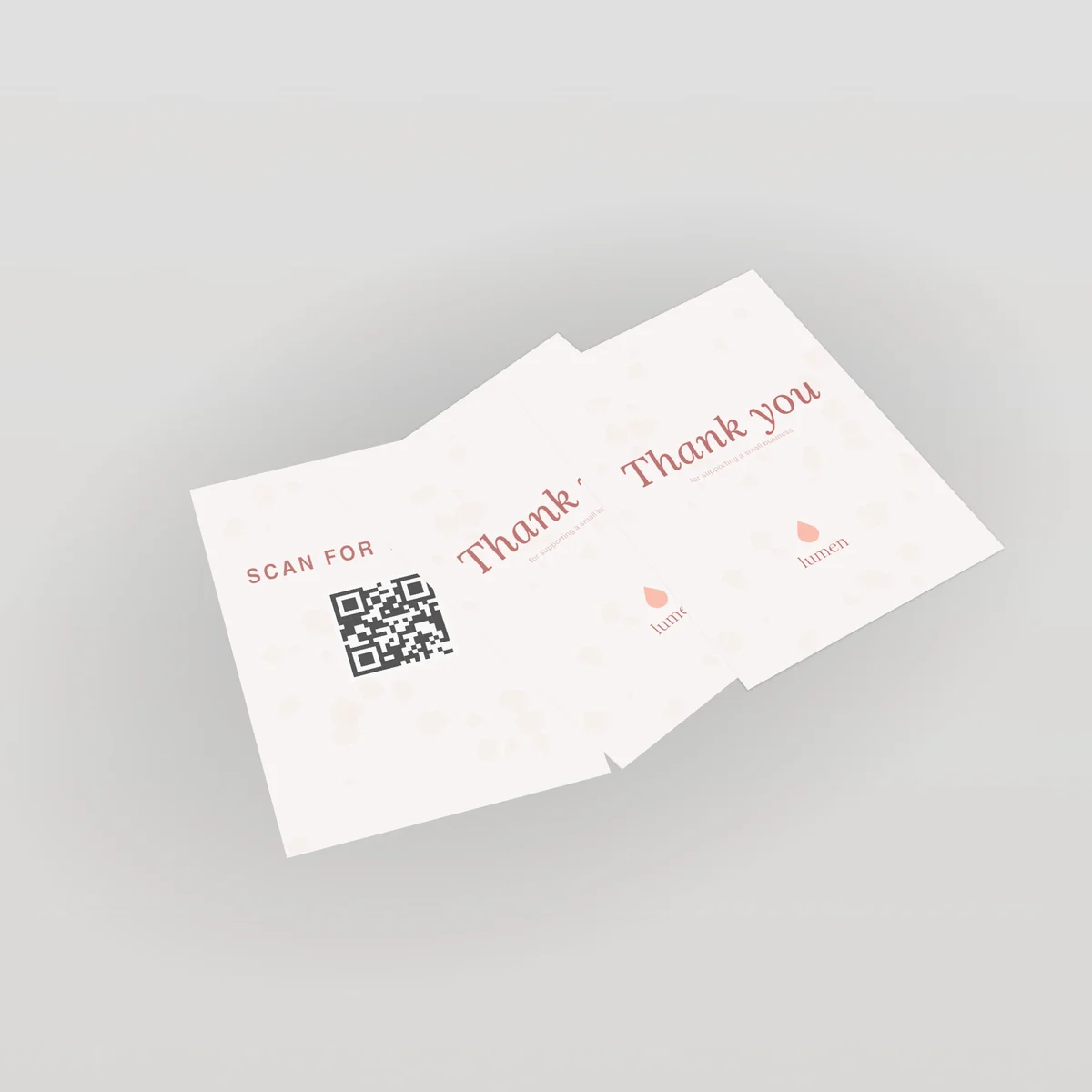
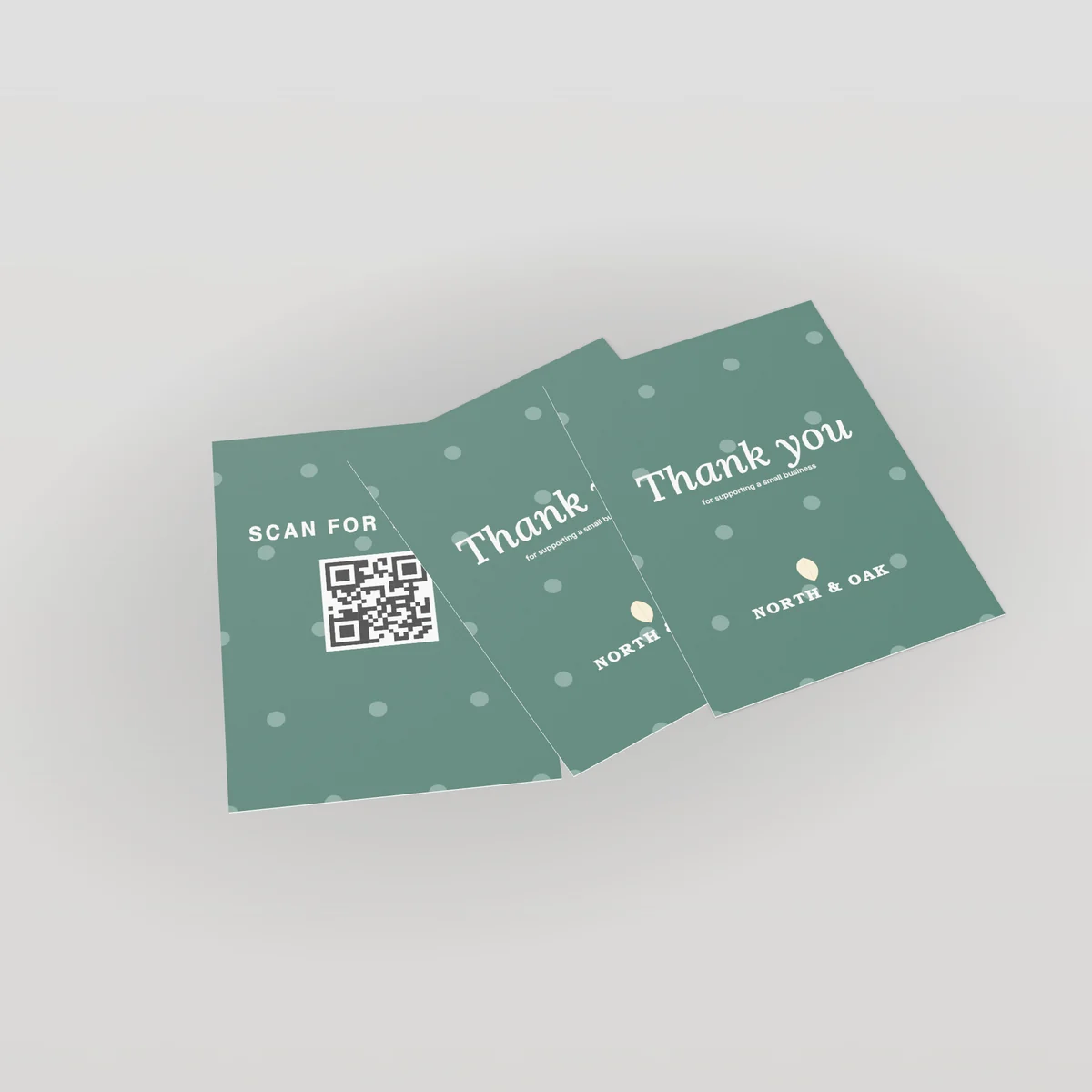
A printed card inside an order is a small piece of paper with an outsized effect. It makes a purchase feel personal, explains how to use or care for the product, invites customers to share their unboxing and can bring them back with an offer. For small brands, a thoughtful card is often the most memorable part of the package.
Types of insert cards
| Card | Purpose |
|---|---|
| Thank-you card | Gratitude and brand warmth |
| Care card | How to use, store or care for the product |
| Discount or referral card | Repeat purchase and word of mouth |
| Review request | Encourage honest reviews (no incentives that bias reviews) |
| Social prompt | Invite customers to share, with your handle or hashtag |
| Product guide or menu | Explain a set, subscription box or sampler |
| QR code card | Link to tutorials, playlists or reorder pages |
Options
- Sizes: business card (3.5 × 2 in), postcard (4 × 6 in), A6, square
- Stocks: matte, gloss, uncoated, kraft, textured, thick premium stocks
- Finishes: foil, spot UV, embossing, rounded corners, edge painting
- Print: one or both sides; variable data for personalization
Tip: When asking for reviews, ask everyone, not just happy customers, and don't offer rewards in exchange for positive reviews. Honest review practices keep you on the right side of FTC rules.
What a card does that packaging cannot
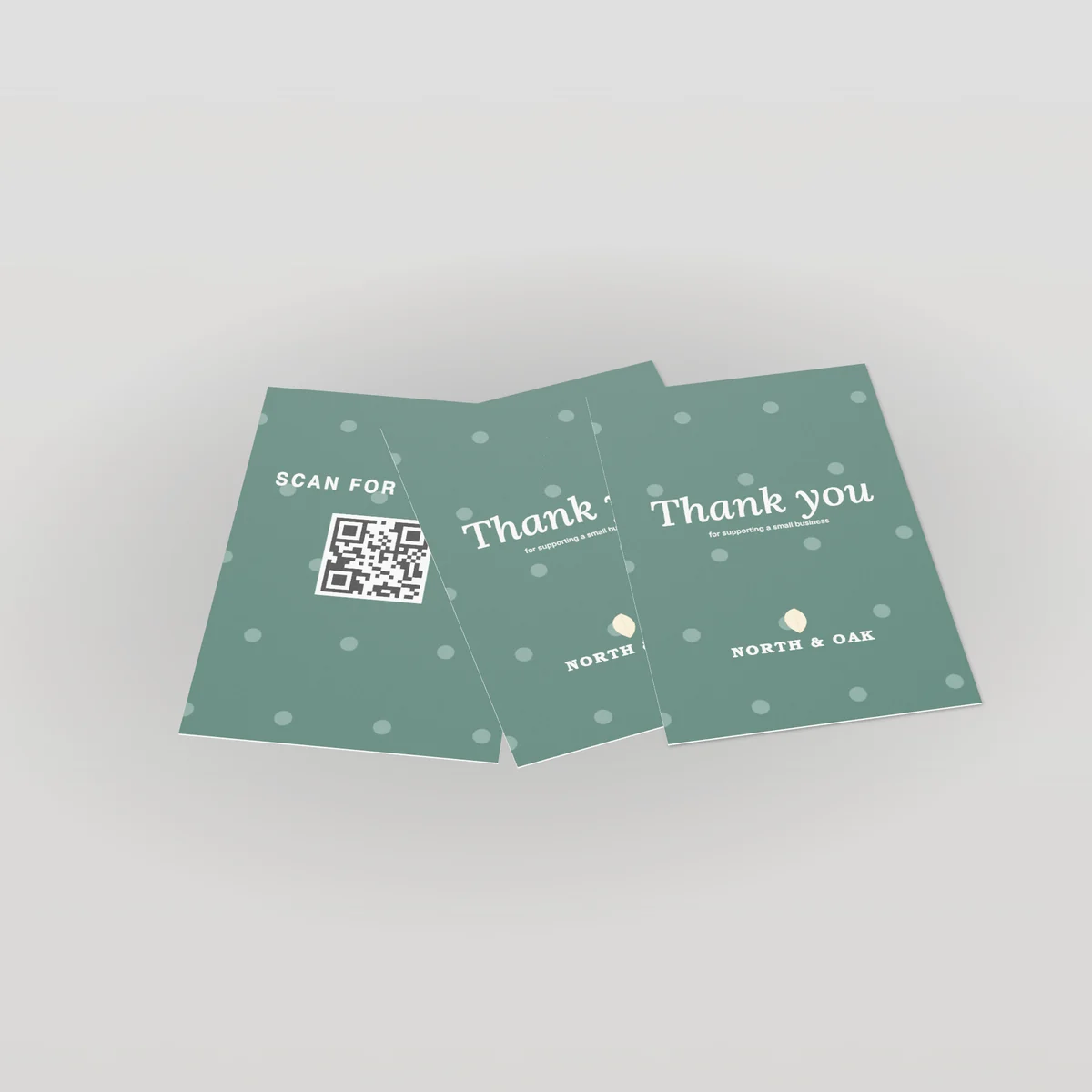
Packaging is designed once and printed thousands of times. A card can feel personal, change every season, and carry the specific information a customer needs right now. It is the easiest place in the box to:
- Say thank you in your brand's voice
- Explain how to use or care for the product
- Invite a review, a referral or a social post
- Offer a discount on the next order
- Tell your story and introduce the people behind the brand
- Point to a community, newsletter or tutorial
Because cards are small and inexpensive, you can test different messages and see which ones customers respond to. Pick one main goal and one secondary goal at most: a card that tries to do everything ends up doing nothing well.
Card stocks and finishes
| Stock | Feel | Best for |
|---|---|---|
| 14–16pt coated card | Smooth, bright | Full-color photography and illustration |
| 18–24pt uncoated card | Premium, natural | Minimal and luxury brands |
| Kraft card | Rustic | Handmade and natural brands |
| Duplexed card (32pt+) | Very thick | Luxury unboxing |
| Recycled card | Textured | Sustainability-minded brands |
Finishes include matte or gloss coating, soft-touch, foil stamping, embossing, spot UV, rounded corners and edge painting on thick stocks.
A thick, rigid card feels premium and substantial; a thin one feels like a flyer. Uncoated stocks are best if you plan to handwrite notes, while coated stocks give brighter colors but can smudge with some pens.
Measuring what works
Treat cards as a small marketing channel:
- Unique discount codes on cards show how many customers reorder because of them.
- Distinct QR links (with tracking parameters) reveal how many people scan.
- Review requests with a direct link can be compared before and after introducing the card.
- A/B testing two messages for a month each helps you learn what resonates.
- Repeat purchase rate for customers who received a card, compared with the period before, shows the overall effect.
Even small improvements in repeat purchases can make cards one of the most profitable pieces of packaging you buy.
Card ideas by industry
| Industry | Card idea |
|---|---|
| Skincare | Routine steps and patch-test advice |
| Candles | First-burn instructions and wick trimming tips |
| Coffee | Brew ratios and tasting notes |
| Apparel | Care instructions and sizing exchange info |
| Jewelry | Care and storage advice; warranty |
| Subscription boxes | This month's theme and product guide |
The psychology of a thank-you card
People remember how an experience made them feel. A thank-you card turns a transaction into a moment of human connection, reminding customers that a real business, often a small team, packed their order. That small gesture can influence whether customers come back, leave a review, or recommend the brand to friends. Cards work best when they feel genuine. A short, sincere message in a brand's natural voice is more memorable than a long marketing script. Some brands add a handwritten signature or a personal note for first orders, which customers often mention in reviews.
Card sizes and formats
| Format | Approximate size | Best for |
|---|---|---|
| Business card size | About 3.5 × 2 in | Short message, small orders, jewelry |
| Postcard | About 4 × 6 in or 5 × 7 in | Thank-you plus a secondary message |
| Square card | About 4 × 4 in to 5.5 × 5.5 in | Modern, design-led brands |
| Folded card | Various | Longer story, instructions, gift messages |
| Booklet or leaflet | Various | Product guides, recipes, subscription content |
Die-cut cards in custom shapes, such as your logo or a product silhouette, are possible too. Choose a size that fits comfortably in your packaging without bending. A card that sits flat on top of tissue or products is seen first; one tucked under products may be missed.
Writing card copy that sounds human
The best thank-you cards sound like a person, not a corporation. Write the way you would speak to a customer who walked into your shop. Short sentences, warm words and a specific detail make a card feel real.
Compare two messages. The first: "Thank you for your purchase. We value your business and hope you enjoy your product." The second: "Thank you for supporting our tiny studio. Every order helps us keep making things we love, and we hope this one makes your week a little brighter." The second message is longer, but it feels personal, specific and memorable.
A few principles help:
- Use your brand voice. Playful brands can be playful; calm, minimal brands can be calm and minimal.
- Be specific. Mention your team, your workshop, your mission or the product itself.
- Keep it short. A few sentences are enough. Customers glance at cards; they rarely read essays.
- End with one action. Follow us, leave a review, share a photo, or use a code on the next order.
- Read it aloud. If it sounds stiff when spoken, rewrite it.
Asking for reviews the right way
Reviews influence buying decisions, and a thank-you card is a natural place to ask. Make it easy: a short URL or QR code that goes directly to your review page. Explain why reviews matter to you, especially if you are a small business. Ask for honest feedback rather than only positive reviews. Do not offer discounts, gifts or other incentives in exchange for positive reviews. Incentivized or selectively solicited reviews can mislead shoppers, may break platform rules and can raise legal concerns under advertising and consumer protection rules. Asking every customer for an honest review, regardless of their experience, is the safest and most trustworthy approach. If you offer a thank-you for leaving any review, make sure it does not depend on the review being positive, and check the rules of the platform where the review will be posted.
Discount codes and repeat purchases
A discount code on a thank-you card can encourage a second order. Second purchases are often the hardest to win, and a small incentive can help. To measure results, use a unique code printed only on the card. Track how many customers use it and how much they spend. Set an expiry date to create gentle urgency, and make sure the terms are clear. If your margins are tight, consider alternatives to discounts: free shipping on the next order, a free sample, early access to new products or entry into a loyalty program.
QR codes on cards
QR codes bridge the physical card and your digital channels. They can link to review pages, product care videos, recipes, styling guides, loyalty sign-ups or your brand story. Use a short, trackable link you control so you can update the destination later. Include a line telling customers what they will find, such as "Scan for care tips" or "Scan to leave a review". Test QR codes on printed proofs with several phones before ordering.
Handwritten notes versus printed cards
Handwritten notes feel personal and are often mentioned in reviews and social posts. They work well for small volumes, first orders, large orders or VIP customers. As volumes grow, handwriting every note becomes impractical. Many brands combine both approaches: a printed card for every order, with a short handwritten line or signature for first orders or special occasions. A printed card designed with a blank area for a signature or short message makes this easy. If you use handwriting fonts in printed cards, be careful. Customers can usually tell, and a fake handwritten note can feel less genuine than an honest printed message.
More card ideas
Food and beverage. Recipes, serving ideas, storage tips or pairing suggestions.
Supplements and wellness. How to take the product as directed on the label, what to expect over time in general terms, and how to contact support. Avoid health claims beyond what is permitted on your label.
Home and decor. Care and cleaning instructions, styling ideas or the story behind the design.
Handmade goods. The maker's story and how the item was made.
Designing the card
Good card design is simple and consistent with your brand. Use your brand colors, typography and logo, and leave space around text so the card breathes. The front often carries a large thank-you message or an image; the back carries secondary content such as a QR code, discount or care instructions. Choose type sizes that are easy to read, especially for longer messages. If you include a code or URL, make it large enough to type easily.
Finishes that make cards memorable
Finishes add a tactile dimension that customers notice the moment they pick up a card. A few options that work particularly well on small insert cards:
- Foil stamping adds a metallic logo or thank-you message that catches the light.
- Embossing or debossing raises or presses a logo into the card, inviting touch.
- Spot UV creates a glossy highlight on a matte card for subtle contrast.
- Soft-touch lamination gives a velvety feel that suits beauty, wellness and luxury brands.
- Edge painting colors the edges of thick cards, a detail that surprises customers.
- Letterpress presses ink into soft cotton paper, creating a crafted, artisanal impression.
- Rounded corners soften the card's shape and resist bent corners in transit.
One finish is usually enough. A thick uncoated card with a single foil logo can feel more premium than a thin card with several effects.
Placing the card in the package
Where the card sits determines whether customers see it. The most reliable spot is on top of the products, the first thing visible when the box or mailer opens. A card placed under products or at the bottom of the box is easily missed or thrown away with packaging. Some brands slot the card into a die-cut insert, tuck it into a tissue fold with a sticker seal or attach it to the product with string. For gift orders, a card in an envelope with the recipient's name adds a personal touch. Our envelope sizes chart shows which envelope fits each card size.
Gift messages and gift orders
When customers send products as gifts, the thank-you card may reach someone who has never heard of your brand. Consider offering a separate gift card with a personal message from the sender, and leaving prices off packing slips for gift orders. A card that introduces the brand gently, without hard selling, can turn gift recipients into new customers. A small line such as "Someone thought of you" or "A gift, chosen just for you" works well.
Sustainability and cards
Cards are small, but they still use paper and ink. Choose recycled or responsibly sourced stocks, avoid plastic laminations if possible, and design cards customers want to keep, such as recipe cards, art prints or postcards. Cards can also explain how to recycle or reuse the rest of the packaging, which supports your sustainability goals. Print realistic quantities. Cards with dated offers or seasonal designs become waste if they are not used before they expire.
Combining cards with other inserts
Thank-you cards often sit alongside other printed inserts such as packing slips, product guides, return instructions and promotional flyers. Too many pieces of paper can feel cluttered. Consider combining messages into one well-designed card or folded insert. If you need several pieces, give each a clear purpose and design them as a set with consistent colors and typography.
Ordering thank-you cards
Before ordering, decide on size, stock, print sides, finishes, quantity and any variable elements such as unique codes or names. Supply artwork with bleed and safe areas. Approve a proof carefully, checking spelling, URLs and QR codes. For premium cards, ask for a physical sample to check thickness and finish. Order enough for a few months of shipping, but avoid printing dated offers on large quantities that might outlast the offer.
How cards are printed
Most insert cards are printed digitally or by offset. Digital printing suits short runs, frequent message changes and variable data such as unique codes or names. Offset printing suits longer runs of the same design and offers excellent color consistency, especially for brand colors. Specialty processes such as letterpress, foil stamping and embossing add a tactile, premium finish and are often combined with either method. If your message changes often, digital printing lets you order smaller quantities more often instead of storing large stocks that may go out of date.
Inviting customers to share
A card is one of the best places to invite customers into your social channels, because it reaches them at the moment they are most excited about their purchase. Keep the invitation simple and specific: a handle, a hashtag and a reason to post. "Share your unboxing and tag @custompacka" works better than a row of social icons. If you plan to repost customer photos, ask permission first and credit the customer. Some brands print a small QR code linking to their Instagram or Pinterest page so customers can follow in one tap.
Referral cards
A referral card gives customers something to pass on: a friend discount, a free gift or a code that rewards both people. Referral cards work particularly well for subscription brands, beauty, food and apparel. Print the referral offer on a detachable section or a second, smaller card so the customer can hand it over easily. Make the terms clear, track redemptions with unique codes and keep the offer simple enough to explain in one sentence.
Cards and packing slips
Packing slips list what is in the order and are often printed on plain paper at the packing station. Some brands combine the packing slip and thank-you message on one branded sheet to reduce paper. Others keep them separate so the card stays clean and keepable while the packing slip carries practical order details. For gift orders, remove prices from packing slips and let the card carry the personal message.
Readable, accessible cards
Cards should be easy to read for everyone. Use a type size that is comfortable at arm's length, strong contrast between text and background, and avoid placing text over busy images. Script and handwriting fonts look personal but can be hard to read in long passages; use them for a short greeting and set the rest in a clear typeface. Keep QR codes large enough to scan easily, and print a short URL next to them for customers who prefer typing.
Planning cards through the year
Cards are one of the easiest pieces of packaging to change with the calendar. A simple plan might include a standard thank-you card all year, a holiday card for the gifting season, a launch card when a new product arrives and an anniversary card for your brand's birthday. Planning ahead lets you order each design in sensible quantities and avoid last-minute printing costs.
Common card mistakes
Too much text. Customers glance at cards; long paragraphs go unread.
Several calls to action. Asking customers to follow, review, refer and subscribe at once weakens every request.
Expired offers. Cards with dated codes become waste once the date passes. Print dated offers in small quantities.
Tiny QR codes. Codes that are too small or low in contrast fail to scan.
Generic copy. "Thank you for your order" is forgettable. A specific, human message in your brand voice stays with customers.
Cards for B2B and wholesale orders
Thank-you cards are not only for consumers. Wholesale customers, retail partners and corporate clients also appreciate a personal touch. A card in a wholesale shipment can thank the buyer, share merchandising tips, introduce new products or provide a direct contact for reorders. Keep the tone professional and the information practical. A small detail like this can strengthen relationships with retail partners.
Cards for marketplaces
If you sell through marketplaces, check their rules about inserts. Some marketplaces restrict inserts that direct customers away from the platform or offer incentives for reviews. A simple thank-you message, care instructions and brand story are usually acceptable. When in doubt, keep inserts informational and avoid incentives tied to reviews.
Choosing paper color for cards
Card color sets the tone. White cards feel clean and versatile. Cream or ivory cards feel warm and classic. Kraft cards feel natural and handmade. Black or dark cards feel premium, especially with foil. Colored cards can match brand colors and stand out among tissue and products. Choose a color that contrasts with the box interior and tissue, so the card is seen immediately.
Storage and packing efficiency
Store cards flat in their boxes, away from moisture and sunlight. Keep a supply at each packing station in a holder so packers can add a card quickly without searching. If cards vary by order type, such as first orders, gifts or subscriptions, label holders clearly. A small amount of organization ensures every order receives the right card.
Worked example: a skincare brand's card strategy
A skincare brand tested two cards over two months. The first carried a long brand story and three requests: follow on Instagram, leave a review and use a discount code. The second carried a short thank-you from the founder, the brand's routine steps on the back and a single QR code linking to a page with how-to videos and an honest review request. The brand tracked QR scans and review volume. The simpler card performed better, and customers began mentioning the routine steps in their reviews. The brand kept the second card, printed it on thick uncoated stock with a small foil logo, and refreshed the message seasonally.
Specification checklist for thank-you cards
- Size and format (flat, folded, die-cut), sized to fit the box without bending.
- Stock, thickness and color.
- Print sides and colors; finishes such as foil, embossing or soft-touch.
- Message, call to action and any QR code or URL.
- Variable data, such as unique codes or names, with a spreadsheet.
- Quantity per design and planned refresh schedule.
- Placement in the package, documented for packers.
More card FAQ
Can I add a QR code that I change later?
Yes. Use a short link or QR code that points to a page you control, so you can update the destination without reprinting cards.
Should cards include my contact details?
Including an email or WhatsApp contact for help with the order reassures customers and reduces negative reviews, because problems reach you directly.
Do cards need to match the box design?
Matching colors and typography makes packaging feel like one system, but a card can also contrast deliberately so it stands out when the box opens.
Quick decision guide for cards
| If you need… | Choose… | Because… |
|---|---|---|
| A low-cost personal touch on every order | Postcard-size card, one or two colors, uncoated stock | Inexpensive, writable and easy to pack |
| A premium unboxing | Thick or duplexed card with foil or emboss | Weight and texture signal quality instantly |
| More repeat purchases | Card with a unique, trackable code | You can measure redemptions and refine the offer |
| More honest reviews | Card with a QR code to your review page | Removes friction without incentives |
| Product education | Folded card or booklet | Room for steps, recipes or care instructions |
| Gift orders | Separate gift message card and price-free packing slip | Keeps the gift personal |
Card copy examples by tone
Warm and personal: "Thank you for supporting our small studio. Every order is packed by hand, and yours made our day."
Minimal and calm: "Made with care. Thank you."
Playful: "You just made our team do a happy dance. Enjoy, and tell us what you think!"
Practical: "Thank you for your order. Scan the code for setup videos and care tips, or email us with any questions."
Choose the tone that matches your brand voice and keep it consistent across every card and message.
How to brief us on thank-you cards
Cards are quick to produce when the essentials are clear:
- Size and where the card sits. Measure the box space so the card lies flat on top.
- Message and goal. Thank-you, review request, discount, instructions or story.
- Stock and finish. Thick uncoated for handwriting, coated for bright color, plus any foil or emboss.
- Variable data. Unique codes or names, supplied as a spreadsheet.
- Quantity per design. And how often you plan to refresh the message.
- Artwork or ideas. Finished files or a rough sketch; our designers can help.
Send what you have, even if some answers are rough. Our specialists reply within one business day with recommendations, a price estimate and next steps, and every order includes free design help and a 3D proof before anything goes to production.
Thank-you cards in one paragraph
A thank-you card turns a delivery into a personal moment. Keep the message short and sincere, choose one clear action, print on a stock that feels good in the hand, place the card on top where it is seen first, and measure the results with unique codes or QR links. Small, consistent gestures like this build loyalty over time.
Ordering
Our minimum is 250 pieces. Request pricing above.
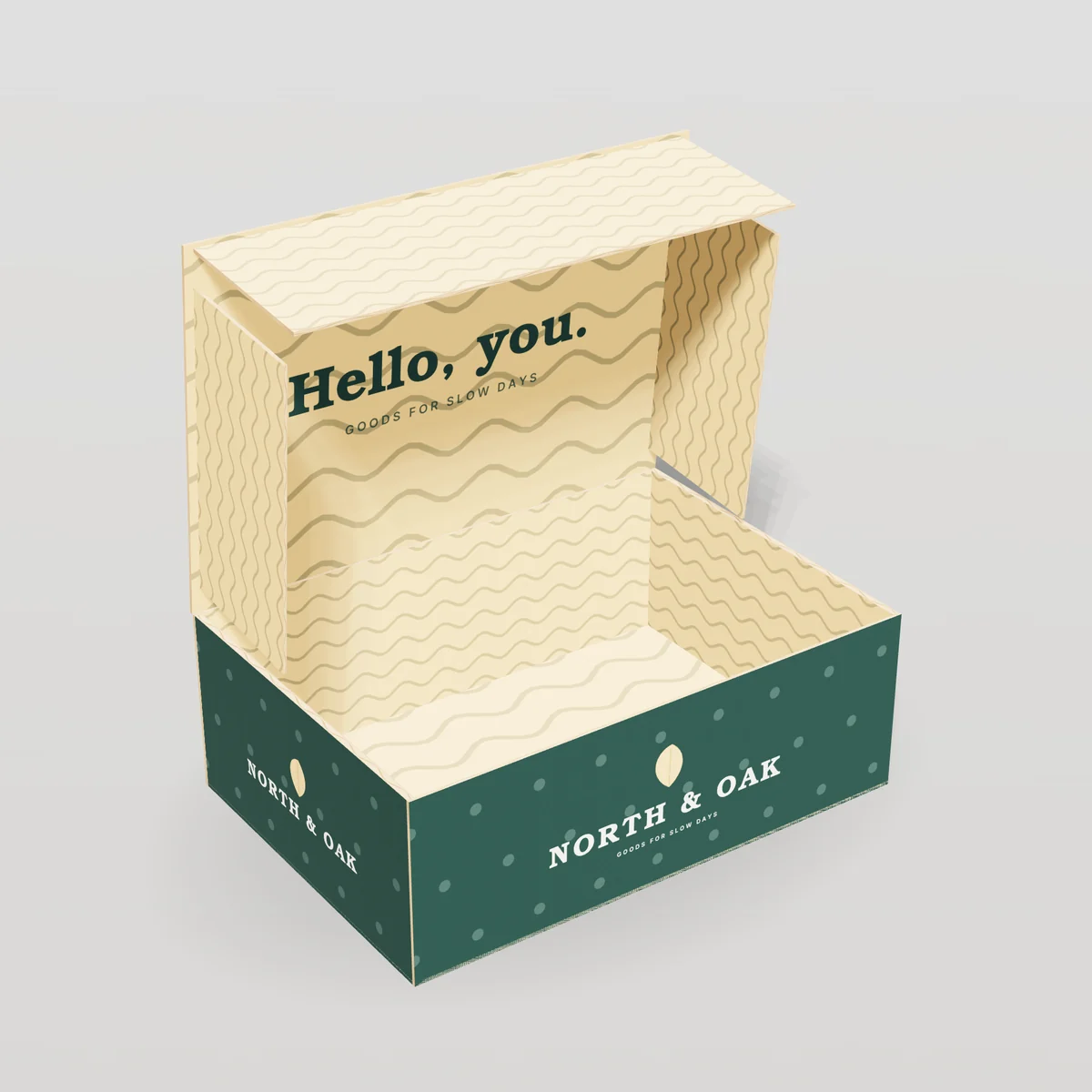 Box StylesMailer BoxesSelf-locking corrugated mailers printed inside and out. The go-to box for DTC brands and subscriptions.
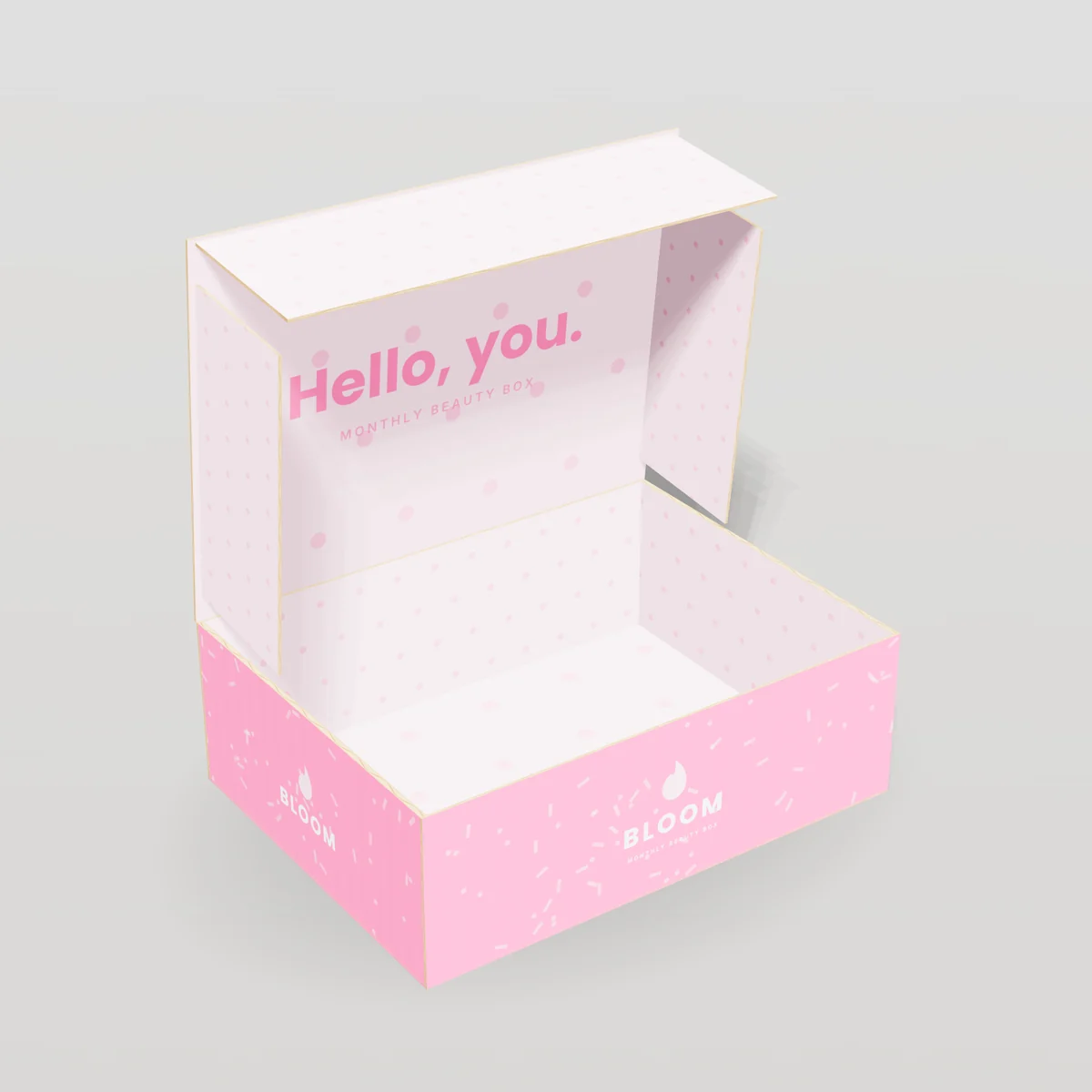 IndustriesSubscription BoxesShippable mailers with interior print that make every monthly box feel like a gift.
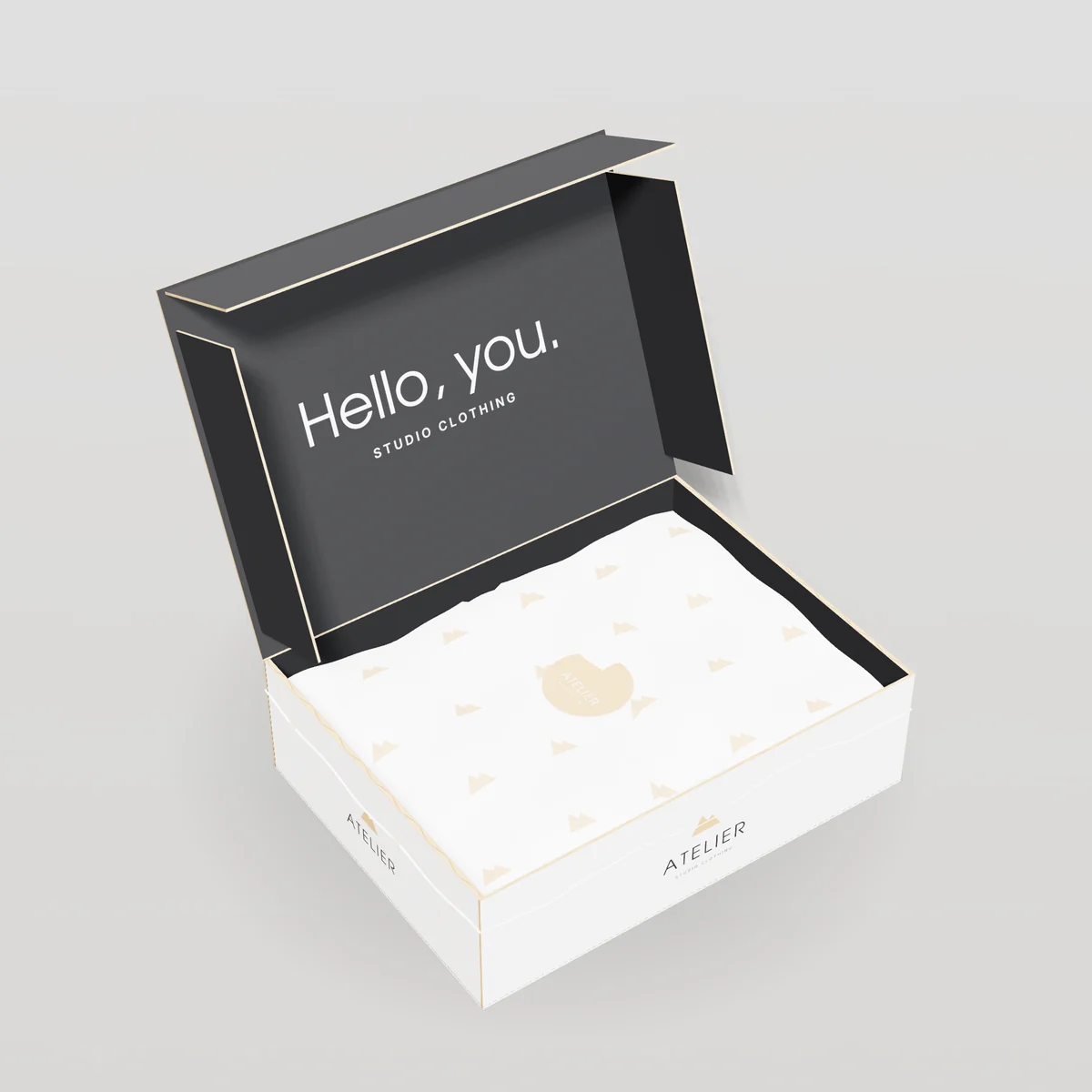 AccessoriesCustom Tissue PaperBranded tissue paper (17gsm) printed with your logo in one or two colors.
 AccessoriesCustom Stickers & LabelsSeal stickers, product labels and roll labels in paper, vinyl, kraft and foil.
How to order thank you cards & inserts
- 1Request a quote
Tell us the style, size, quantity and artwork you have. Use the form or the live estimator.
- 2Free design & dieline
We send a dieline for your exact size, check your artwork and help with layout at no charge.
- 3Approve your proof
Review a digital 3D proof (and an optional physical sample) before anything is printed.
- 4Production & QC
Your boxes are printed, finished, die-cut and inspected against the approved proof.
- 5Delivered to your door
Shipped flat-packed with tracking to any address in the contiguous US.
Key terms on this page
- Insert
- A component inside a box that holds products in place, such as die-cut paperboard, corrugated, foam or molded pulp.
- Kraft
- Paper or board made from unbleached wood pulp, naturally brown and strong.
- Spot UV
- A clear, glossy UV-cured varnish applied to selected areas to create contrast with a matte background.
- Embossing
- Raising part of the board surface into a relief using matched dies, often combined with foil or ink.
- Point (pt)
- The unit of paperboard thickness: 1 point equals 0.001 inch. 18pt board is 0.018 inch thick.
- Foil stamping
- Applying metallic or pigmented foil to packaging with heat and pressure using a metal die.
- Debossing
- Pressing a design into the board so it sits below the surface. The opposite of embossing.
- Soft-touch lamination
- A film with a velvety, matte texture that makes packaging feel premium and resists fingerprints.
- Lamination
- Bonding a thin film (matte, gloss or soft-touch) or paper to board for protection and finish.
- Finish
- Any treatment applied after printing to change appearance or protect the surface, such as coatings, laminations, foil, embossing or spot UV.
- Artwork
- The final graphic files (logos, images, text and colors) placed on a dieline and used to make printing plates or digital print files.
- Bleed
- Artwork that extends beyond the cut line, normally 1/8 inch (3 mm), so that no unprinted edge appears if cutting shifts slightly.
- Proof
- A preview of the final package (digital PDF, 3D render or physical sample) that the customer approves before production.
- Digital printing
- Printing directly from a digital file without plates. Ideal for short runs, multiple designs and fast changes.
- Offset printing
- Lithographic printing that transfers ink from metal plates to a rubber blanket and then to the sheet. Sharp detail and consistent color for larger runs.
- Tissue paper
- Thin, light paper used to wrap products inside boxes, often printed with a brand pattern.
More definitions in our packaging glossary.
Customer reviews
Reviews come only from verified customers. Ordered thank you cards & inserts from us? Share your experience.
Discussed on Quora & X
Thank You Cards & Inserts FAQ
What is the minimum order for thank-you cards?
Our minimum is 250 pieces.
What size should my card be?
4 × 6 in postcards and business-card sizes are the most popular.
Can cards be personalized?
Yes. Digital printing allows names or codes on each card.
Can I add a QR code?
Yes. QR codes can link to tutorials, reviews or reorder pages.
Should the card be handwritten?
Handwritten notes are memorable for small volumes. Printed cards with a handwritten-style font, or a printed card with a short handwritten signature, scale better.
Can you print a different message on each card?
Yes, with variable data digital printing.
Should I include a discount code on my thank-you card?
A discount can encourage a second purchase. Use a unique code to track results and set clear terms.
Can I ask for reviews on a thank-you card?
Yes. Ask for honest reviews, make it easy with a link or QR code, and do not offer incentives in exchange for positive reviews.
What stock is best for writing on?
Uncoated stocks accept pens and pencils best. Coated stocks can smudge with some pens.
How many cards should I order at first?
Order enough for one to three months of shipping at first. Once you know which message works, order larger quantities to lower the unit cost.
Can cards be printed on recycled paper?
Yes. Recycled and responsibly sourced stocks are available in coated, uncoated and textured finishes.
What is the best paper for thank-you cards?
Thick uncoated stock is a popular choice because it feels premium and accepts handwriting.
Can cards be printed with foil?
Yes. A small foil logo or message is a popular premium touch on thank-you cards.
Can thank-you cards include a discount for the next order?
Yes. A unique code with a clear expiry date encourages a second purchase and lets you measure results.
Can I order cards in small quantities?
Yes. Digital printing makes small runs of cards practical, so you can test messages before ordering more.