Quick answer
Hot-foil gold, silver, rose gold, holographic and colored foils for logos and accents. Typical turnaround is 10–14 business days after proof approval.
What is foil stamping?
Foil stamping (also called hot foil stamping or foil blocking) applies a thin layer of metallic or pigmented foil to packaging using heat, pressure and a metal die. The die, engraved with your design, is heated and pressed against a roll of foil on top of the printed board. Where the die touches, the foil's adhesive layer bonds to the board and the foil releases from its carrier film, leaving a sharp, mirror-like image.
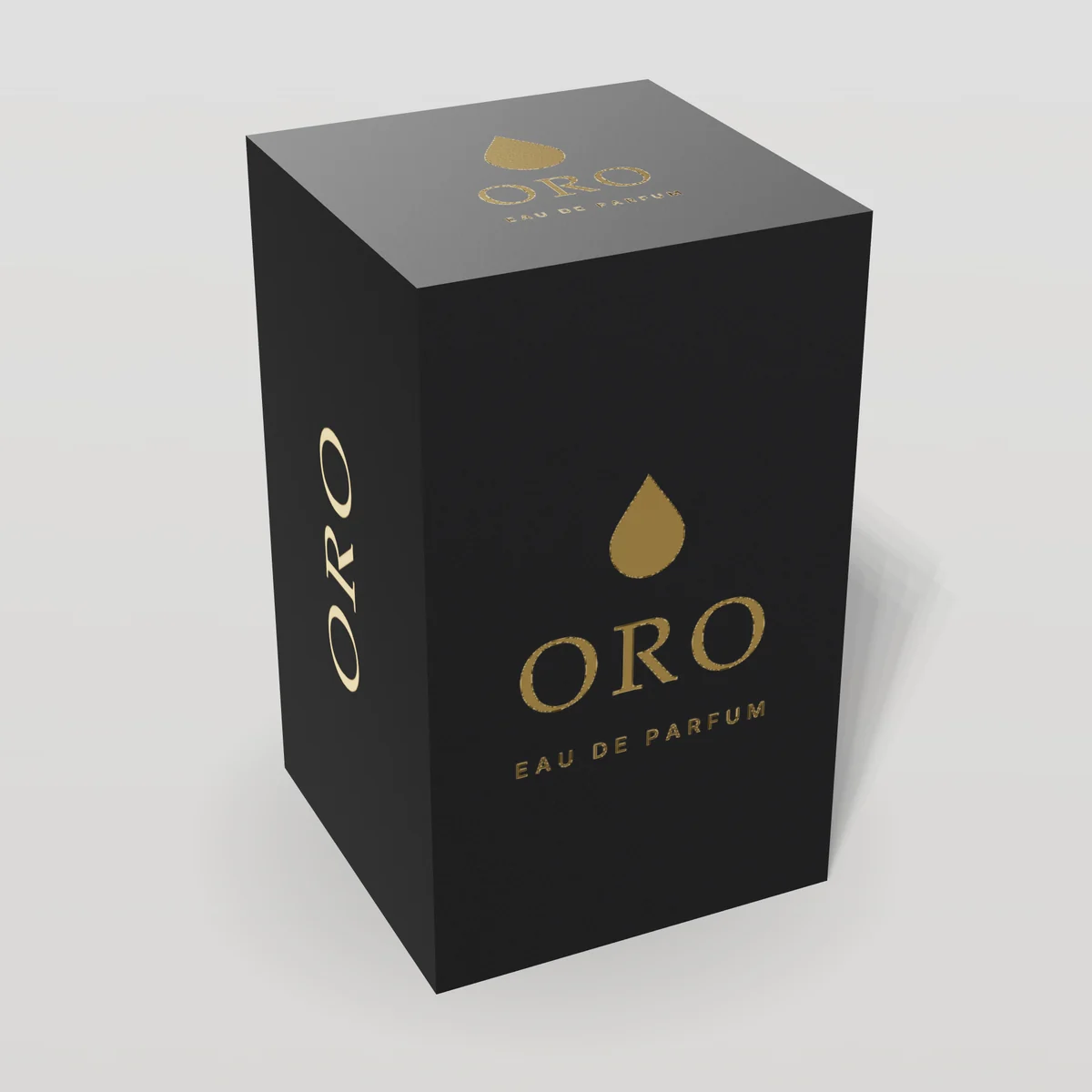
No ink can match foil's reflectivity. As the box moves in the hand or under store lights, foil catches the light and draws the eye. That is why foil is the most popular premium finish in cosmetics, fragrance, spirits, jewelry, chocolate and gift packaging.
Foil colors and effects
| Foil | Effect | Common uses |
|---|---|---|
| Gold | Warm, classic luxury | Fragrance, chocolate, gifts |
| Silver | Cool, modern, clinical | Skincare, tech, spirits |
| Rose gold | Soft, contemporary | Beauty, jewelry |
| Copper | Warm, artisan | Coffee, candles, craft brands |
| Holographic | Rainbow shimmer | Trend-led beauty, limited editions |
| Matte metallic | Subtle sheen | Understated premium |
| Pigment foils (black, white, colors) | Opaque, flat color with a slight sheen | Text on kraft or dark board |
Foil with other finishes
- Foil + embossing (combination stamping): the foiled area is also raised, creating a sculpted metallic logo.
- Foil on soft-touch: the contrast between velvety matte and mirror shine is dramatic.
- Foil on kraft: gold or copper on brown board looks premium and natural.
- Foil + spot UV: use carefully; one hero effect usually works better.
Cost of foil stamping
Foil adds two costs:
- A one-time die made for your design (reusable for reorders).
- A per-unit stamping cost that depends on foil area and number of foil colors.
Small, logo-sized foil areas are the most economical. Each additional foil color usually means another die and pass. On product pages, the "What finishes cost" table shows estimated added cost for foil on that specific box.
Where foil works best
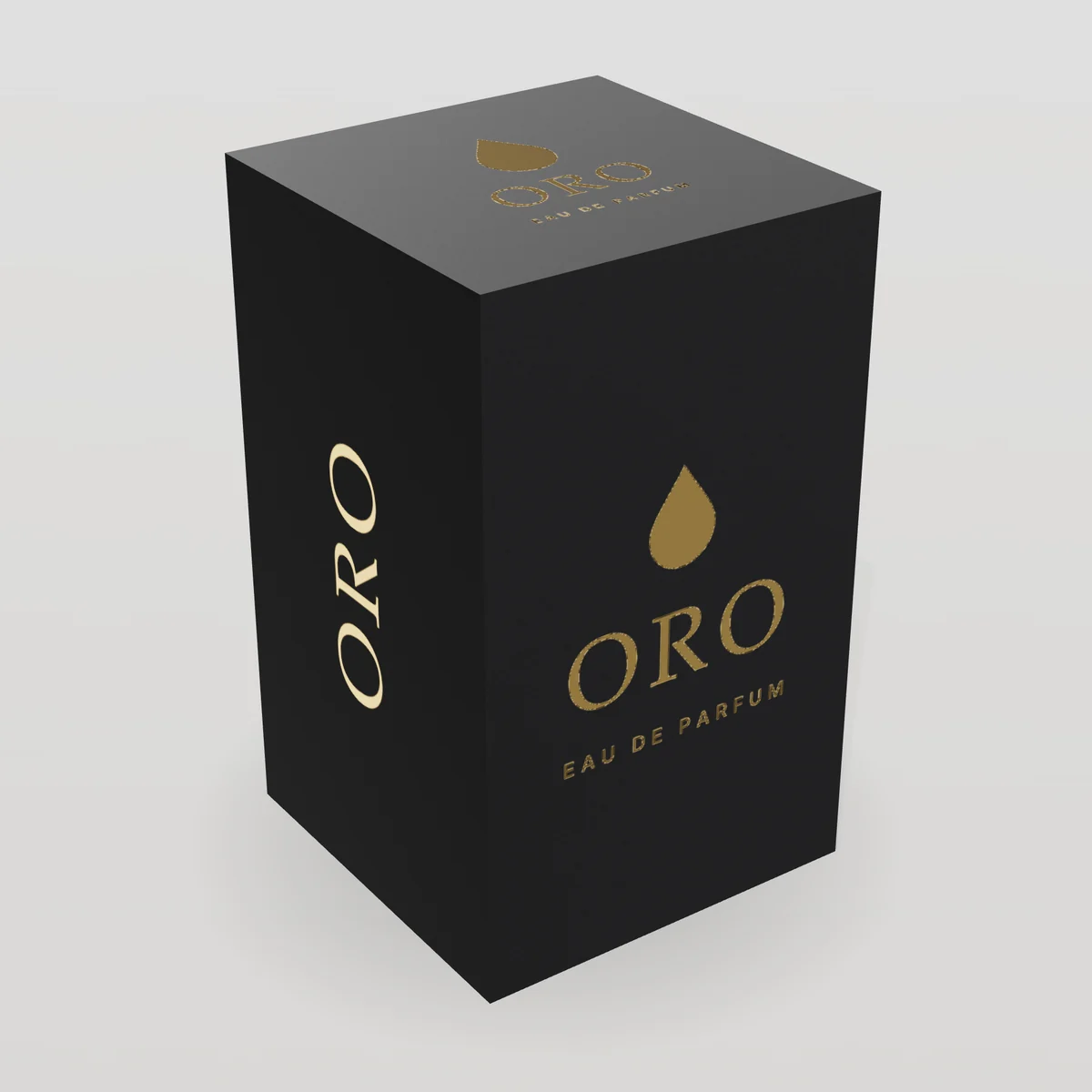 IndustriesPerfume BoxesFragrance cartons and rigid presentation boxes with inserts that cradle the bottle.
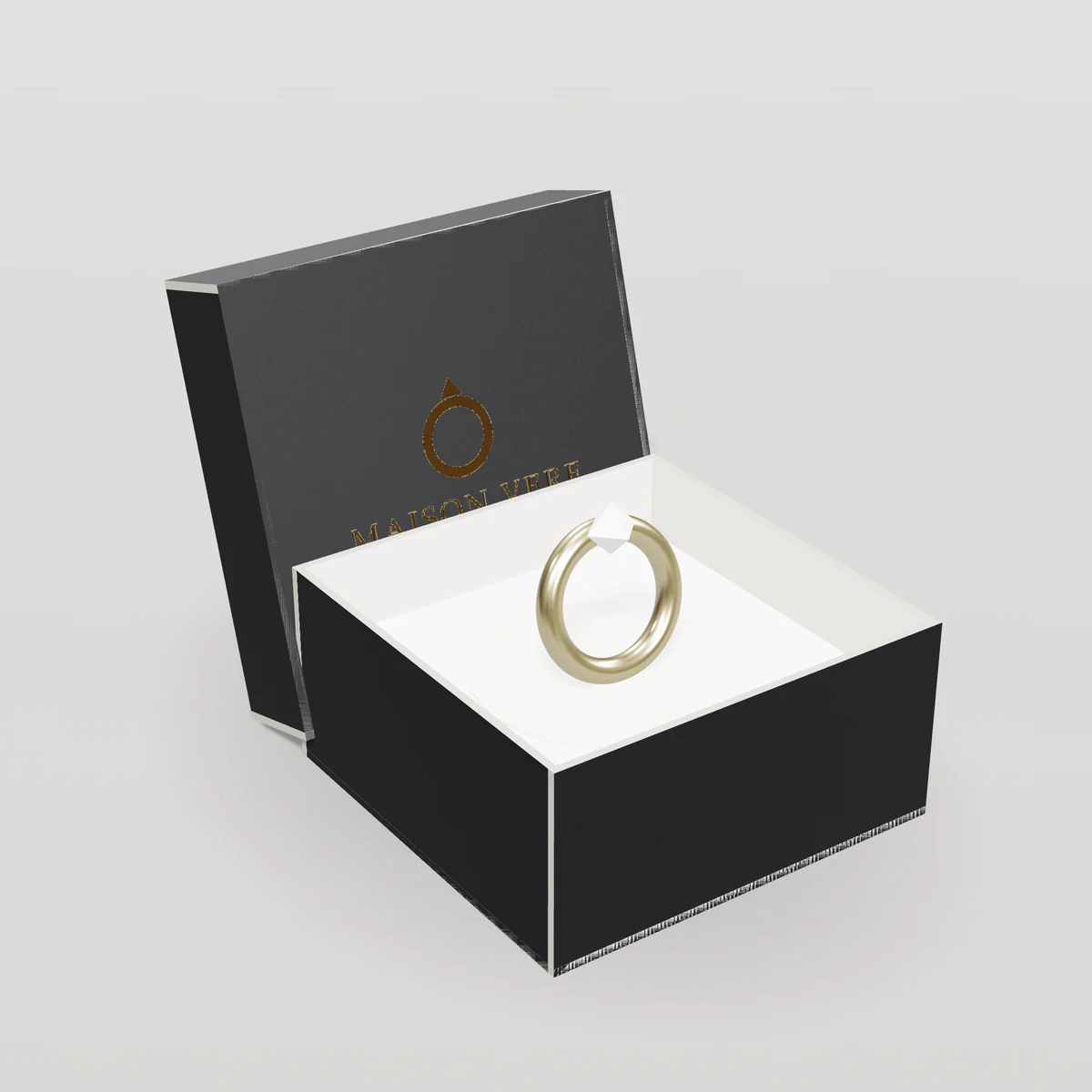 IndustriesJewelry BoxesRigid lid-and-base, drawer and magnetic boxes with velvet or foam inserts.
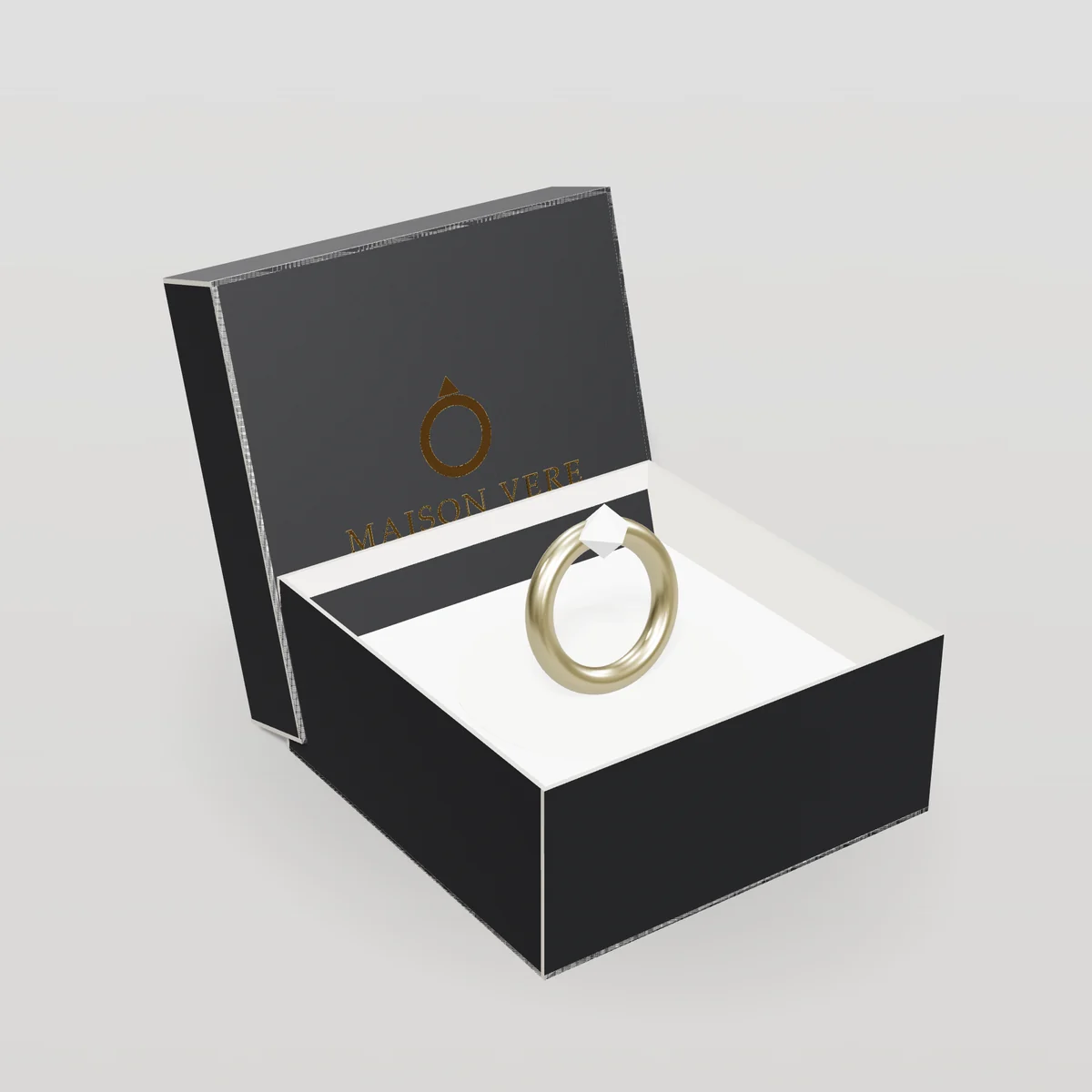 Box StylesRigid BoxesLuxury setup boxes made from thick greyboard wrapped in printed or specialty paper.
 Box StylesMagnetic Closure BoxesBook-style rigid boxes with hidden magnets for a satisfying, reclosable unboxing.
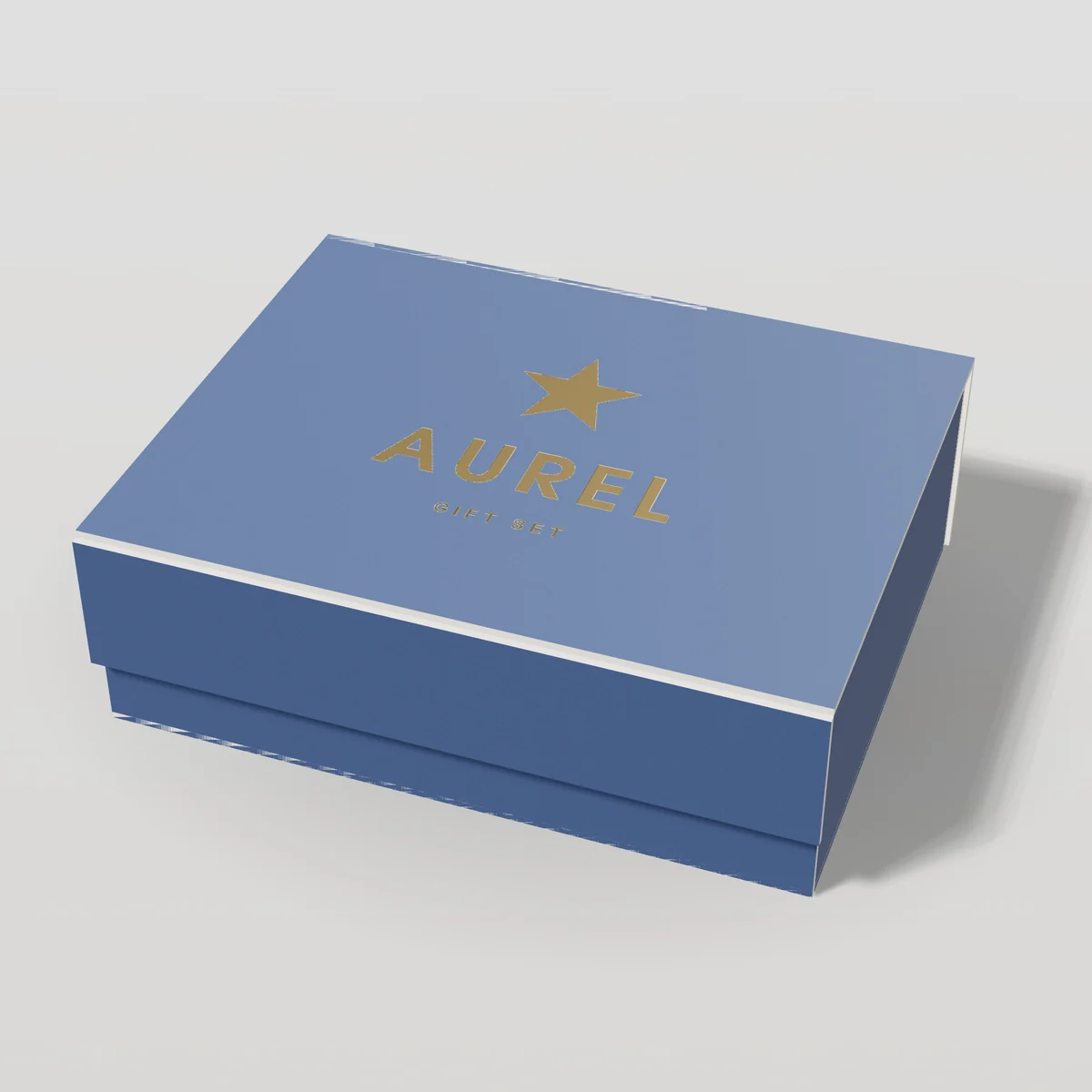
How hot foil stamping works
Hot foil stamping transfers a very thin metallic or pigmented layer from a carrier film onto your packaging using heat, pressure and a custom metal die.
- Die making. Your foil artwork is engraved or etched into a metal die, usually magnesium for short and medium runs, or brass for long runs and fine detail.
- Make-ready. The die is mounted on a heated platen in a foil stamping press or a die-cutter with foil units, and aligned with the printed sheet.
- Stamping. The foil film passes between the die and the sheet. The heated die presses the film against the board; the adhesive layer on the foil melts and bonds to the surface wherever the die touches.
- Release. As the press opens, the carrier film peels away, leaving the foil only in the shape of your design.
Foil stamping is usually done after printing and lamination, and before die-cutting. It can be combined with embossing in one step using a combination (foil-emboss) die, which stamps and raises the foil at the same time for a sculpted metallic effect.
Anatomy of a foil
A roll of stamping foil is a remarkable piece of engineering, with several layers thinner than a human hair:
| Layer | Purpose |
|---|---|
| Carrier film (polyester) | Holds the other layers until stamping, then peels away |
| Release layer | Lets the foil separate cleanly from the carrier |
| Color / lacquer layer | Gives the tint (gold, rose gold, copper, colors) |
| Metallized layer | A vacuum-deposited aluminum layer that creates the mirror shine |
| Adhesive (size) layer | Heat-activated glue that bonds to the packaging |
Pigment foils skip the metallized layer and transfer a flat, opaque color. Holographic foils have a microscopic embossed pattern that diffracts light into rainbow effects.
Choosing a foil color
| Foil | Mood | Works well on |
|---|---|---|
| Classic gold | Heritage, celebration, luxury | Black, navy, deep green, burgundy, kraft |
| Champagne / pale gold | Understated elegance | White, cream, pastels, soft-touch |
| Rose gold | Modern, feminine, beauty | Blush, white, grey, black |
| Silver | Clean, modern, technical | Black, blue, white |
| Copper | Warm, artisan, natural | Kraft, earthy greens and browns |
| Black or matte black | Minimal, sophisticated | White, kraft, light pastels |
| White pigment foil | Crisp contrast | Kraft and dark boards |
| Holographic | Playful, futuristic, festive | White, black, pastels |
| Colored metallics (blue, red, green) | Bold, festive | Contrasting dark or white bases |
Gold looks different on different bases: on white it reads bright and yellow, on black it looks rich and deep, on kraft it looks warm and vintage. View samples on your actual board.
Hot foil vs. cold foil vs. digital foil
| Hot foil | Cold foil | Digital foil | |
|---|---|---|---|
| Process | Heated die presses foil | Adhesive printed, foil applied without heat | Toner or polymer printed, foil bonded by heat roller |
| Tooling | Metal die | Printing plate | None |
| Look | Crisp, bright, slightly debossed | Smooth, can be overprinted with color | Smooth, very fine detail possible |
| Overprinting | Usually not | Yes: colored metallics and gradients | Limited |
| Run length | Short to long | Long runs | Very short runs, personalization |
| Best for | Logos, text, premium accents | Large metallic areas, labels | Prototypes, variable data |
For most custom boxes, hot foil stamping is the right choice: crisp, durable and economical across a wide range of quantities.
Design rules for foil
- Vector artwork only, on a separate layer, as a 100% spot color named for the foil (for example, "Foil_Gold").
- Minimum line weight: about 0.5 pt (0.2 mm); thinner lines may break or fill in.
- Minimum text size: about 6 pt for simple sans-serif fonts; larger for serif fonts with fine strokes.
- Spacing: keep foil elements at least 0.5–1 mm apart so they do not bridge together.
- Large solid areas: very large solid foil areas can show small imperfections (pinholes, uneven coverage); patterns or textures help.
- Folds: keep foil 1/16 in (1.5 mm) away from folds and cut edges.
- Registration: foil registers well to print, but allow small tolerances; avoid foil that must align perfectly with a thin printed outline.
Foil on different surfaces
| Surface | Result |
|---|---|
| Matte lamination | Excellent; the most popular base |
| Soft-touch lamination | Excellent; dramatic contrast |
| Gloss lamination | Good, but less contrast |
| Uncoated SBS or kraft | Good, with a slightly textured, vintage look |
| Textured specialty papers | Beautiful; foil may not fill deep texture fully |
| Corrugated (litho-laminated) | Good on the printed top sheet |
| Fabric and faux leather (rigid boxes) | Good with suitable foils |
Foil and recyclability
Foil adds a microscopically thin layer, and in small areas (logos, text, accents) foil-stamped paperboard is generally accepted in paper recycling. Large full-coverage metallic films are a different matter and can make recycling harder. If sustainability is a priority, keep foil to logos and accents, and pair it with paper-based materials and aqueous coatings elsewhere.
Foil die types and why they matter
The die is the heart of foil stamping. Its material affects detail, durability and cost.
| Die | Typical use | Notes |
|---|---|---|
| Magnesium (etched) | Short and medium runs | Economical, quick to make, good detail |
| Copper | Medium to long runs, finer detail | More durable than magnesium |
| Brass (engraved) | Long runs, sculpted foil-emboss | Most durable; can be sculpted in multiple levels |
Dies are made for your specific artwork and size, so the first order includes a one-time die cost. Keep your die details on file: reorders with the same artwork can reuse it, lowering cost.
Combination foil-emboss
A combination die stamps foil and embosses it in one pass, creating raised metallic relief that catches light along its edges. It is one of the most luxurious effects in packaging, popular on fragrance, spirits, premium chocolate and jewelry boxes. Design tips:
- Keep shapes bold and simple; fine detail can flatten.
- Use 18pt or thicker board (or rigid wraps) for depth.
- Expect a higher die cost than flat foil, especially for sculpted multi-level dies.
- Combine with matte or soft-touch for maximum contrast.
Foil on the inside of boxes
Foil is not just for the lid. A foil message or pattern on the inside of a mailer or rigid box lid can create a memorable reveal. Because the inside is often uncoated or printed with a single color, foil adheres well and stands out. Ask us about combining interior print with a small foil detail; see interior printing.
Foil and photography
Foil is mirror-like, so it reflects whatever is around it. In product photos it can look dark or muddy if the lighting is wrong. For best results:
- Use large, soft light sources and position them so the foil reflects a bright surface.
- Angle the box slightly to catch a highlight across the foil.
- Shoot video, where moving reflections show foil at its best.
- In renders and mockups (such as our 3D Box Builder), foil is approximated; order a sample to see the real effect.
Proofing foil
On PDF proofs, foil appears as a colored layer. Check:
- Every foil element is on the foil layer and nothing else is.
- Foil color is specified correctly (for example, gold vs. champagne).
- Small text and fine lines meet minimum sizes.
- Position relative to folds and edges.
For first-time foil projects or color-critical metallics, a printed sample is worth it.
Worked example: a coffee brand's gift box
A specialty coffee roaster creates a holiday gift box (8 × 6 × 3 in) with two bags of coffee.
- Structure: mailer box in E-flute with a white outer liner.
- Print: deep forest green with a small illustration pattern.
- Finish: matte lamination.
- Foil: copper foil on the logo and "Holiday Blend".
- Inside: one-color print with a thank-you message.
Copper foil on deep green signals warmth and craft, and at 1,000 units the foil adds only a modest amount per box. See coffee and tea boxes.
Common mistakes with foil
- Lines and text too thin, which break or fill in.
- Large solid foil areas that show pinholes; use patterns or reduce area.
- Foil across folds, which cracks.
- Choosing gold for every brand. Copper, rose gold, silver or black may fit your brand better.
- Approving foil on screen only. Metallics never look accurate on screens.
- Forgetting die costs on very short runs, where digital foil may be cheaper.
Holographic and specialty foils
Beyond gold and silver, foils come in a wide range of effects. Holographic foils break light into rainbow patterns and suit playful, tech and beauty brands. Patterned holographic foils carry designs such as stripes, dots or textures. Pigment foils are flat, non-metallic colors applied with the same process, useful for printing a solid color on dark board where ink would be weak. Matte metallic foils give a softer, brushed look than mirror-like gloss foils. Specialty foils can also offer security features, making counterfeiting harder for high-value products.
Foil on dark and colored boards
Foil really shines on dark boards. A gold logo on black, navy or deep green board is one of the most recognizable premium looks in packaging. Because foil is opaque, it sits on top of any background color without the dulling that ink suffers on dark surfaces. On colored boards, choose foils that contrast in both color and brightness. Silver on pale gray, for example, may be too subtle, while copper on teal creates a striking pairing.
Foil size and coverage
Foil works best on logos, accents, borders, patterns and short text. Very large solid foil areas are possible but can show small imperfections, look less refined and cost more. If you want a large metallic surface, consider a metallic board or metallic paper wrap instead, which gives an all-over shine more economically, with printed colors and white ink on top.
Fine detail and minimum sizes
Foil reproduces detail well, but very thin lines and very small type can fill in or break up. As a general guide, keep foil lines and type above the minimums your supplier specifies, and avoid fine serifs at very small sizes. Reversed-out details, where the board shows through small gaps in a foil area, need extra space so the gaps stay open. Ask for minimum sizes before finalizing artwork.
Foil and lamination
Foil can be applied on top of laminations and coatings, but the surface must be compatible. Soft-touch lamination with gold foil is a classic premium combination. Gloss lamination under foil makes the foil look even brighter. Some coatings resist foil adhesion, so tell your supplier about all finishes at the quote stage. When foil sits on soft-touch, the contrast between velvety matte and bright metallic is what makes the effect so appealing.
Foil on corrugated mailers
Foil can be applied to corrugated mailers, especially those with smoother white or coated liners. Because corrugated surfaces are less flat than paperboard, foil designs should be bold and avoid very fine detail. A foil logo on the lid of a mailer box is a popular way to elevate e-commerce packaging. Pair foil with a soft-touch or matte coating for a premium look, or apply it to uncoated kraft for a natural contrast.
Foil for seasonal and limited editions
Foil is an effective way to mark special editions without redesigning packaging. A holiday version might add a gold foil pattern to a standard design; a limited edition might carry a foil number or badge. Because foil is applied in a separate step, it can sometimes be added to a run of standard printed cartons for a smaller special batch, keeping costs manageable.
Planning foil with a budget
Foil adds a die cost and a separate production step. To control cost, limit foil to one color and one or two areas, group foil areas so a single die covers them, reuse dies across reorders and sizes where possible, and avoid foil on hidden surfaces. A single foil logo on the most visible panel often delivers most of the premium impression for a fraction of the cost of extensive foiling.
Foil care and handling
Foil is durable but can scuff on sharp edges or when cartons rub together in transit. Protective coatings under or around foil help, and packing cartons carefully for shipment protects the foiled panels. Store finished cartons flat and dry, and avoid stacking heavy weights directly on foil areas for long periods.
Foil on rigid boxes
Rigid boxes are one of the best canvases for foil. The wrap paper is smooth and often laminated, so foil adheres well and looks crisp. Foil can be applied to the wrap paper before it is wrapped around the board, which allows precise placement on the lid, front panel or sides. A foil logo centered on a matte or soft-touch lid is a classic luxury look. For multi-level effects, combine foil with embossing using a combination die.
Foil and brand color
Foil colors cannot be matched exactly to a Pantone ink color, because foil is a metallic or pigment layer rather than ink. Choose from your supplier's foil range and request a sample swatch. If your brand uses gold, decide whether you want a yellow gold, a pale champagne, a rose gold or a copper tone, and match it across all packaging, labels and accessories.
Foil and accessibility
Foil can be harder to read in some lighting because it reflects light. For important text, such as product names, instructions or warnings, use printed ink in a contrasting color and keep foil for decorative elements and logos. This keeps the package attractive and easy to read.
Foil terms you will hear
- Hot foil: foil applied with a heated die.
- Cold foil: foil applied with adhesive printed on the press, then cured.
- Digital foil: foil applied to a digitally printed toner or polymer pattern.
- Combination die: a die that foils and embosses in one step.
- Registration: alignment of foil with printed artwork.
- Dwell time: how long the die stays in contact with the board.
Foil on labels, cards and tags
Foil is not only for boxes. Labels, thank-you cards, hang tags, stickers and sleeves can all carry foil details. A foil logo on a label or seal ties small items to the main packaging and adds a premium touch at low cost. Ordering foil accessories alongside boxes helps match foil color and finish across the whole system.
Foil and sustainability
Foil adds a very thin metallic layer to the surface. Small foil areas on paperboard are generally compatible with paper recycling, as the thin layer is separated during pulping. Large foil coverage is less desirable from a recycling perspective. If sustainability is a priority, keep foil to logos and accents, choose foils designed for recyclability where available, and avoid laminating large foil-stamped areas with plastic films.
Questions to ask before choosing foil
- Which foil color and finish suits the brand: gloss, matte, holographic or pigment?
- What surface will the foil sit on: coated board, kraft, soft-touch or gloss lamination?
- Is the design detail suitable for foil?
- Will foil be combined with embossing?
- How many foil areas and dies are needed?
- Will the die be reused for reorders or other products?
Measuring the value of foil
Foil is a premium signal that customers notice. It helps products stand out on shelves, look special in unboxing photos and feel worth their price. For gifts, limited editions and premium ranges, foil often pays for itself through stronger perception and higher willingness to pay. For everyday products, a small foil accent can deliver a similar effect at minimal cost.
Specification checklist for foil
- Foil color and finish (gloss, matte, holographic, pigment).
- Surface beneath the foil: coated, kraft, soft-touch, gloss lamination.
- Foil areas and sizes, with minimum line weights checked.
- Combination with embossing, if any.
- Vector foil artwork on a separate layer.
- Die reuse plan for reorders and other products.
More foil FAQ
Can foil be printed over?
Printing over foil is possible with some processes, creating colored metallic effects, though it is less common than foil on top of print.
Quick decision guide for foil
| If you need… | Choose… | Because… |
|---|---|---|
| Classic luxury | Gold foil on black or navy | Timeless premium contrast |
| Modern minimal | Matte silver or champagne foil | Understated shine |
| Playful or tech | Holographic foil | Rainbow effects that catch the eye |
| Short runs | Digital foil | No dies; flexible designs |
| Maximum premium | Combination foil-emboss | Raised metallic logo |
| Solid color on dark board | Pigment foil | Opaque color where ink is weak |
How to brief us on foil stamping
Foil is quoted alongside your boxes. Include:
- Box style, size and material. Foil behaves differently on each surface.
- Foil color and finish. Gold, silver, copper, holographic or pigment; gloss or matte.
- Foil areas. Which panels and how large, with artwork on a separate layer.
- Other finishes. Lamination, spot UV or embossing.
- Quantities. Foil cost per unit falls as quantity rises.
Send what you have, even if some answers are rough. Our specialists reply within one business day with recommendations, a price estimate and next steps, and every order includes free design help and a 3D proof before anything goes to production.
Foil stamping: the short version
Use foil sparingly on the most visible panel, choose a color that complements the board, keep details above minimum sizes and away from folds, and reuse dies across reorders to keep costs down.
Foil stamping in one paragraph
Foil stamping uses heat, pressure and a metal die to transfer a thin metallic or pigmented layer onto packaging. It adds mirror-bright logos and accents that catch the light, especially on matte or soft-touch bases and dark or kraft boards. Keep artwork bold, away from folds and on a separate layer; choose a foil color that suits your brand and board; and use foil for accents rather than large areas for the best look, cost and recyclability.
What foil stamping adds to popular box styles
Estimated unit prices from our published pricing model for each style at its most popular size, full-color print, delivered within the contiguous US. The last two columns show what foil stamping adds per box at 1,000 and 5,000 units; setup tooling is spread across the run, so the premium shrinks as quantity grows.
| Box style | Without (1,000) | With (1,000) | Adds at 1,000 | Adds at 5,000 |
|---|---|---|---|---|
| Mailer Boxes9 × 6 × 3" | $1.06 | $1.30 | +$0.24 | +$0.13 |
| Shipping Boxes12 × 10 × 6" | $1.31 | $1.62 | +$0.31 | +$0.19 |
| Product Boxes4 × 4 × 4" | $0.49 | $0.70 | +$0.21 | +$0.09 |
| Folding Cartons3 × 3 × 5" | $0.42 | $0.62 | +$0.20 | +$0.09 |
| Tuck End Boxes4 × 2 × 6" | $0.40 | $0.60 | +$0.20 | +$0.09 |
| Auto-Lock Bottom Boxes5 × 3 × 7" | $0.55 | $0.75 | +$0.20 | +$0.10 |
| Rigid Boxes8 × 6 × 3" | $2.89 | $3.12 | +$0.23 | +$0.13 |
| Magnetic Closure Boxes9 × 7 × 3" | $3.51 | $3.76 | +$0.25 | +$0.14 |
| Two-Piece Boxes8 × 8 × 3" | $3.10 | $3.35 | +$0.25 | +$0.14 |
| Sleeve Boxes6 × 4 × 2" | $0.67 | $0.89 | +$0.22 | +$0.10 |
| Pillow Boxes6 × 3 × 1.5" | $0.32 | $0.52 | +$0.20 | +$0.10 |
| Gable Boxes6 × 4 × 5" | $0.71 | $0.92 | +$0.21 | +$0.10 |
| Display Boxes10 × 7 × 4" | $1.13 | $1.38 | +$0.25 | +$0.14 |
| Window Boxes5 × 3 × 5" | $0.63 | $0.84 | +$0.21 | +$0.09 |
| Hanger Boxes4 × 1.5 × 6" | $0.41 | $0.60 | +$0.19 | +$0.09 |
| Tube Packaging3 × 3 × 7" | $1.64 | $1.83 | +$0.19 | +$0.09 |
Estimates for planning. Your quote confirms the exact price for your size, coverage and artwork.
How to order foil stamping
- 1Request a quote
Tell us the style, size, quantity and artwork you have. Use the form or the live estimator.
- 2Free design & dieline
We send a dieline for your exact size, check your artwork and help with layout at no charge.
- 3Approve your proof
Review a digital 3D proof (and an optional physical sample) before anything is printed.
- 4Production & QC
Your boxes are printed, finished, die-cut and inspected against the approved proof.
- 5Delivered to your door
Shipped flat-packed with tracking to any address in the contiguous US.
Key terms on this page
- Hot foil
- Traditional foil stamping using a heated die.
- Die
- A custom tool, usually steel rule mounted in a board, used to cut and crease packaging to shape.
- Board
- A general term for thick paper materials used in packaging, including paperboard, corrugated board and greyboard.
- Finish
- Any treatment applied after printing to change appearance or protect the surface, such as coatings, laminations, foil, embossing or spot UV.
- Kraft
- Paper or board made from unbleached wood pulp, naturally brown and strong.
- Embossing
- Raising part of the board surface into a relief using matched dies, often combined with foil or ink.
- Spot UV
- A clear, glossy UV-cured varnish applied to selected areas to create contrast with a matte background.
- Greyboard
- Thick, dense recycled board used as the structural core of rigid boxes, usually 1.2 to 3 mm thick.
- Specialty paper
- Textured, colored, metallic or otherwise distinctive paper used to wrap rigid boxes or print labels.
- Carton
- A box made from paperboard, usually a folding carton. In shipping, "carton" can also mean a corrugated case.
- Artwork
- The final graphic files (logos, images, text and colors) placed on a dieline and used to make printing plates or digital print files.
- Make-ready
- Setting up a press or machine before a run, including mounting plates and adjusting color. A major part of setup cost.
- Lamination
- Bonding a thin film (matte, gloss or soft-touch) or paper to board for protection and finish.
- Die-cutting
- The process of cutting and creasing printed sheets into box shapes using a die.
- Cold foil
- A foil process applied with adhesive on press rather than heat, allowing printed colors over the foil. Suits large foil areas and fine detail on long runs.
- Plate
- A printing surface (metal for offset, polymer for flexo) that carries the image of one color.
- Vector artwork
- Graphics made of mathematical paths rather than pixels, which scale to any size without losing quality. Preferred for logos.
- Spot color
- A pre-mixed ink printed as a solid color, often matched to a Pantone reference.
- Coverage
- The proportion of a surface covered by ink. Heavy coverage uses more ink and can affect drying and cracking.
- Registration
- The alignment of printed colors and finishes with each other and with the dieline.
- Soft-touch lamination
- A film with a velvety, matte texture that makes packaging feel premium and resists fingerprints.
- SBS (solid bleached sulfate)
- Premium paperboard made from bleached virgin fiber, bright white throughout, with the best print and finish quality.
- Paperboard
- Thick paper (usually 0.010 inch or more) used for folding cartons, such as SBS, kraft and recycled board.
- Lid
- The top part of a box, hinged or separate.
- Rigid box
- A premium box made from thick greyboard wrapped in printed or specialty paper, delivered assembled. Also called a setup box.
- Mailer box
- A self-locking corrugated box with a hinged lid and tuck front, widely used for e-commerce and subscriptions.
- E-flute
- A thin corrugated flute about 1/16 inch thick. It prints sharply and folds crisply, making it the standard for mailer boxes.
- Liner
- The flat paper faces of corrugated board. Can be kraft (brown) or bleached (white).
More definitions in our packaging glossary.
Customer reviews
Reviews come only from verified customers. Ordered foil stamping from us? Share your experience.
Discussed on Quora & X
Foil Stamping FAQ
What is foil stamping?
A process that applies metallic or colored foil to packaging using a heated metal die and pressure.
How much does foil stamping cost?
It adds a one-time die cost plus a per-unit cost depending on area and colors. Small logo areas are the most economical.
Can foil be combined with embossing?
Yes. Combination stamping raises and foils the same area for a sculpted metallic effect.
What is the smallest text I can foil?
Keep text at about 6 pt or larger and lines at least 0.25–0.5 pt for crisp results.
Does foil work on kraft?
Yes. Gold, copper and pigment foils look great on kraft.
Is foil recyclable?
Small foil areas generally do not prevent paper recycling; large areas may complicate it in some facilities.
Can I reuse my foil die for reorders?
Yes, when the artwork and size stay the same. Reusing a die lowers the cost of reorders.
What is the difference between foil and metallic ink?
Foil is a separate mirror-like layer applied with a die and is far more reflective. Metallic inks contain metal pigments and have a softer shimmer at a lower cost.
Can foil be printed in any color?
Foils come in a wide range of metallic and pigment colors, plus holographic patterns. Exact matches to unusual brand colors may require custom foil, which has minimums.
Can foil match my brand's exact gold?
Foil comes in a range of standard golds, from yellow to pale champagne and rose gold. We send swatches so you can choose the closest match to your brand.
Will foil crack on folds?
Foil can crack if it crosses a fold, so we place it on flat panels and keep it away from creases.