Quick answer
Branded carton-sealing tape in paper or poly, printed with your logo and colors. Typical turnaround is 10–14 business days after proof approval.
What is custom packing tape?
Custom packing tape is carton-sealing tape printed with your logo, colors or messages. It brands plain shipping boxes instantly, signals professionalism, helps warehouses identify your cartons and adds tamper evidence: if branded tape is cut and replaced with plain tape, it is obvious.
Widths and lengths
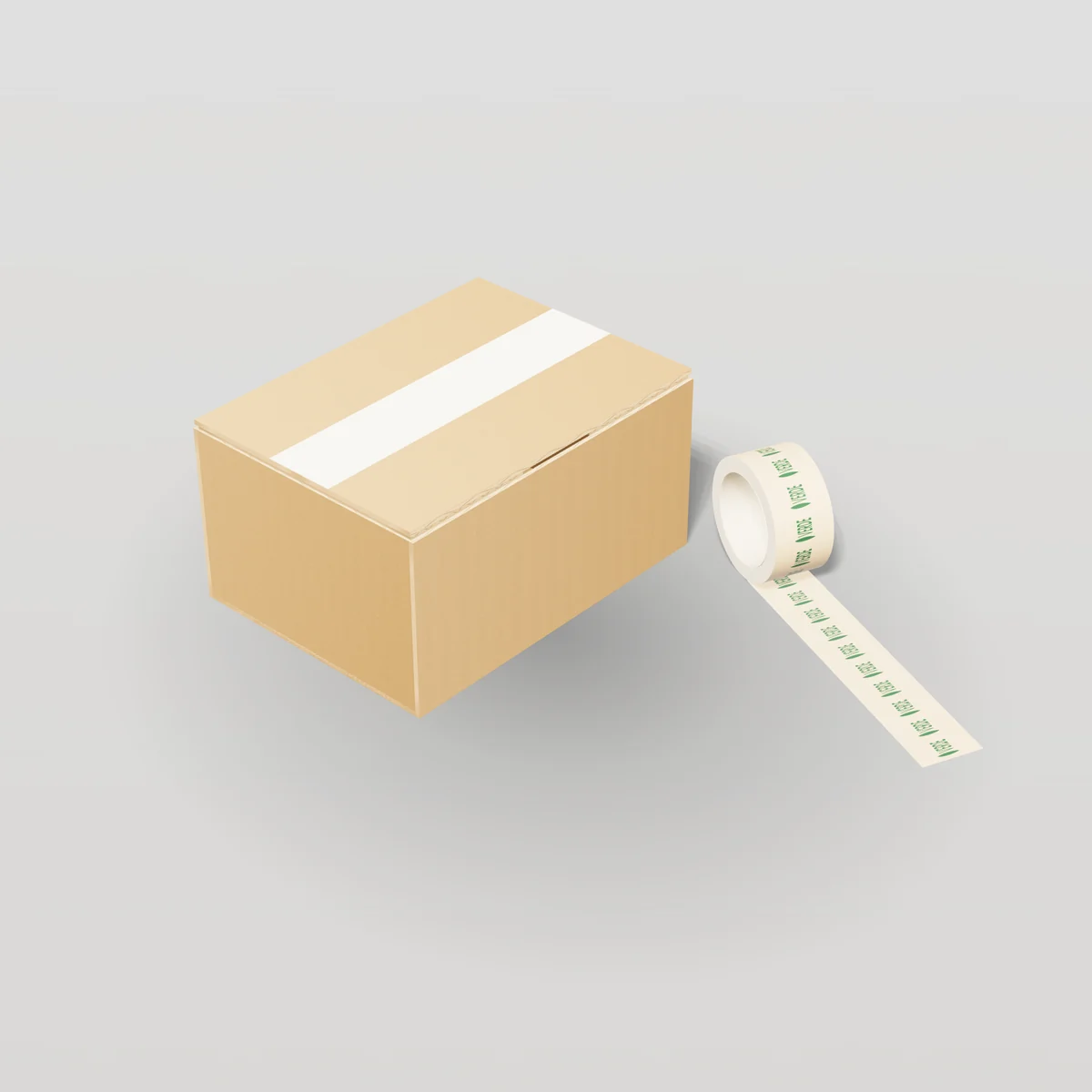
Common widths are 2 in and 3 in. Roll lengths vary by type.
Tip: Paper tape keeps the box mono-material for recycling and looks great on kraft boxes.

Why custom tape is a smart branding tool
Custom packing tape brands every box you ship, including plain stock boxes, for a fraction of the cost of printed boxes. It also adds security: branded or patterned tape makes tampering more obvious, because a resealed box would need matching tape. For growing brands that ship in plain RSC shipping boxes, printed tape is often the first branding upgrade.
Tape types compared
| Tape | How it seals | Strengths | Considerations |
|---|---|---|---|
| Water-activated paper tape (WAT) | Water activates a starch adhesive that bonds into the box fibers | Very strong, tamper-evident, recyclable with the box | Needs a dispenser for efficient use |
| Reinforced water-activated tape | WAT with fiberglass strands | Strongest for heavy boxes | Fibers complicate recycling slightly |
| Paper tape with pressure-sensitive adhesive | Self-adhesive paper | Easy to use, paper-based | Less bond strength than WAT |
| Polypropylene (BOPP) tape | Pressure-sensitive acrylic or hot-melt adhesive | Cheap, quick, water-resistant | Plastic; separate from cardboard for recycling |
| PVC tape | Rubber adhesive | Quiet unwind, strong | Plastic; less common today |
How water-activated tape actually bonds
Water-activated tape is a strip of kraft paper coated on one side with a starch-based adhesive. The adhesive is dry and inert on the roll, so it does not stick to itself, collect dust or lose tack in storage the way pressure-sensitive tapes can. When the dispenser draws the tape across a wetted brush or roller, the water reactivates the starch. Pressed onto a corrugated box, the softened adhesive penetrates the surface fibers of the liner. As it dries, it forms a bond that is part of the box surface rather than sitting on top of it.
This is why water-activated tape behaves so differently from plastic tape. A pressure-sensitive tape relies on surface contact and can lift if the box is dusty, cold, made from heavily recycled liner or stored in a humid warehouse. A properly applied gummed tape grips the fibers themselves. If someone tries to peel it, the top layer of the box comes with it, leaving a torn, obvious mark. That makes it one of the simplest forms of tamper evidence available for parcel shipping.
The same mechanism explains the main requirement: the tape must be moistened correctly. Too little water and the adhesive does not fully activate, so the bond is weak. Too much water and the adhesive is diluted or slides before it sets. Good dispensers control this automatically, and most packing teams find the right setting within a day of use.
Water-activated tape (also called gummed tape) is popular with brands focused on presentation and sustainability:
- It bonds into the cardboard. Once dry, the starch adhesive becomes part of the box surface. Peeling it off tears the box, so tampering is visible.
- It is paper. It can go into recycling with the box.
- It performs in temperature extremes where some pressure-sensitive tapes struggle.
- It looks clean: no shiny plastic strips on a kraft box.
You will need a water-activated tape dispenser (manual or electric) that moistens and cuts the tape. Electric dispensers can be programmed for set lengths, which speeds packing and saves tape.
Reinforced or non-reinforced: choosing the right grade
Non-reinforced water-activated tape is a single paper layer with adhesive. It is ideal for light and medium e-commerce parcels: apparel, cosmetics, books, small electronics accessories and subscription boxes. It is fully paper-based, which makes it the simplest choice when you want the entire package to go into paper recycling.
Reinforced tape sandwiches fiberglass strands, usually in a crisscross or diamond pattern, between two layers of paper. The strands add tensile strength and resist splitting, so the tape holds heavier boxes, sharper edges and rougher handling. It suits heavier shipments, multi-item orders, boxes that will be stacked on pallets and parcels that travel long distances through several hubs.
| Grade | Typical use | Strength | Recycling |
|---|---|---|---|
| Non-reinforced, light | Small mailers and light parcels | Good for light loads | Paper; recycles with the box |
| Non-reinforced, heavy | Standard e-commerce shipping boxes | Good to very good | Paper; recycles with the box |
| Reinforced | Heavy, dense or long-distance parcels | Very high | Generally accepted by paper mills, which screen out the strands |
The exact capacity of any tape depends on its weight, the box board, the taping pattern and how well it is applied. Ask for the supplier's specification and test it on your heaviest regular shipment before committing.
Choosing a dispenser
The dispenser is the difference between a fast, tidy packing station and a frustrating one. There are three common types.
Manual tabletop dispensers pull tape across a water reservoir and a brush; you tear or cut each length by hand. They are inexpensive and suit low-volume shippers sending a few dozen parcels a day.
Lever-action manual dispensers measure a length with each pull of a handle and cut it automatically. They are faster and more consistent, which helps teams standardise how much tape goes on each box.
Electric dispensers dispense a pre-set length at the press of a button, with heated water on many models to improve adhesion in cold conditions. They are the fastest option and pay back quickly for brands shipping hundreds of parcels a day. Programmable lengths also reduce waste because every box receives the right amount of tape.
Whatever type you choose, keep the water reservoir clean and refilled, replace brushes when they wear and store tape rolls in a dry place. Damp storage can activate the adhesive slightly, causing rolls to stick.
Applying tape properly
Good taping is simple once the habit is set:
- Fill the box correctly. An underfilled box lets the top flaps sag under the tape; an overfilled box bulges and strains the seal. Pack so the flaps close flat.
- Center the strip over the seam. On a regular slotted container, the strip covers the meeting line of the two major flaps.
- Extend down the sides. Let the tape run two to three inches down each end panel. This anchors the seal and resists the flaps lifting.
- Press firmly along the full length. Smoothing the tape with a hand or a pad ensures full contact. With water-activated tape, press within a few seconds of applying, before the adhesive begins to set.
- Seal the bottom the same way. The bottom carries the load, so it deserves equal care. For heavy boxes, use an H-pattern or a second strip.
| Method | Description | Use |
|---|---|---|
| Single strip | One strip along the center seam, extending down the sides | Light boxes |
| H-pattern | Center seam plus both edge seams | Heavier boxes, maximum security |
| Double strip | Two overlapping strips along the seam | Heavy boxes with plastic tape |
| L-clip | Strip extending 2–3 in down each side | Standard practice for RSCs |
For most e-commerce boxes, a single strip of water-activated tape with 2–3 in down each side is sufficient.
Designing printed tape that works
Printed tape is seen in fragments: a strip across the top, a little down each side, a portion torn at the cut. Designs that rely on a single long message rarely read in full. Patterns that repeat every few inches guarantee your logo appears on every box regardless of how much tape is used.
Keep artwork bold. Thin strokes and small type blur on paper tape and disappear on clear tape. A simple logo mark, a wordmark of moderate weight or a short message reads best.
Work with the tape color. Kraft tape is warm brown; white tape gives cleaner contrast; colored plastic tapes can match brand colors. Dark inks on light tape are easiest to read. White ink on kraft tape is possible but generally needs a heavier ink film.
Think about repeat length and spacing. Leave enough space between repeats so the design does not look crowded, but not so much that short strips miss the logo entirely.
Consider messages. Tape can carry practical messages as well as branding: "Fragile", "Handle with care", "Opened? Contact us", "Recycle me with the box" or a short web address. Practical messages help carriers and customers alike.
Ask for a proof. Your supplier will show the repeat on a flat strip. Picture it on a box: across the top seam and down the sides.
Plastic tape: when it makes sense
Polypropylene (BOPP) tape remains common because it is inexpensive, quick to apply with a handheld gun and resistant to moisture. It suits high-volume operations without water-activated dispensers, cold-chain shipments where moisture is constant and boxes that will be reopened and resealed several times in a warehouse.
Its downsides are visual and environmental. A shiny plastic strip looks out of place on premium kraft packaging, and it is a different material from the box. Many recycling programs ask customers to remove plastic tape, although small amounts are typically screened out at paper mills. If you use plastic tape, a printed version still adds branding and tamper evidence.
Branded tape as a step toward branded packaging
Printed tape is often the first branding step a growing business takes. It transforms plain stock shipping boxes at low cost and without changing the packing process. As volumes grow, brands often add a printed insert card, then custom tissue, and eventually a fully printed mailer box. Tape remains useful throughout: on outer shipping cartons, on bulk shipments to retailers and on returns.
If you already use printed mailer boxes, consider whether you need printed tape at all. Many mailer boxes close with tuck flaps and need no tape, or a single sticker seal. Printed tape is most valuable on regular slotted shipping boxes, which always need sealing.
Storing and handling tape
Store tape in a cool, dry place away from direct sunlight. Water-activated tape keeps for a long time when dry, but humidity can soften the adhesive and cause rolls to stick or the paper to curl. Plastic tapes can lose tack in very cold or very hot storage. Rotate stock so older rolls are used first, and keep rolls in their cartons until needed to protect edges from damage. A crushed roll edge can cause tape to tear unevenly in a dispenser.
Calculating how much tape you need
To estimate usage, measure the length of tape on a typical box. For a single strip across the top of a 12 × 10 × 6 in box with three inches down each end, you need roughly the box length plus six inches, or about eighteen inches. Double that if you seal the bottom with tape as well, so about three feet per box. Multiply by the number of boxes you ship in a month, then divide by the roll length to find how many rolls you need. Add a margin for testing, waste and growth.
Electric dispensers can make this calculation exact: once lengths are programmed per box size, your tape consumption becomes predictable, which makes reordering simple.
Packing tape and carrier handling
Parcels travel through conveyor belts, sorting chutes, trucks and delivery vans. Along the way they are dropped, pushed, stacked under heavier boxes and exposed to temperature swings between warehouses and vehicles. The seal has to hold through all of it.
The most common seal failures are easy to prevent. Flaps that pop open usually mean the tape did not extend far enough down the sides, or the box was overfilled so the flaps pushed up against the tape. Tape that peels away from the surface usually means a dusty or cold box, the wrong adhesive for the board, or tape that was not pressed down properly. Splits along the seam usually mean the box was too heavy for the tape grade, which is when reinforced tape or a second strip helps.
Carriers generally expect boxes to be sealed securely along all seams so contents cannot fall out. Paper and plastic tapes designed for carton sealing both meet that expectation when applied correctly. Avoid household tapes such as masking tape, cellophane tape and string, which are not designed for parcel sealing and can fail or snag on sorting equipment.
Sustainability and the tape you choose
Tape is a small component, but it touches every box. Paper-based tapes keep the package in one material family, so customers can recycle the whole box without peeling anything off. That simplicity matters because many people will not remove tape before recycling. Paper mills routinely handle small amounts of tape, but making the package easier to recycle is still worthwhile.
Water-activated tape can also reduce total tape use. Because it bonds so strongly, a single strip often replaces the several overlapping strips of plastic tape packers apply when they are not sure the seal will hold. Fewer strips means less material and a cleaner look.
If you make claims about your tape on your website or packaging, keep them specific: "paper tape, recyclable with the box where cardboard is collected" is clearer and more accurate than a general "eco-friendly" claim. Reinforced tape contains fiberglass, so describe it accurately as well.
Using tape to communicate
Because tape sits on the outside of the box, it is the first branded touchpoint a customer sees on a plain shipper. It can also communicate with people who handle the parcel before it arrives.
For customers: your logo, a short thank-you message, a social handle or a playful line that builds anticipation, such as "Something good is inside".
For carriers and warehouses: handling instructions such as "Fragile", "This side up" or "Heavy". Printed instructions are more consistent than handwritten notes.
For security: a repeating logo pattern discourages tampering because replacing a strip with plain tape is obvious. Some brands print a small notice asking customers to contact them if the seal has been broken.
For returns: if customers reuse your box for returns, printed tape on the reseal strip or a second roll supplied in the box can keep the returned parcel identifiable.
Choosing a tape color
Tape color affects both branding and readability. Natural kraft tape is warm and understated and matches brown corrugated boxes. White tape gives the cleanest contrast for colored logos and stands out on kraft boxes. Colored plastic tapes can match brand colors, but they are less common in paper. Clear tape with printing gives a lighter, more minimal look on printed boxes. A simple test: print your logo at tape size on paper, cut it out and lay it across a sample box. You will quickly see whether it reads well.
Tape for retail and wholesale shipments
When you ship cartons of products to retailers, distributors or fulfillment centers, tape plays a different role. Bulk cartons are opened by receiving teams who need to identify contents quickly and confirm cartons have not been tampered with in transit. Printed tape with your brand name helps receiving teams spot your cartons among many others. Some brands use a different tape color for wholesale shipments so warehouse staff can tell them apart from direct-to-consumer orders at a glance.
Check retailer and fulfillment center requirements before shipping. Some specify carton labeling, sealing methods or restrictions on certain tapes for automated handling. Following their guidance avoids receiving delays and chargebacks.
Planning your first printed tape order
- Decide on type and width. Water-activated paper tape in a common width is a good starting point for most e-commerce brands; plastic tape suits operations that need speed without dispensers.
- Check dispenser compatibility. Make sure roll width and core size fit the dispenser you have or plan to buy.
- Prepare simple artwork. One or two colors, a logo or short message, and a clear repeat.
- Estimate quantity. Calculate monthly usage and order enough for several months, balancing price breaks against storage space.
- Approve the proof. Check the repeat, colors and spelling carefully.
- Test on arrival. Seal a few boxes, ship them to yourself or a colleague and check how they arrive.
Troubleshooting water-activated tape
Tape does not stick. The adhesive may not be activated enough. Check the water level and brush condition, and make sure the tape passes through the wetting system. Very cold boxes can slow adhesion; warmer water helps.
Tape slides or wrinkles. Too much water dilutes the adhesive. Reduce wetting or adjust the dispenser.
Tape curls before applying. The roll may have absorbed moisture. Store tape in a dry place and keep rolls wrapped.
Edges lift after drying. The tape may not have been pressed firmly enough, or the box surface may be coated in a way that resists adhesion. Press along the full length, and test tape on coated or printed boxes before rolling it out.
Tape tears unevenly at the cut. Dispenser blades may be dull, or roll edges damaged. Replace blades and handle rolls carefully.
Comparing printed tape with other branding options
| Option | Cost per order | Visibility | Effort to apply | Best for |
|---|---|---|---|---|
| Printed tape on stock box | Low | Outside, every parcel | No extra step | Brands starting branded shipping |
| Logo sticker on stock box | Low | Outside, one spot | One extra step | Very small volumes |
| Printed shipping label area | Very low | Outside | No extra step | Minimal branding needs |
| Printed mailer box | Medium to high | Outside and inside | No extra step | Established brands, premium unboxing |
| Printed tissue and card inside | Low to medium | Inside only | Extra steps | Brands focused on the reveal |
Many brands combine printed tape on the outside with tissue and a card on the inside, which delivers a branded experience for a fraction of the cost of fully printed boxes.
Tape for different box types
Regular slotted containers (RSCs). The classic shipping box has four top flaps that meet at a center seam. A strip along the seam with a few inches down each end is standard. Heavy RSCs benefit from an H-pattern that also seals the edge seams.
Mailer boxes. Roll-end tuck-front mailers close with tuck flaps and dust flaps, and often need no tape at all. Where extra security is needed, a short strip or a sticker seal at the front works well and keeps the box easy to open.
Half-slotted and telescoping boxes. Boxes with a separate lid can be taped around the lid edge on two or four sides. This keeps the lid in place during transit.
Pallet cartons. Large cartons for freight usually need heavier tape and an H-pattern on top and bottom, especially if they will be stacked.
Opening experience
How a box opens matters to customers. Water-activated tape bonds strongly, so a customer without scissors may struggle. A few simple choices make opening easier: leave a short folded tab at one end of the strip, print an arrow or "Open here" message, or use a box with a tear strip. Avoid encouraging customers to use sharp knives deep in the box, where they could damage the product. Tape that extends just a few inches down each side, rather than wrapping fully around, is easier to cut and still secure.
Building a tape standard for your team
A short written standard keeps every parcel consistent, no matter who packs it. Include the tape type and width for each box size, the taping pattern (single strip, H-pattern or double strip) and how far tape should extend down the sides, the dispenser length setting for each box if you use an electric dispenser, when to use reinforced tape or an extra strip, and how to handle returns and reseals. Post the standard at the packing station with a photo of a correctly sealed box. New team members learn faster, and customers receive parcels that look the same every time.
Measuring the results
Printed tape is easy to evaluate. Track damage claims and "box arrived open" complaints before and after switching tape. Ask customers whether they noticed the packaging in post-purchase surveys. Watch for your tape in customer photos on social media. Compare tape consumption per box if you move to programmed electric dispensers. These simple measures show whether the change pays for itself, and they usually do through fewer seal failures and a more professional first impression.
Printed tape for subscription and gifting brands
Subscription boxes and gift shipments benefit from tape that signals what is inside. A monthly theme message, a seasonal pattern or a simple "Your box has arrived" line turns the moment a customer sees the parcel into part of the experience. Because tape is inexpensive to change, some brands run several designs through the year: a standard roll for everyday orders and a limited roll for holidays or launches. Keep the logo consistent across designs so the brand stays recognizable while the message changes.
For corporate gifting, printed tape with the client's name or a co-branded message can make a shipment feel personal without printing custom boxes for every program.
Specification checklist for printed tape
- Tape type: water-activated paper, reinforced paper or plastic.
- Width, roll length and core size, checked against your dispenser.
- Tape color and print colors, with Pantone references.
- Artwork with repeat length and spacing.
- Quantity of rolls and storage plan.
How to brief us on printed tape
For printed tape, we need just a few details:
- Tape type. Water-activated paper, reinforced or plastic.
- Width and dispenser. So rolls fit your equipment.
- Colors. Tape color and one or two ink colors.
- Artwork. Logo or message as a vector file.
- Rolls per month. So we can suggest an order size.
Send what you have, even if some answers are rough. Our specialists reply within one business day with recommendations, a price estimate and next steps, and every order includes free design help and a 3D proof before anything goes to production.
Ordering
Our minimum is 36 rolls. Request pricing above.
 Box StylesShipping BoxesPrinted corrugated regular slotted cartons (RSC) for e-commerce, wholesale and freight.
 IndustriesE-commerce BoxesRight-sized mailers and shippers that cut dimensional weight and damage rates.
 AccessoriesCustom Stickers & LabelsSeal stickers, product labels and roll labels in paper, vinyl, kraft and foil.
 Box StylesMailer BoxesSelf-locking corrugated mailers printed inside and out. The go-to box for DTC brands and subscriptions.
How to order custom packing tape
- 1Request a quote
Tell us the style, size, quantity and artwork you have. Use the form or the live estimator.
- 2Free design & dieline
We send a dieline for your exact size, check your artwork and help with layout at no charge.
- 3Approve your proof
Review a digital 3D proof (and an optional physical sample) before anything is printed.
- 4Production & QC
Your boxes are printed, finished, die-cut and inspected against the approved proof.
- 5Delivered to your door
Shipped flat-packed with tracking to any address in the contiguous US.
Key terms on this page
- Tamper evidence
- Features that show if a package has been opened, such as seals, tear strips or shrink bands.
- Shipper
- A box used to ship products, often corrugated.
- Kraft
- Paper or board made from unbleached wood pulp, naturally brown and strong.
- Regular slotted container (RSC)
- The standard corrugated shipping box with four top and four bottom flaps of equal depth (FEFCO 0201).
- Water-activated tape
- Paper tape with an adhesive activated by water that bonds into box fibers, secure and recyclable with the box.
- Liner
- The flat paper faces of corrugated board. Can be kraft (brown) or bleached (white).
- Board
- A general term for thick paper materials used in packaging, including paperboard, corrugated board and greyboard.
- Panel
- A face of a box, such as the front, back, side, top or bottom panel.
- Artwork
- The final graphic files (logos, images, text and colors) placed on a dieline and used to make printing plates or digital print files.
- Proof
- A preview of the final package (digital PDF, 3D render or physical sample) that the customer approves before production.
- Insert
- A component inside a box that holds products in place, such as die-cut paperboard, corrugated, foam or molded pulp.
- Mailer box
- A self-locking corrugated box with a hinged lid and tuck front, widely used for e-commerce and subscriptions.
- Carton
- A box made from paperboard, usually a folding carton. In shipping, "carton" can also mean a corrugated case.
- Point (pt)
- The unit of paperboard thickness: 1 point equals 0.001 inch. 18pt board is 0.018 inch thick.
- Lid
- The top part of a box, hinged or separate.
- Pallet
- A flat platform used to ship stacked goods. The standard US GMA pallet is 48 by 40 inches.
- Tear strip
- A perforated or reinforced strip that opens a box by pulling a tab.
- Pantone (PMS)
- The Pantone Matching System, a standardized color reference used to specify exact spot colors.
- Dimensional weight (DIM weight)
- A billing method used by carriers that charges by package volume when it is higher than actual weight. Calculated as L × W × H divided by a divisor.
More definitions in our packaging glossary.
Customer reviews
Reviews come only from verified customers. Ordered custom packing tape from us? Share your experience.
Discussed on Quora & X
Custom Packing Tape FAQ
What is the minimum order for custom tape?
Our minimum is 36 rolls.
Is paper tape recyclable?
Yes. Paper tape can be recycled with the cardboard box.
What is water-activated tape?
Paper tape with an adhesive activated by water that bonds into the box fibers for a secure, tamper-evident seal.
Is water-activated tape better than plastic tape?
For corrugated boxes, it bonds more securely, shows tampering and is recyclable with the box. Plastic tape is cheaper and needs no dispenser.
How much tape do I use per box?
Measure your typical box: the seam length plus 2–3 in down each side, times the number of seams you tape.
Can I print my logo on paper tape?
Yes. Logos print well on kraft and white paper tapes in one or two colors.
How many rolls of printed tape should I order first?
Estimate tape per box, multiply by your monthly shipments and divide by the roll length to find monthly roll use. Many brands order enough for three to six months on the first run, then adjust once actual usage is known. Our minimum is 36 rolls.
Can I use printed water-activated tape on coated or printed boxes?
Water-activated tape bonds best to uncoated corrugated surfaces. Heavily coated, laminated or varnished boxes may resist the adhesive. Test on a sample of your box before ordering, or choose a pressure-sensitive tape for coated boxes.
Does printed tape need a special dispenser?
No. Printed water-activated tape uses the same dispensers as plain gummed tape, and printed plastic tape fits standard handheld tape guns. Check roll width and core size against your dispenser.
Is plastic packing tape acceptable to carriers?
Yes. Carton-sealing plastic tape is widely used and accepted when applied properly. Avoid household tapes, string or masking tape for sealing parcels.
How long does printed tape last in storage?
Kept cool and dry, water-activated tape keeps for a long time. Plastic tapes can lose tack if stored in extreme heat or cold. Rotate stock so older rolls are used first.
Can I print my website or social handle on packing tape?
Yes. A short website address or social handle is a popular addition. Keep it short and bold so it reads on the narrow tape.