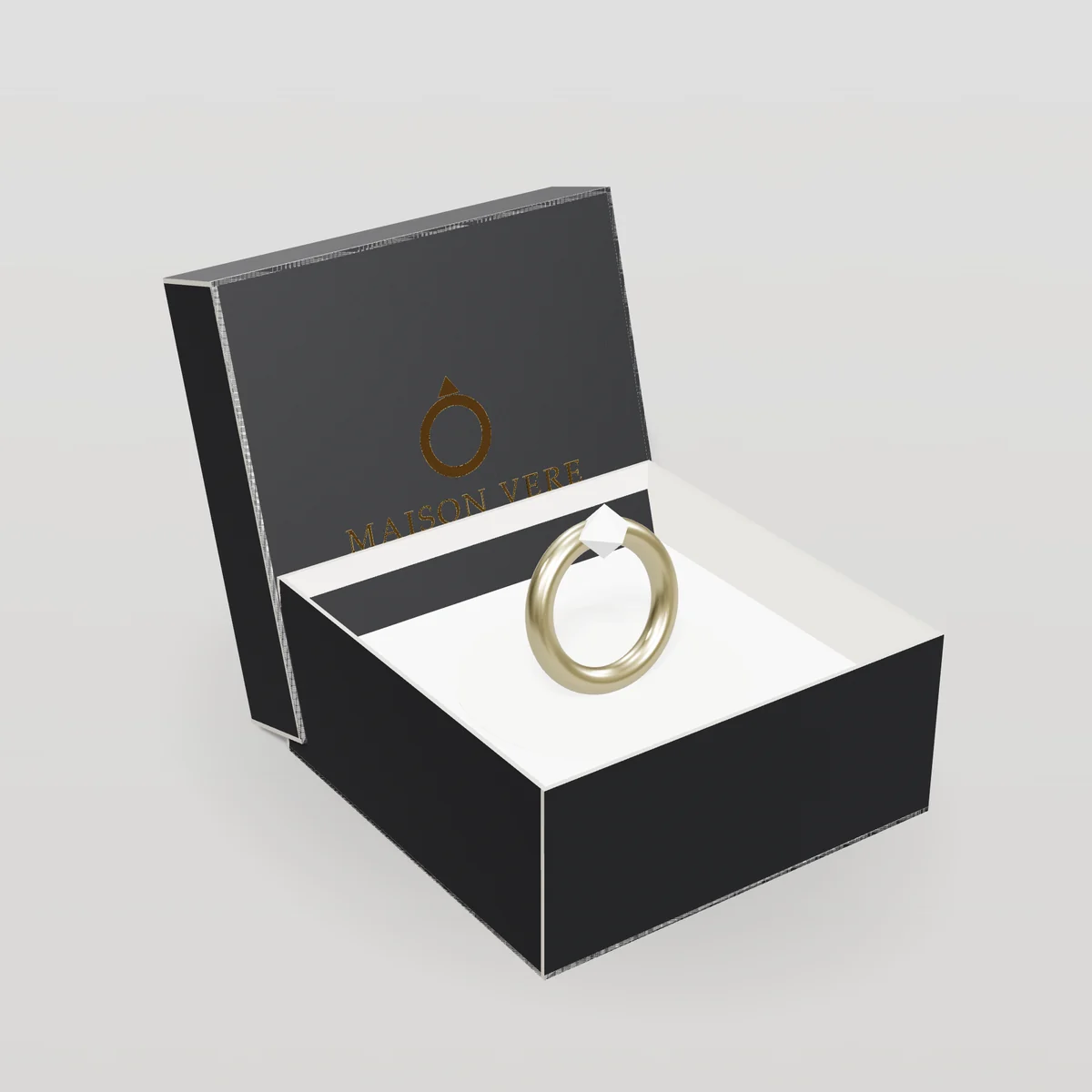
Quick answer
Book-style rigid boxes with hidden magnets for a satisfying, reclosable unboxing. Estimated prices start around $2.66 per unit at 10,000 units and $7.35 at 100 units for a 9×7×3" box. Typical turnaround is 10–14 business days after proof approval.
Magnetic Closure Boxes: specifications
| Closure | Concealed neodymium magnets in flap and front wall |
|---|---|
| Board | 1.5–2.5 mm greyboard |
| Wrap | Printed art paper, soft-touch, textured specialty papers |
| Options | Ribbon pull, foam or paperboard insert, foil, embossing |
| Collapsible | Optional flat-pack version saves up to 70% shipping volume |
| Minimum order | 100 units |
| Turnaround | 12–16 business days after proof |
Magnetic Closure Boxes: price breaks
How the estimated unit price of a 9×7×3" magnetic closure box in Rigid greyboard + printed wrap changes with quantity. Setup costs are spread over more boxes as the run gets longer, so the per-box price drops sharply in the first few tiers.
| Quantity | Est. unit price | Est. total | Saving vs. first tier |
|---|---|---|---|
| 100 | $7.35 | $735 | — |
| 250 | $5.00 | $1,250 | −32% |
| 500 | $4.07 | $2,035 | −45% |
| 1,000 | $3.51 | $3,505 | −52% |
| 2,500 | $3.05 | $7,622 | −59% |
| 5,000 | $2.82 | $14,124 | −62% |
| 10,000 | $2.66 | $26,615 | −64% |
Estimates from our published pricing model, full-color print, no finishes, delivered to the contiguous US. Your written quote confirms the exact price. Get an exact quote →
Popular sizes for magnetic closure boxes
Sizes are inside dimensions (length × width × height) in inches. Any custom size is available at no extra cost; these are simply the sizes brands order most.
| Size (L×W×H) | Typical use | Est. @ 500 | Est. @ 1,000 | Quote |
|---|---|---|---|---|
| 6 × 6 × 2" | Gift sets, apparel accessories, small electronics | $3.09 | $2.60 | Quote |
| 8 × 6 × 3" | Gift sets, apparel accessories, small electronics | $3.65 | $3.12 | Quote |
| 9 × 7 × 3" | T-shirts, subscription kits, books, multi-item orders | $4.07 | $3.51 | Quote |
| 10 × 10 × 4" | T-shirts, subscription kits, books, multi-item orders | $5.35 | $4.69 | Quote |
| 12 × 9 × 4" | Shoes, hoodies, bundles, home goods | $5.63 | $4.94 | Quote |
Material options and how they affect price
Estimated unit price at 1,000 units for a 9×7×3" magnetic closure box with full-color printing, by material. Material choice changes look, strength and recyclability as well as cost.
| Material | What it’s like | Est. unit price |
|---|---|---|
| Rigid greyboard + printed wrap | Thick greyboard (about 1.5–2.5 mm) wrapped in printed paper: the heavy, structured feel of luxury packaging. | $3.51 |
| Rigid greyboard + kraft wrap | Rigid greyboard wrapped in natural kraft paper: premium structure with a natural, understated finish. | $3.39 |
Printing options compared
How the print specification changes the estimated unit price of a 9×7×3" magnetic closure box in Rigid greyboard + printed wrap. One- and two-color printing carries a small plate charge that matters less as quantities grow; full-color digital and offset printing have no plate charge in our model.
| Printing | 500 units | 1,000 units | 5,000 units |
|---|---|---|---|
| Plain (no print) | $3.82 | $3.27 | $2.62 |
| 1 color | $4.02 | $3.41 | $2.70 |
| 2 colors | $4.14 | $3.49 | $2.75 |
| Full color outside | $4.07 | $3.51 | $2.82 |
| Full color outside + inside | $4.30 | $3.71 | $3.00 |
What is a magnetic closure box?
A magnetic closure box is a book-style rigid box: a base tray attached to a hinged cover that wraps over the top and down the front, where hidden magnets pull the flap shut with a soft, satisfying snap. The box opens like a book and closes on its own. Because it is built from thick greyboard wrapped in printed or specialty paper, it has the weight and crisp edges of luxury packaging, plus a closure that feels engineered.
Magnetic boxes are among the most requested premium packaging formats for good reasons:
- The snap. The tactile click of the magnets is part of the experience customers remember and share on video.
- Reclosable and reusable. Customers keep magnetic boxes for storage, which keeps your brand visible for months.
- A large, uninterrupted lid for a hero logo, foil or embossing.
- Room for inserts that turn a product into a curated set.
They are the format of choice for PR and influencer kits, product launches, gift sets, high-end cosmetics, jewelry, tech accessories and corporate gifts.
How a magnetic box is built
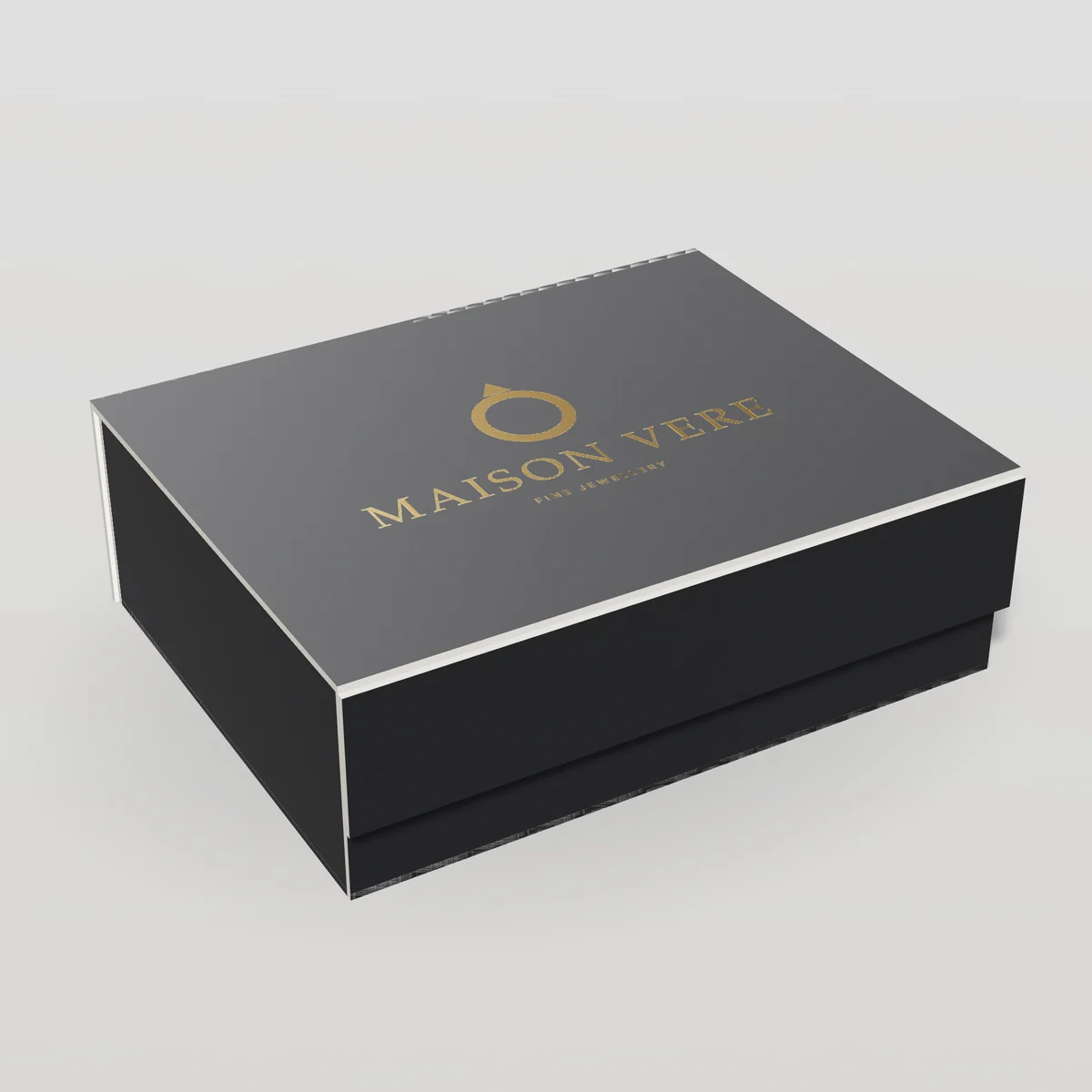
A magnetic closure box has three main parts:
- Base tray. A rigid greyboard tray wrapped in paper, holding the product and insert.
- Cover (case). A single wrapped board that forms the back spine, the lid and the front flap, glued to the back of the base.
- Magnets. Thin neodymium disc or bar magnets are hidden between the board and the wrap: one set inside the front flap and a matching set (or a steel plate) inside the front wall of the base.
The wrap papers are printed flat, laminated and embellished, then wrapped around the boards by machine and finished by hand. Inside, a liner paper covers the board edges, and an optional insert holds products.
Variations
- Full-flap magnetic box: the classic; the flap covers the whole front wall.
- Partial-flap: a shorter flap that closes partway down the front, showing a band of the base.
- Collapsible magnetic box: the base walls fold flat for shipping and storage; magnets hold the box square once assembled. Saves up to about 70% of storage volume compared with fixed rigid boxes.
- Double-door (gate-fold): two flaps meet in the center with magnets, for dramatic reveals.
- Magnetic drawer or shoulder hybrids for special projects.
Materials
| Component | Options | Notes |
|---|---|---|
| Greyboard | 1.5 mm, 2.0 mm, 2.5 mm | 2.0 mm is the most common |
| Wrap paper | Printed art paper, kraft, textured specialty, metallic, soft-touch laminated | Specialty papers can replace printing |
| Liner | Printed or plain paper | Inside print creates the reveal |
| Magnets | Neodymium discs or bars | Strength matched to box size |
| Insert | Paperboard, wrapped greyboard, EVA foam, molded pulp, velvet | Custom-cut to your products |
Read more about board and paper choices in our rigid chipboard guide.
Printing and finishing
Magnetic boxes are canvases for the best finishing techniques because the wrap paper is printed flat:
- Soft-touch lamination + foil logo: the signature luxury combination.
- Matte lamination + spot UV pattern: a tone-on-tone effect that catches the light.
- Blind embossing or debossing on textured paper: understated and tactile.
- Full-color printed interior with a message on the inside lid ("For you." is a classic).
- Colored or metallic papers with a single foil for a refined, low-ink look.
Inserts and layout
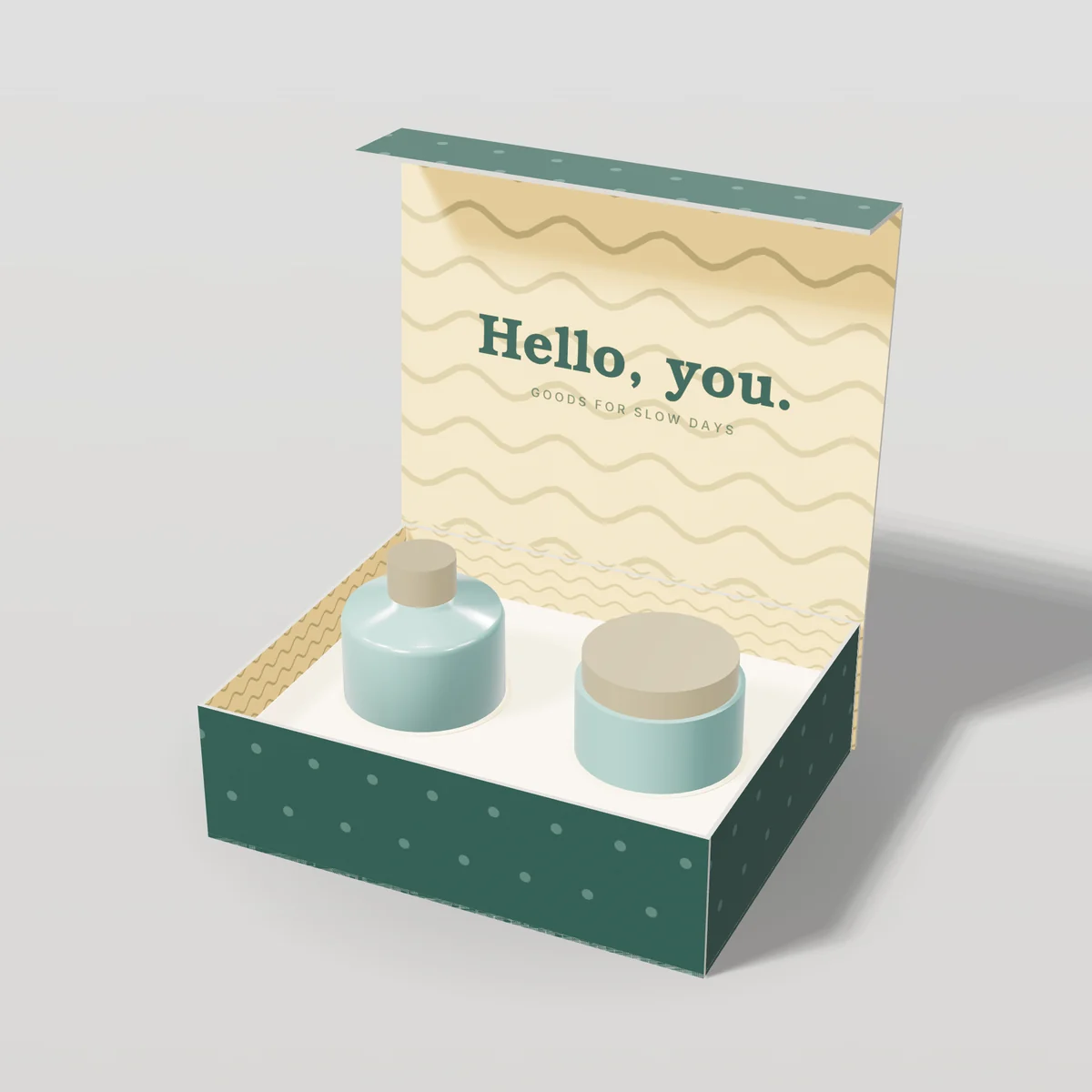
A magnetic box is often bought for its insert as much as its exterior. Plan the layout around how the customer should experience the products:
- Hero layout: one product centered in a cavity, everything else hidden underneath or in a compartment.
- Grid layout: several products in equal cavities, ideal for sets and samplers.
- Tiered layout: a lift-out tray with a second layer underneath for a two-stage reveal.
- Card slot: a die-cut slot in the lid for a welcome card or instructions.
Material choice depends on protection needs: paperboard and wrapped greyboard inserts for most cosmetics and accessories; EVA foam for glass, electronics and anything that ships; molded pulp for a plastic-free option. See custom inserts.
Sizing a magnetic box
Magnetic boxes are measured by the inside dimensions of the base tray (Length × Width × Height). The outside is larger because of the board thickness and the wrapping cover: with 2 mm board, expect roughly 0.3–0.4 in larger on length and width and 0.25 in on height.
- Lay out the products and insert, then measure the footprint and tallest item.
- Add insert thickness and the clearance between products and lid.
- Decide on a flap style (full or partial).
- Check the outside size against your shipper or mailer.
For PR kits, choose a size that fits inside a standard shipping box with 1–2 in of cushioning on every side.
Shipping and storage
Standard magnetic boxes ship fully assembled, so they take more warehouse and freight space than flat cartons. Two ways to manage that:
- Collapsible magnetic boxes ship flat and assemble in seconds.
- Plan storage early: pallets of assembled rigid boxes are bulky, so order in quantities your space can handle.
For e-commerce delivery, ship each magnetic box inside a mailer or shipping box with paper cushioning. Soft-touch and dark wraps show scuffs, so a tissue wrap or dust sleeve is worthwhile.
Pricing magnetic closure boxes
The table at the top of this page shows estimates for a 9 × 7 × 3 in magnetic box. Price drivers:
- Size (board, wrap and shipping volume)
- Board thickness
- Wrap paper (specialty papers cost more)
- Finishes (foil, emboss, spot UV)
- Insert type
- Collapsible or fixed
- Quantity
A smaller cosmetics or jewelry set, 6 × 6 × 2 in, compares like this:
| Quantity | Est. unit price | Est. total | Saving vs. first tier |
|---|---|---|---|
| 100 | $6.12 | $612 | — |
| 250 | $3.93 | $982 | −36% |
| 500 | $3.09 | $1,546 | −50% |
| 1,000 | $2.60 | $2,602 | −58% |
| 2,500 | $2.22 | $5,558 | −64% |
| 5,000 | $2.05 | $10,228 | −67% |
| 10,000 | $1.92 | $19,199 | −69% |
Estimates from our published pricing model, full-color print, no finishes, delivered to the contiguous US. Your written quote confirms the exact price. Get an exact quote →
Ways to manage cost
- Use a colored or textured specialty paper with one foil logo instead of full printing.
- Choose a paperboard insert if foam protection is not essential.
- Standardize one box size across several kits and change the insert.
- Go collapsible to cut storage and inbound freight.
Designing a magnetic box
Artwork is designed on wrap dielines for the cover and the base. Plan for:
- The lid face: your hero logo or artwork.
- The spine: visible when boxes are stored on a shelf; a small logo works well.
- The front flap: the first thing the customer touches; a subtle detail or "Open" cue.
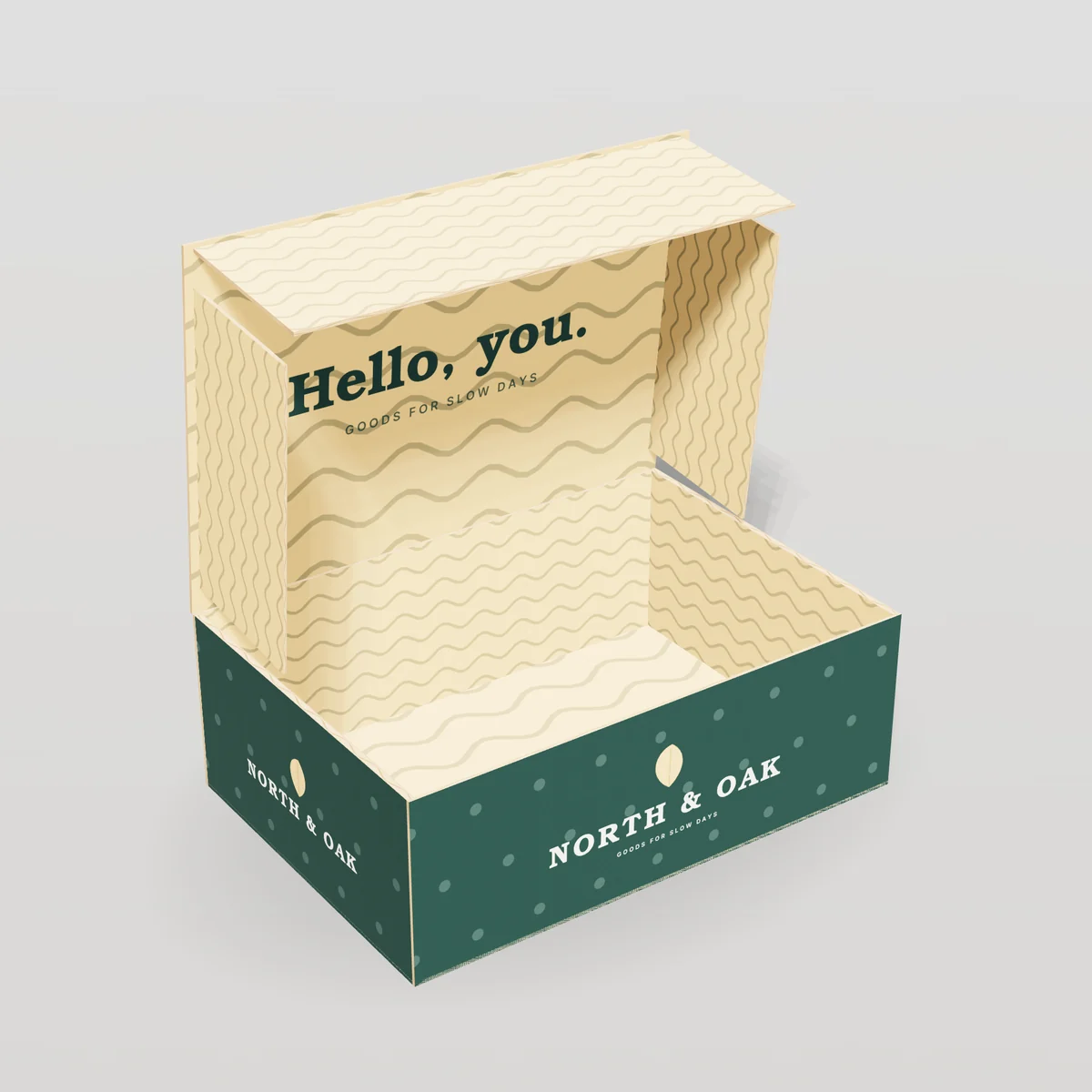
- The inside lid: the reveal; a message, pattern or color.
- Turn-ins: artwork extends around edges and into the box.
Keep important elements away from corners and hinge lines, extend backgrounds through turn-ins, and supply foil and emboss as separate vector artwork.
Magnetic boxes by use case
- PR and influencer kits: bold interior messages, layered inserts, card slot for the story.
- Product launches: limited-edition prints and foil numbering.
- Corporate gifting: subtle exterior, branded interior, insert for curated items. See gift boxes.
- Cosmetics and skincare sets: soft-touch with foil, cavities for bottles and jars. See cosmetic boxes.
- Jewelry and watches: small magnetic boxes with velvet inserts. See jewelry boxes.
- Tech accessories: foam inserts for devices and cables. See electronics boxes.
- Wedding and event favors: small magnetic boxes with ribbons and foil names.
Worked example: a PR kit
An illustrative example. A skincare brand launching a three-step routine sends 150 kits to creators.
- Products: a 50 ml cleanser, a 30 ml serum and a 50 ml cream jar
- Box: magnetic closure, 10 × 8 × 3 in inside, 2 mm board
- Wrap: soft-touch black with gold foil logo on the lid; printed blush interior with "Your new routine" on the inside lid
- Insert: wrapped greyboard with three cavities and a card slot
- Shipping: each kit inside a printed E-flute mailer with paper cushioning
- Why it works: a dramatic two-step unboxing, protected glass, and a box creators keep and show on camera
Sustainability
Magnetic boxes are mostly paper and recycled greyboard. Their biggest environmental advantage is longevity: customers keep and reuse them. To improve end-of-life recyclability, choose paper or pulp inserts over foam, keep plastic laminations modest and note on the box that magnets should be removed before recycling.
Magnetic vs. other premium boxes
| Compared with | Choose magnetic when… | Choose the alternative when… |
|---|---|---|
| Rigid lid-and-base | You want a hinged lid and the magnetic snap | A lift-off lid suits the product or budget |
| Two-piece box | Maximum premium feel | A lighter lid-and-base is enough |
| Sleeve box | Reclosable gifting | A slide-out reveal is preferred |
| Mailer box | The box is a keepsake | The box must ship alone at low cost |
Ordering checklist
- Products, weights and layout
- Inside dimensions of the base
- Fixed or collapsible; full or partial flap
- Board thickness
- Wrap paper and finish; interior print
- Foil, emboss, spot UV
- Insert type and card slot
- Quantity, delivery ZIP and target date
The anatomy of the snap
The defining moment of a magnetic closure box is the soft "click" as the lid closes. That sensation comes from small, flat magnets embedded under the wrap paper: typically one or two in the front flap of the lid and matching magnets or steel plates in the front wall of the base. Their strength and position are chosen so the lid closes firmly without slamming and opens with a gentle pull.
Getting it right involves:
- Magnet strength: too weak and the lid pops open in transit; too strong and opening feels like a struggle.
- Magnet placement: centered for even closure, or two magnets for wide lids.
- Concealment: magnets sit in shallow recesses so the wrap stays perfectly flat.
- Alignment: the lid flap must meet the base squarely each time.
Our production partners test closure on samples before the run starts.
Magnetic box variations
| Variation | Description | Use |
|---|---|---|
| Classic flap lid | Hinged lid with a front flap that closes onto the base | Most premium gift and product boxes |
| Book-style | Opens like a book cover, often with magnets on the side | Presentation kits, media, stationery |
| Collapsible magnetic | Ships flat; folds into shape and is held by magnets | E-commerce and brands with storage limits |
| Double-door | Two flaps open from the center | Dramatic reveals, luxury sets |
| Magnetic with drawer | Lid opens to reveal an internal drawer | Multi-layer kits |
| Magnetic with ribbon pull | Ribbon to lift the product or insert | Jewelry, fragrance |
Collapsible magnetic boxes in detail
Traditional magnetic boxes ship assembled, which takes significant space in freight and storage. Collapsible magnetic boxes are wrapped as separate panels joined by paper hinges. At packing, the box is unfolded, the sides lift into place, and magnets (or a double-sided strip) hold the structure. They look nearly identical to traditional boxes when assembled and can reduce inbound freight volume dramatically.
They are a strong choice for:
- E-commerce brands storing boxes at a 3PL
- Large runs where freight volume would be significant
- Brands without much storage space
Designing the inside of a magnetic box
The inside of the lid is the first surface seen when the box opens, making it one of the most valuable design spaces:
- A printed liner with a pattern, message or founder's note
- A card pocket holding a welcome card or instructions
- A mirror panel for cosmetics (special construction)
- Ribbon pull-tabs to lift products or inserts
- A foil or debossed detail on the liner
Magnetic boxes for influencer and PR kits
Magnetic boxes are the default for influencer seeding and PR because they film well: the snap, the lid opening, and a well-arranged insert make a natural unboxing video. Ideas:
- Personalized lids or cards with the recipient's name (digital printing or a printed sleeve)
- Layered reveal: a printed tissue or card on top, then products
- QR code linking to launch content
- Reusable box that remains on a creator's shelf in future videos
Worked example: a smartwatch accessory brand
A brand sells premium watch straps.
- Box: collapsible magnetic box, 6 × 4 × 2 in, so stock ships flat to the 3PL.
- Wrap: black paper with soft-touch lamination.
- Finish: silver foil logo; spot UV pattern on the lid.
- Insert: wrapped greyboard with a strap cavity and a pocket for spare pins.
- Shipping: inside a printed E-flute mailer.
See electronics boxes.
Common mistakes with magnetic boxes
- Magnets too weak for heavy lids or long flaps.
- Shipping without an outer box, causing dents and scuffs.
- Ignoring storage space for assembled boxes.
- Text near edges and hinges, where wrap tolerances show.
- Foam inserts in an otherwise paper box when wrapped board would work.
Magnetic boxes by size and use
| Size (approx.) | Typical contents |
|---|---|
| 4 × 4 × 2 in | Jewelry, watch straps, small accessories |
| 6 × 6 × 3 in | Fragrance, skincare duos, candles |
| 8 × 6 × 3 in | Cosmetics sets, tech accessories |
| 10 × 8 × 3 in | Gift sets, PR kits |
| 12 × 9 × 4 in | Apparel, larger gift hampers |
| 14 × 10 × 4 in | Premium apparel, presentation kits |
Sizes are made to order, so start from your products and insert layout rather than these examples.
Ribbons, pulls and lifting details
Small details make magnetic boxes feel finished:
- Ribbon pull under the insert lifts products out gracefully.
- Ribbon stay keeps the lid from falling back too far.
- Thumb cut-outs in the insert help grip small items.
- Card pocket in the lid holds a message or guide.
- Tissue layer under the lid adds a soft reveal.
Each detail adds a little cost and assembly time; choose the ones that suit your unboxing.
Magnetic boxes in one paragraph
A magnetic closure box is a rigid greyboard box with a hinged lid held shut by hidden magnets, prized for its satisfying snap and long life on customers' shelves. Choose 2.0 mm board for most sizes, a laminated or specialty wrap, one premium finish such as foil or deboss, and a wrapped board insert to keep everything paper-based. Consider collapsible versions to save freight and storage, ship each box inside a corrugated mailer, and plan 12–16 business days of production.
Why the snap matters
Packaging designers talk about "sensory cues": signals of quality that customers feel rather than read. A magnetic closure is one of the strongest. The resistance as the lid opens, the controlled fall as it closes and the soft click at the end tell the customer, without words, that the object has been engineered with care. The same principle is used by makers of premium cars, phones and watches, whose doors, lids and clasps are tuned to sound and feel a certain way.
For a brand, that cue does two things. It raises perceived value at the moment of opening, which is when customers form their first impression of a product. And it repeats every time the box is reused, because customers open and close a magnetic box many times as they store things in it. That repetition is why magnetic boxes are so often kept and why they appear in unboxing videos: the snap is satisfying to film and to hear.
Of course, the cue only works if the rest of the box is equally well made: square corners, tight wraps, a clean liner and an insert that holds the product precisely. We check closure strength, alignment and finish on samples before production so the snap feels right on every box.
Magnetic box checklist
- [ ] Products measured and insert layout sketched
- [ ] Traditional or collapsible construction chosen
- [ ] Board thickness (usually 2.0 mm) and wrap paper chosen
- [ ] Lamination and one premium finish selected
- [ ] Liner print and any card pocket or ribbon details decided
- [ ] Outer shipping mailer planned
- [ ] Storage space for assembled boxes confirmed
- [ ] Sample ordered for launches or color-critical work
Photographing your magnetic closure boxes
Film the snap. A short video of the lid closing captures the main appeal of the format. For stills, show the box closed at three-quarter view, then open at about 100 degrees with the insert and contents visible. Raking light reveals foil and debossing on the lid.
Related guides
 GuideFinishes & embellishmentsHow foil stamping, embossing, debossing, spot UV, soft-touch, windows and inserts work, what they cost, and how to combine them without overspending.
 GuideUnboxing & brand designHow to design packaging that sells and gets shared: brand hierarchy, color, typography, the unboxing sequence, inserts and low-cost upgrades that matter.
 GuideHow much custom packaging costsRealistic 2026 price ranges for custom mailer, shipping, carton, rigid and pouch packaging, what drives cost, and proven ways to lower your unit price.
 GuideBox styles explainedA practical comparison of every common box style: mailer, RSC shipper, tuck end, auto-lock, rigid, magnetic, sleeve, pillow, gable, display, window and tube.
What finishes and add-ons cost
Estimated extra cost per unit at 1,000 units when you add one finish to a 9×7×3" magnetic closure box (base estimate $3.51). One-time tooling such as foil and embossing dies is already spread across the run in the per-unit figure and listed separately for reference.
| Finish | What it does | Adds per unit | One-time setup |
|---|---|---|---|
| Matte lamination | A thin film with a smooth, low-glare finish that protects print from scuffs. | +$0.06 | — |
| Soft-touch | A velvety, premium coating that invites customers to hold the box. | +$0.11 | — |
| Spot UV | Clear glossy varnish on selected areas for a sleek contrast against matte. | +$0.16 | $80.00 |
| Foil stamping | Gold, silver, rose gold or holographic foil for logos and accents. | +$0.25 | $120 |
| Embossing / debossing | Raised or recessed logo detail you can feel with your fingertips. | +$0.23 | $120 |
| Window | A die-cut window with clear film so the product sells itself. | +$0.13 | $60.00 |
| Custom insert | Paperboard, corrugated or foam inserts that hold products in place. | +$0.25 | $80.00 |
How magnetic closure boxes compare with similar styles
Estimated unit prices at 1,000 units for each style at its most popular size, full-color print, delivered within the contiguous US, so you can weigh magnetic closure boxes against the alternatives customers often consider.
| Style | Typical board | Minimum | 1,000 units | Ships | Best for |
|---|---|---|---|---|---|
| Magnetic Closure Boxes9 × 7 × 3" | Rigid greyboard + printed wrap | 100 units | $3.51 | Assembled | Book-style rigid boxes with hidden magnets for a satisfying, reclosable unboxing. |
| Rigid Boxes8 × 6 × 3" | Rigid greyboard + printed wrap | 100 units | $2.89 | Assembled | Luxury setup boxes made from thick greyboard wrapped in printed or specialty paper. |
| Two-Piece Boxes8 × 8 × 3" | Rigid greyboard + printed wrap | 100 units | $3.10 | Flat | Lid-and-base boxes in rigid board or paperboard. A timeless gift and apparel format. |
| Sleeve Boxes6 × 4 × 2" | SBS white paperboard (18pt) | 250 units | $0.67 | Flat | A printed sleeve over a sliding tray. Interactive, premium and easy to brand on two surfaces. |
| Mailer Boxes9 × 6 × 3" | E-flute corrugated, white | 100 units | $1.06 | Flat | Self-locking corrugated mailers printed inside and out. The go-to box for DTC brands and subscriptions. |
Learn about these materials
How to order magnetic closure boxes
- 1Request a quote
Tell us the style, size, quantity and artwork you have. Use the form or the live estimator.
- 2Free design & dieline
We send a dieline for your exact size, check your artwork and help with layout at no charge.
- 3Approve your proof
Review a digital 3D proof (and an optional physical sample) before anything is printed.
- 4Production & QC
Your boxes are printed, finished, die-cut and inspected against the approved proof.
- 5Delivered to your door
Shipped flat-packed with tracking to any address in the contiguous US.
Key terms on this page
- Magnetic closure box
- A rigid book-style box with a hinged lid and a front flap that closes with hidden magnets.
- Rigid box
- A premium box made from thick greyboard wrapped in printed or specialty paper, delivered assembled. Also called a setup box.
- Tray
- An open-topped box base, often used with a sleeve or lid.
- Greyboard
- Thick, dense recycled board used as the structural core of rigid boxes, usually 1.2 to 3 mm thick.
- Specialty paper
- Textured, colored, metallic or otherwise distinctive paper used to wrap rigid boxes or print labels.
- Lid
- The top part of a box, hinged or separate.
- Embossing
- Raising part of the board surface into a relief using matched dies, often combined with foil or ink.
- Insert
- A component inside a box that holds products in place, such as die-cut paperboard, corrugated, foam or molded pulp.
- Board
- A general term for thick paper materials used in packaging, including paperboard, corrugated board and greyboard.
- Wrap
- The printed or specialty paper glued around the board of a rigid box or tube.
- Plate
- A printing surface (metal for offset, polymer for flexo) that carries the image of one color.
- Liner
- The flat paper faces of corrugated board. Can be kraft (brown) or bleached (white).
- Kraft
- Paper or board made from unbleached wood pulp, naturally brown and strong.
- Paperboard
- Thick paper (usually 0.010 inch or more) used for folding cartons, such as SBS, kraft and recycled board.
- EVA foam
- A dense, smooth foam used for protective inserts with precise cavities, common in premium electronics and jewelry packaging.
- Molded pulp
- Packaging formed from wet paper fiber in molds and dried, used for protective inserts and trays. Plastic-free and recyclable.
- Chipboard
- A dense, usually recycled board. Thin chipboard is used for backing cards; thick chipboard (greyboard) forms the core of rigid boxes.
- Soft-touch lamination
- A film with a velvety, matte texture that makes packaging feel premium and resists fingerprints.
- Lamination
- Bonding a thin film (matte, gloss or soft-touch) or paper to board for protection and finish.
- Spot UV
- A clear, glossy UV-cured varnish applied to selected areas to create contrast with a matte background.
- Debossing
- Pressing a design into the board so it sits below the surface. The opposite of embossing.
- Inside dimensions
- The usable space inside a box, the standard way to specify custom box sizes (L × W × H).
- Shipper
- A box used to ship products, often corrugated.
- Cushioning
- Materials that absorb shock and vibration to protect products, such as paper void fill, molded pulp, foam or air pillows.
- Sleeve
- An open-ended band or tube that slides over a tray or box, often printed to brand plain packaging.
- Artwork
- The final graphic files (logos, images, text and colors) placed on a dieline and used to make printing plates or digital print files.
- Vector artwork
- Graphics made of mathematical paths rather than pixels, which scale to any size without losing quality. Preferred for logos.
- E-flute
- A thin corrugated flute about 1/16 inch thick. It prints sharply and folds crisply, making it the standard for mailer boxes.
More definitions in our packaging glossary.
Customer reviews
Reviews come only from verified customers. Ordered magnetic closure boxes from us? Share your experience.
Discussed on Quora & X
Magnetic Closure Boxes FAQ
What is a magnetic closure box?
It is a rigid, book-style box with a hinged lid and a front flap that closes with hidden magnets. It is used for premium gifts, PR kits and luxury products.
What is the minimum order for magnetic boxes?
Our minimum for custom magnetic closure boxes is 100 units.
How long does production take?
Typically 12–16 business days after proof approval, plus shipping, because each box is wrapped individually.
Do magnetic boxes ship flat?
Standard magnetic boxes ship assembled. Collapsible magnetic boxes ship flat and fold into shape, saving storage and freight.
Are the magnets strong enough to keep the box closed?
Yes. We match magnet strength to box size and contents so the flap closes firmly but opens easily.
Can I add an insert?
Yes. Paperboard, wrapped greyboard, EVA foam, velvet and molded pulp inserts are available, custom-cut to your products.
Can magnetic boxes be recycled?
The paper and greyboard are recyclable once magnets and any foam insert are removed. Paper or pulp inserts make recycling easier.
Can you print inside a magnetic box?
Yes. Interior printing on the lid lining and base is one of the most effective ways to create a memorable reveal.
Are the magnets visible?
No. Magnets are hidden under the wrap paper in shallow recesses.
How long do magnetic boxes take to produce?
Typically 12–16 business days after proof approval because of wrapping and assembly, plus shipping.
Can I get a magnetic box with a window?
Yes, though windows on rigid boxes add cost and complexity. A printed liner or a well-designed insert is often a more elegant reveal.
Are collapsible magnetic boxes as sturdy as traditional ones?
Once assembled they are very close in strength and appearance. For retail display where seams might be noticed, traditional construction is best.
How strong are the magnets?
Strong enough to keep the lid closed during normal handling and easy to open with one hand. Strength is matched to the lid size.
Can I ship magnetic boxes by mail?
Ship them inside a corrugated mailer or shipping box so the wrap is not scuffed and the lid cannot be forced open.
What is the minimum order?
Most magnetic closure boxes start at 100 units.
Can magnetic boxes be printed inside?
Yes. The liner can be printed with a pattern, message or brand color.
What finishes are popular on magnetic boxes?
Soft-touch or matte lamination with foil stamping or debossing on the lid.
Are collapsible magnetic boxes available?
Yes. They ship flat and fold into shape with magnets holding the walls.
Can I add a ribbon?
Yes: ribbon pulls under inserts, ribbon stays for the lid and decorative ribbons are common.
Where do you deliver magnetic boxes?
We deliver to business and residential addresses across the contiguous United States with tracking, usually within 3–7 business days after production. Alaska, Hawaii and expedited freight are quoted separately.
What if my magnetic boxes arrive with a defect?
Report it within 7 days of delivery with photos and your order number. If there is a production defect or the boxes do not match your approved proof, we reprint or refund the affected items under our reprint guarantee.