Quick answer
Print on the inside of the box for a hidden message, pattern or brand story. Typical turnaround is 10–14 business days after proof approval.
What is interior printing?
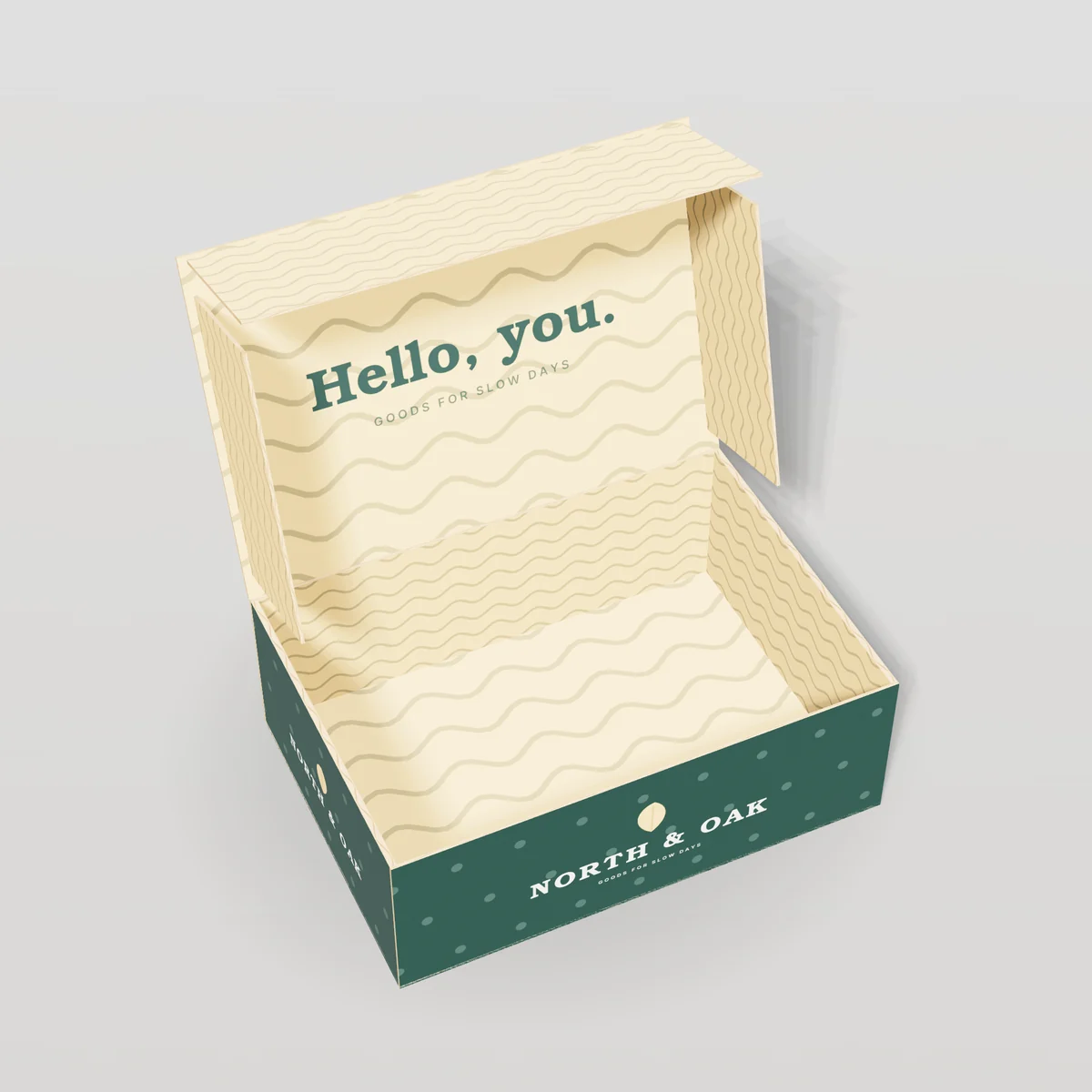
Interior printing means printing the inside surfaces of a box: the inside of a mailer lid, the walls and base of a tray, the inside of a carton. It is one of the highest-impact, lowest-cost upgrades in packaging because it creates a reveal: the moment the customer opens the box and sees something unexpected.
Why print the inside of a box?
The outside of a box is designed to be recognized; the inside is designed to be remembered. When customers open a mailer or a gift box, the first thing they see is the inside of the lid and the interior walls. A printed interior turns that moment into a reveal: a burst of brand color, a pattern, a personal message, a joke, instructions or an invitation to share. Because customers photograph the inside more than the outside, interior printing is often the most visible part of your packaging on social media.
It is also cost-efficient. A plain or one-color outside with a printed inside can feel more premium than a fully printed outside, at a lower price, and it keeps the shipping exterior understated, which some brands prefer for discretion and to reduce theft risk.
What to print inside
- A flood color in your brand color
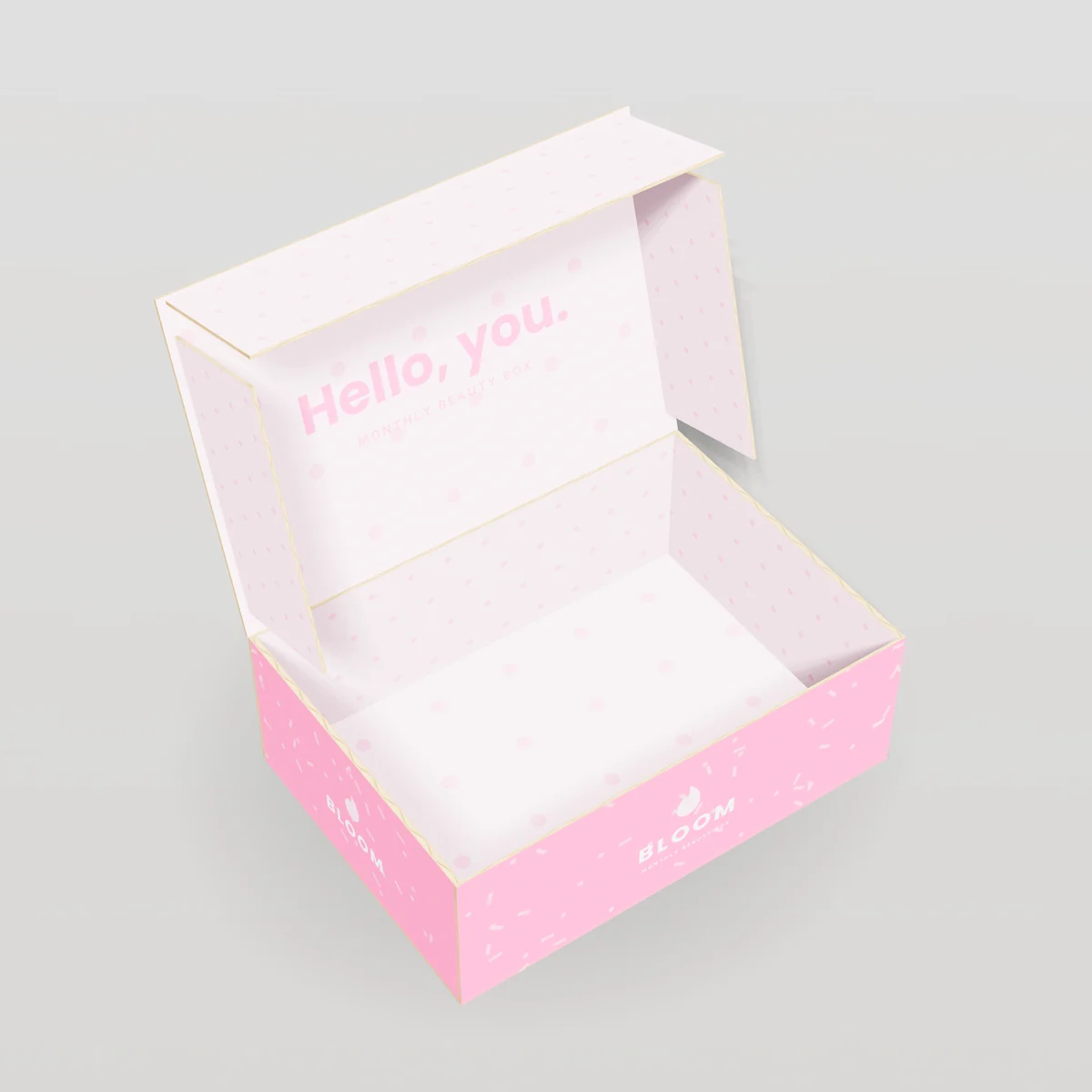
- A repeating pattern or illustration
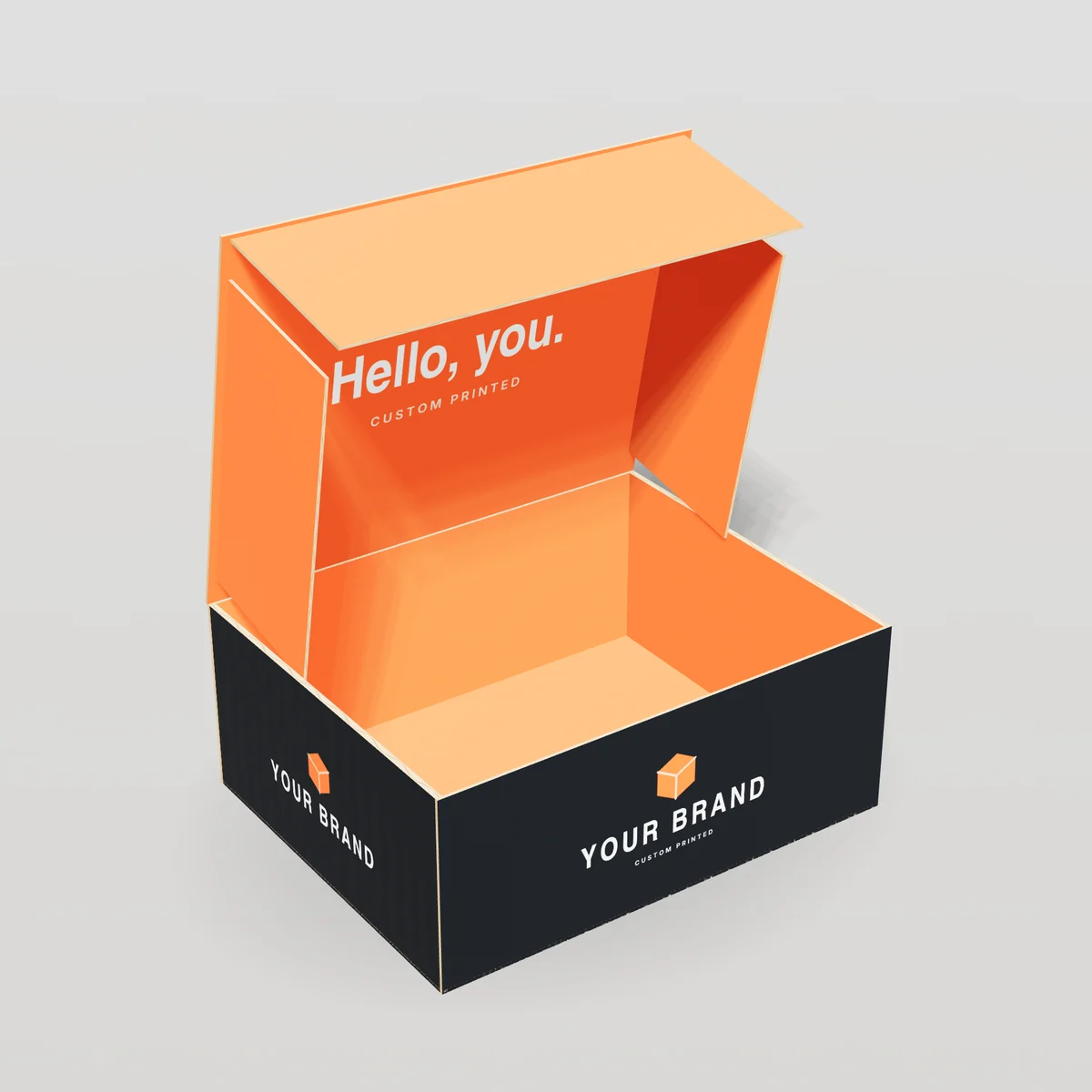
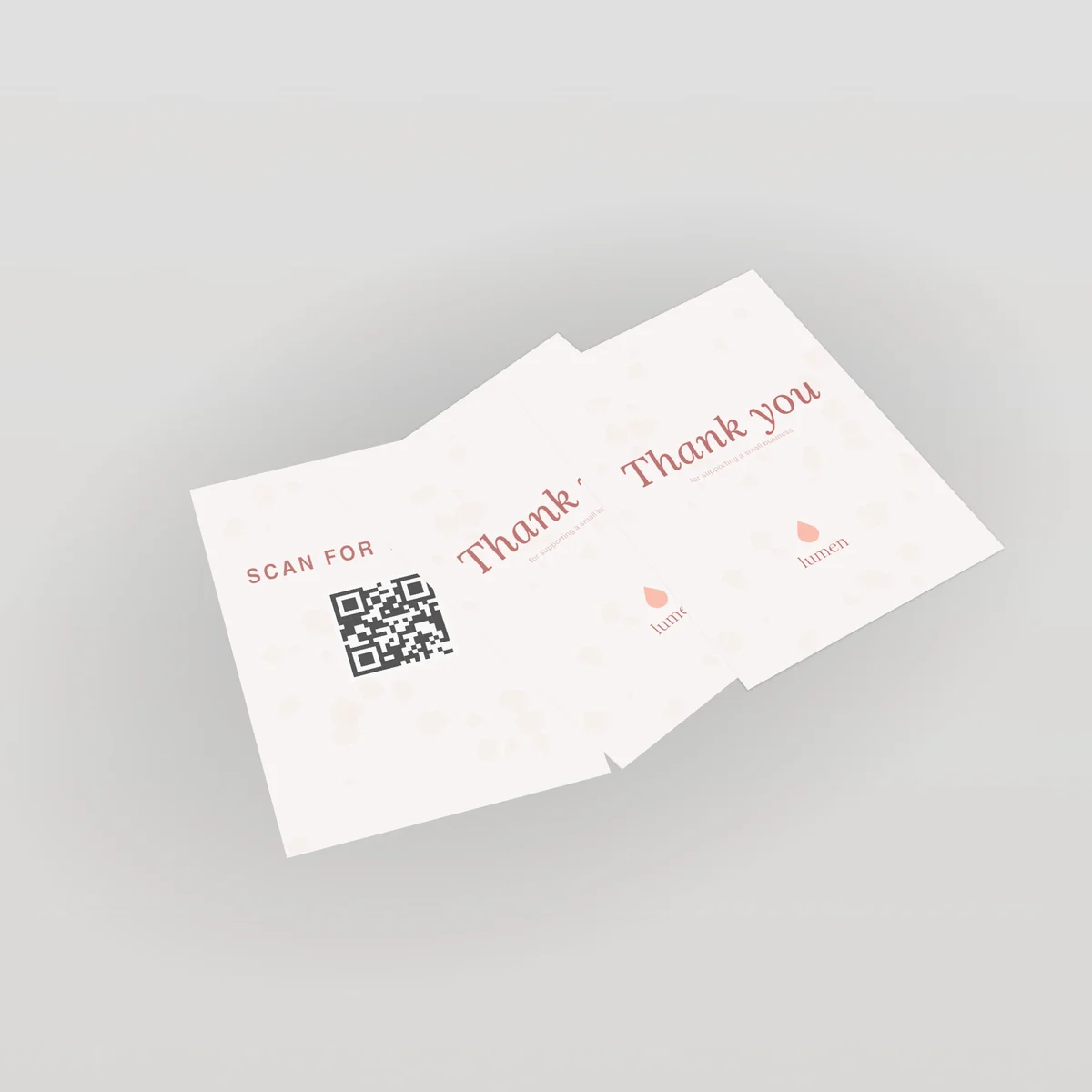
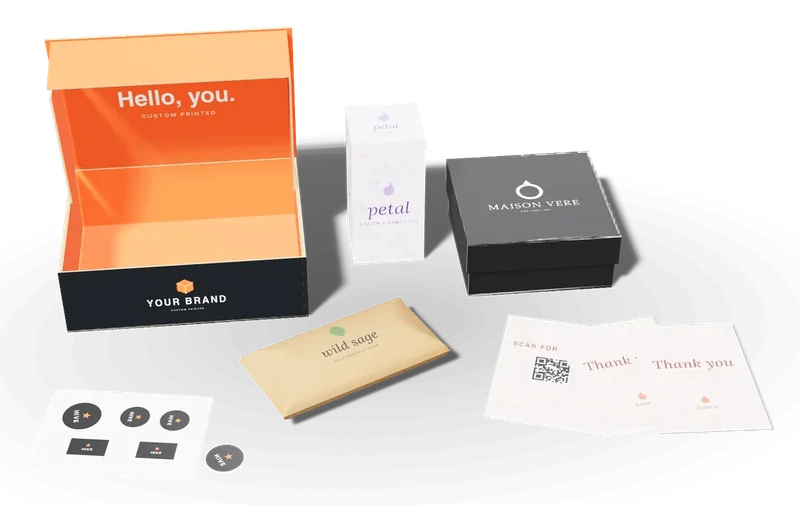
- A message under the lid ("Hello, you.", "Made for you", "Thank you for supporting a small business")
- Instructions or a QR code to a tutorial or playlist
- A social prompt ("Share your unboxing @yourbrand")
-
Seasonal or limited artwork
-
A message under the lid: "Hello, gorgeous", "You made it", "Thank you for supporting a small business"
- Brand pattern or color: a full flood of your brand color makes the reveal pop
- Instructions: how to use, care for or assemble the product
- Social prompts: your handle, a hashtag, a QR code to a video or community
- Story: where the product comes from, who made it
- Offers: a code for the next purchase or a referral
- Recycling instructions: how to dispose of the packaging
Mix one emotional element (message, pattern) with one practical element (instructions, QR code) for a balanced interior.
Interior printing by box style
| Style | What customers see first | Best interior areas |
|---|---|---|
| Mailer box | Inside lid and front flap | Lid panel, inner walls, base |
| Shipping box | Inside of the flaps | Flaps and walls |
| Tuck end carton | Inside of the tuck and panels | Tuck flap, inner back panel |
| Rigid box | Liner under the lid | Lid liner, base liner |
| Magnetic box | Inside of the hinged lid | Lid liner |
| Sleeve box | Tray base and inner sleeve | Tray floor |
| Display box | Inside back panel when open | Header and inner panels |
Print options for interiors
| Option | Effect | Cost |
|---|---|---|
| One-color flood | Strong color reveal | Lowest |
| One-color pattern or message | Personality | Low |
| Two-color | Richer design | Medium |
| Full color | Photography and illustration | Higher |
On mailer boxes, interior printing is applied to the same sheet as the exterior, so it adds a print pass rather than a whole new component.
Tip: Design the inside lid as the "hero" photo moment. Customers usually photograph an opened box from above.
| Option | Look | Cost impact | Notes |
|---|---|---|---|
| One color | Logo, message or pattern in one ink | Low | Great value; dark ink on white or kraft |
| Two colors | More contrast and detail | Low–medium | Brand color + black |
| Full color (CMYK) | Photos, gradients, illustration | Medium | Most dramatic reveal |
| Flood color | Entire interior in one color | Low–medium | Bold and simple |
| Rigid box liner print | Printed liner paper | Medium | Fully custom interior |
On corrugated mailers, the inside liner can be white or kraft. Full-color interiors look brightest on white liners.
Designing the interior
- Use the production dieline. Interior panels are mirrored relative to the outside; our dieline marks which side is which.
- Think about orientation. Text inside the lid should read correctly when the box opens toward the customer.
- Avoid glue and tuck areas. Ink on glue flaps can weaken bonds; the dieline shows no-print zones.
- Allow for shipping label placement on the outside so it does not cover the opening experience.
- Keep messages short. Big type, few words.
- Test with a printed sample if the interior is central to your brand.
- Use the dieline: inside and outside panels are on opposite sides of the same sheet.
- Keep messages away from folds and glue areas.
- Consider how the inside looks with products and tissue in place.
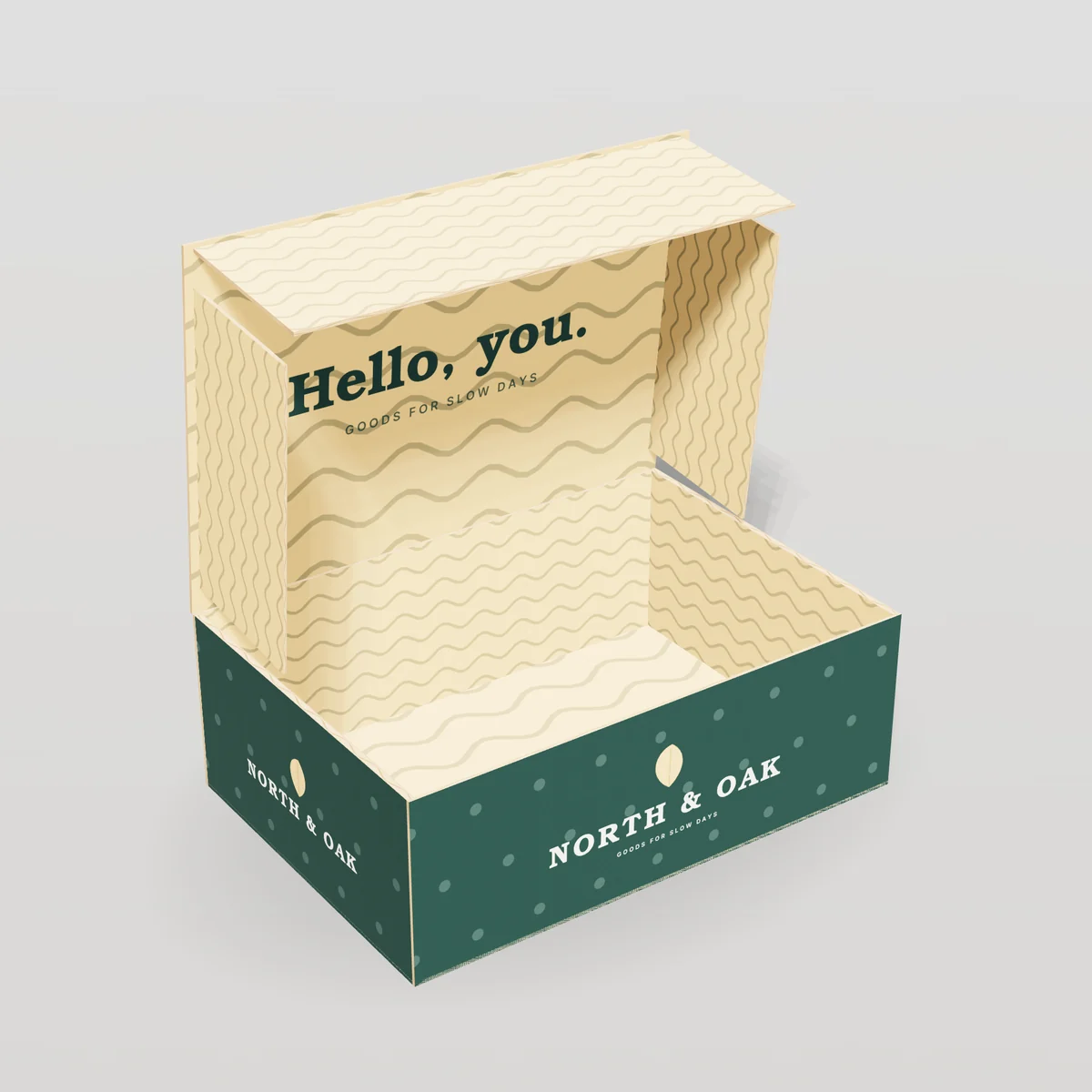 Box StylesMailer BoxesSelf-locking corrugated mailers printed inside and out. The go-to box for DTC brands and subscriptions.
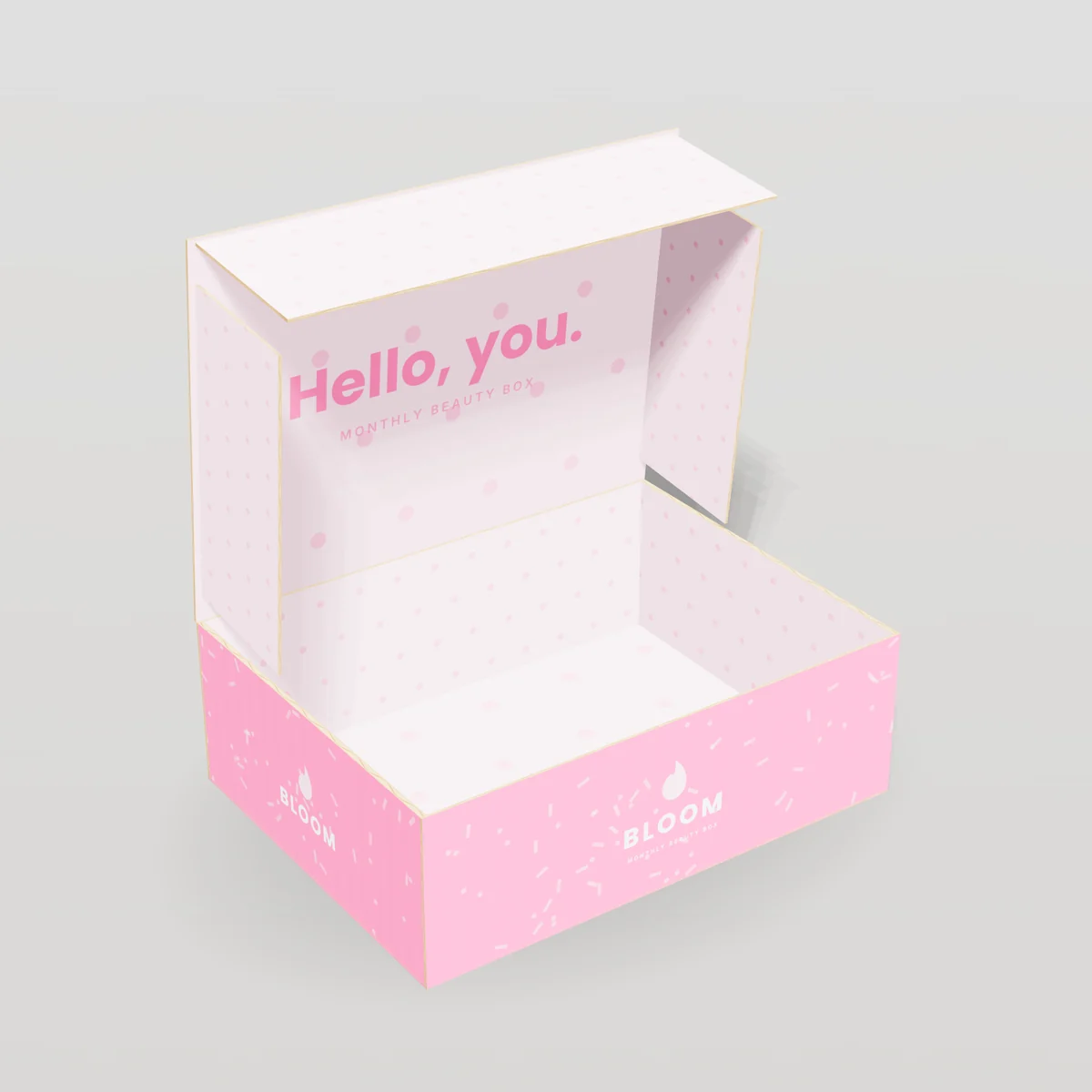 IndustriesSubscription BoxesShippable mailers with interior print that make every monthly box feel like a gift.
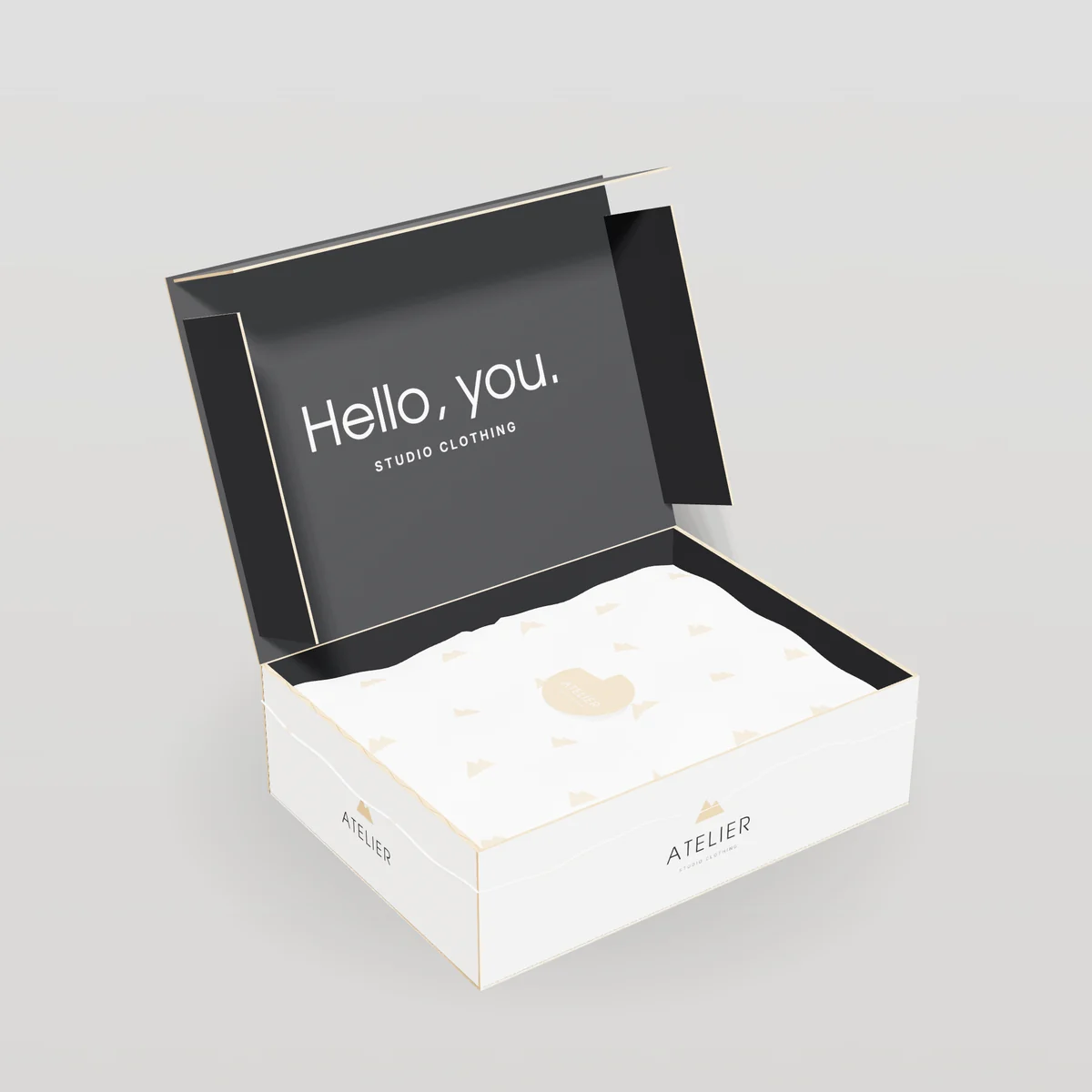 IndustriesApparel BoxesMailers, lid-and-base boxes and poly mailers for clothing, from tees to outerwear.
 Box StylesTuck End BoxesStraight and reverse tuck end cartons that open and reclose cleanly. Ideal for lightweight retail products.

Combining interior and exterior printing
| Exterior | Interior | Effect |
|---|---|---|
| Plain kraft + one-color logo | Full-color pattern | Understated outside, joyful reveal |
| Full color outside | One-color message inside | Consistent, with a personal touch |
| Black outside | Bright brand color inside | Dramatic contrast |
| White outside, minimal | Illustrated interior | Gallery-like reveal |
Printing processes for interiors
Interior printing requires printing both sides of the board, which means a second print pass or a press that prints both sides. Methods:
- Digital printing can print inside and out economically on short runs.
- Offset prints each side in a separate pass on cartons.
- Flexo can print the inside liner of corrugated before converting.
- Rigid boxes use a separately printed liner paper.
Because of the extra pass, interior printing adds cost per unit and may add a little production time. The table on this page shows estimates by box style.
Sustainability
Interior printing uses ink, not extra material, and water-based inks keep corrugated and paperboard recyclable. It can even reduce waste by replacing separate inserts or printed cards with information printed inside the box.
Worked example: an apparel brand's mailer
An apparel brand ships T-shirts in a 10 × 8 × 3 in E-flute mailer.
- Outside: kraft with a one-color black logo, durable and discreet in transit.
- Inside: full-color brand pattern with "Welcome to the crew" under the lid and a QR code to styling tips.
- Extras: branded tissue and a sticker seal.
The cost increase for interior print is modest, while the reveal becomes the moment customers share. See apparel boxes.
Writing messages for the inside of the box
The words under the lid are read in a moment of anticipation, so they deserve care.
- Be brief. Three to ten words read best at a glance.
- Sound like your brand. Playful, warm, minimal or bold, but consistent.
- Speak to the customer. "You" is more personal than "we".
- Avoid time-sensitive offers printed permanently; use a card for promotions that change.
- Add one action. "Tag us @yourbrand", "Scan for the routine", "Recycle me with cardboard".
Examples by tone:
| Tone | Example |
|---|---|
| Warm | "Made with care, just for you." |
| Playful | "Open me first. Then everything else." |
| Minimal | "Hello." |
| Bold | "Your new favorite thing." |
| Helpful | "Scan for a 2-minute setup video." |
QR codes inside packaging
A QR code inside the box connects the physical unboxing to digital content: tutorials, playlists, care guides, reorder pages, reviews or community sign-ups. Tips:
- Print at least 0.8 in (2 cm) square with a clear quiet zone.
- Use dark code on a light background.
- Use a link you control (a redirect on your domain) so you can change the destination later without reprinting.
- Tell people what they get: "Scan for the care guide".
- Test the printed code on several phones.
Interior printing on kraft vs. white
On kraft liners, dark one- or two-color designs look rich and natural; bright full-color patterns look muted. On white liners, full-color designs pop. A popular combination is a kraft outside (understated in transit) with a white inside (bright reveal), which requires a white inner liner on corrugated board.
Interior printing and the shipping label
Remember that the outside of an e-commerce box carries a shipping label. If your exterior is minimal, the label can dominate it; the interior then becomes the main branded surface. Plan exterior space for the label and keep the brand experience inside.
Common mistakes
- Upside-down text inside the lid because of panel orientation.
- Ink in glue areas.
- Too much text that no one reads.
- Fine detail on fluted board that blurs.
- QR codes too small or placed across folds.
How interior printing is produced
Printing the inside of a box means printing both sides of the board. For digital and offset cartons, the board can pass through the press twice, once for each side, or through a press that prints both sides in sequence. For corrugated mailers, the inside liner can be printed by flexo, digital or pre-print methods depending on quantity and quality. Each approach has cost implications: a second print pass adds setup and press time, which is why interior printing raises unit prices modestly. One or two-color interiors are usually the most economical, and full-color interiors suit brands that want a dramatic reveal.
Interior color as a design tool
The simplest interior print is a solid color. A flood of color inside a kraft or white box creates contrast the moment the lid opens and frames the product like a gallery wall. Bright interiors suggest energy and playfulness; deep colors suggest luxury; soft pastels feel calm and caring. When choosing an interior color, consider how it looks with your product, tissue and insert together. A pink interior with pink tissue might disappear, while a pink interior with white tissue and a black product creates a striking composition.
Patterns, illustrations and storytelling
Patterns and illustrations turn the inside of a box into something to explore. A repeating logo pattern feels classic and brand-led. An illustration across the lid and base can tell a story: the landscape where ingredients come from, the hands that made the product, or a playful scene that matches the brand personality. Because the inside of the lid is seen first, many brands put their strongest visual or message there and keep the base simpler so the product stays the hero.
Practical information inside the box
The inside of a box is valuable space for useful information, especially when it reduces printed inserts. Common examples include setup or first-use steps, care instructions, a reminder of what is in the kit, a QR code for videos or reordering, and recycling guidance for each component. Information printed inside the box cannot fall out or get lost, and it saves the cost and waste of separate leaflets. Keep text short and readable; customers will glance at it while unpacking.
Interior printing for subscription and gift boxes
Subscription boxes are opened repeatedly by the same customers, so interior printing can change the experience over time. Some brands print a different message for each season while keeping the outside constant, which avoids reprinting the whole box. Gift boxes benefit from interiors that feel celebratory, such as a congratulatory message under the lid, because the recipient may not know the brand yet. A short line explaining who the brand is can turn a gift recipient into a customer.
Interiors and social sharing
Unboxing photos and videos usually show the open box from above, so the inside of the lid and the product presentation fill the frame. An interior with a clear logo, a handle or a hashtag gives customers a natural way to tag your brand when they share. Keep social cues small and tasteful; the interior should feel like a gift, not an advertisement. A simple line such as "Show us your unboxing" works better than a list of platforms.
Color matching between inside and outside
When the inside and outside of a box are printed in different passes or on different surfaces, colors can vary slightly. For example, the same brand color printed on the outside of a white mailer and the inside kraft liner will look different because the base color changes. If matching matters, provide Pantone references for both sides and approve a printed proof. Often, designing the interior with a complementary rather than identical color avoids matching concerns entirely.
Cost-effective interior choices
Interior printing does not need to be elaborate to make an impact:
- One color on the inside of a kraft mailer gives a strong reveal at modest cost.
- Printing only the inside of the lid focuses the effect where customers look first.
- A repeating pattern in one color looks rich without full-color printing.
- Combining interior print with a plain outside can cost less than a fully printed outside and delivers a memorable surprise.
Interior printing and recycling
Printed interiors do not usually affect the recyclability of paper-based boxes. Water-based inks on corrugated and standard inks on paperboard are compatible with paper recycling. Heavy coatings or laminations inside a box are less common and generally unnecessary, since the interior is not exposed to handling in transit. If you add recycling guidance inside the box, keep it specific and accurate for each component.
Interior printing by industry
Apparel: a printed interior frames folded garments and tissue. Brands often print a pattern or a short welcome message inside the lid.
Beauty and skincare: soft colors and calm messages inside the lid set the mood for a ritual. Routine steps printed inside the base can replace a leaflet.
Subscription boxes: monthly themes, guides to the contents and teasers for next month keep each box fresh.
Food and drink: recipes, serving suggestions and storage tips printed inside save paper and add value.
Candles and home fragrance: first-burn instructions and scent stories printed inside the lid help customers enjoy the product safely.
Electronics: setup steps and support links printed inside the lid guide customers before they open the manual.
Gifts and corporate packaging: personalized messages, event details or brand stories make the gift feel considered.
Designing for the opened box
When a box opens, the customer sees the inside of the lid, the top of the contents and parts of the inner walls. Design for this view, not for the flat dieline. A pattern that looks balanced flat may be broken up by folds and flaps. Put the main message or visual on the inside of the lid, centered for the customer's line of sight. Keep important text away from fold lines and flaps that tuck in. Print a sample or make a paper mockup to see how the design looks in three dimensions.
Interior printing and inserts
If the box has an insert, much of the interior base may be hidden. In that case, focus interior printing on the lid and visible walls, or print the insert itself. A printed insert can carry the reveal message, while the base remains plain. Plan box, insert and interior printing together so each surface has a purpose.
Interiors for mailer boxes
Roll-end tuck-front mailers are the most common box for interior printing. When opened, the lid stands up and the inside of the lid faces the customer like a billboard. The front tuck flap and side dust flaps are also visible. Many brands print a large logo or message on the inside of the lid, a pattern on the flaps and a simple color on the base. For mailers with tissue and an insert card, keep the interior design calm enough that the products and card still stand out.
Interiors for folding cartons
Folding cartons can be printed inside, though the inside is usually seen briefly when the carton is opened. Interior printing on cartons is often used for instructions, brand stories, coupons or decorative patterns that make the opening moment special. Because cartons are often printed by offset, interior printing usually means a second pass, which adds cost. Use it where it adds real value, such as replacing a separate leaflet.
Interiors for rigid boxes
Rigid boxes are usually lined with paper rather than printed inside the board. The lining paper can be printed with a pattern, color or message, giving a luxurious interior. Paired with a wrapped insert, a printed lining creates a jewelry-box effect. Lining papers can also be textured, foil-stamped or embossed for extra richness.
Questions to ask before printing inside
- What will customers see first when they open the box?
- Will an insert, tissue or card cover part of the interior?
- Should the interior carry practical information, brand storytelling or both?
- Does the interior need to match the outside exactly, or complement it?
- What is the budget for an extra print pass?
- Will the interior design work for several products or seasons?
Measuring the impact of interior printing
Interior printing is a brand investment, and its impact can be observed. Watch for unboxing photos and videos from customers, and notice how often the interior appears in them. Ask in post-purchase surveys whether customers noticed the packaging. Track repeat purchases and social mentions before and after introducing a printed interior. Many brands find that a printed interior generates more customer-shared content than any other packaging upgrade.
Interior printing and returns
If customers might return products, interior printing can help. Printing simple return instructions inside the lid, such as how to reseal the box or where to find the return label, makes returns easier and reduces support requests. For mailers with tear strips and second adhesive strips, interior printing can show customers how to reuse the box.
Interior printing lead times
Printing both sides adds a production step, which can add time. For digital printing, the extra time is usually small. For offset or flexo, a second pass or a two-sided press setup is required. Plan interior printing with the rest of the order so the schedule accounts for it.
Interior printing FAQ for designers
Designers often ask whether interior print shows through to the outside. On thick paperboard and corrugated, it does not. On very thin boards with dark interior colors, slight show-through may be possible on light outside areas. Test with a printed sample if your outside design has large light areas.
Specification checklist for interior printing
- Box style and which surfaces are visible when opened.
- Interior design: solid color, pattern, message or full artwork.
- Print colors and method; Pantone references for brand colors.
- Interaction with inserts, tissue and cards.
- Practical information to include, such as steps, care or recycling guidance.
- Budget for the second print pass.
More interior printing FAQ
Does interior printing cost a lot more?
It adds a second print pass, so unit cost rises modestly. One-color interiors on mailers are an economical way to add a reveal.
Can interior printing replace a printed leaflet?
Often, yes. Instructions, care tips and recycling guidance printed inside the box cannot get lost and save a separate printed piece.
Quick decision guide for interior printing
| If you need… | Choose… | Because… |
|---|---|---|
| A low-cost reveal | One color inside a kraft mailer | Strong impact for a small cost increase |
| Brand storytelling | Illustration or message inside the lid | Seen first when the box opens |
| Fewer printed inserts | Instructions printed inside | Information cannot get lost |
| Seasonal refresh | Change the interior only | Outside design stays constant |
| Luxury feel | Printed lining paper in rigid boxes | Jewelry-box effect |
| Social sharing | Logo or handle inside the lid | Appears in unboxing photos |
Interior printing ideas to try
- A large logo inside the lid, in a contrasting color.
- A short, warm message that changes with the season.
- A pattern that continues from the outside design.
- A map, illustration or story connected to the product's origin.
- Step-by-step instructions for using the product.
- A QR code linking to a welcome video.
How to brief us on interior printing
Interior printing is added to your box quote. Include:
- Box style. Which interior surfaces show when opened.
- Design. Color, pattern, message or full artwork.
- Inserts, tissue and cards. So the interior works with them.
- Colors. One color or full color, with Pantone references.
Send what you have, even if some answers are rough. Our specialists reply within one business day with recommendations, a price estimate and next steps, and every order includes free design help and a 3D proof before anything goes to production.
Interior printing in one paragraph
Interior printing turns the inside of a box into a surprise. Customers see it first when the lid opens, so it is ideal for a message, a pattern, a story or practical instructions. A single color inside a mailer is affordable and memorable, while full interiors suit premium kits. Plan the interior with inserts, tissue and cards so everything works together.
What printing the inside adds, by box style
Estimated unit prices with full color outside only versus full color inside and out, at each style’s most popular size, delivered within the contiguous US.
| Box style | Outside only (1,000) | Inside + out (1,000) | Adds at 1,000 | Adds at 5,000 |
|---|---|---|---|---|
| Mailer Boxes9 × 6 × 3" | $1.06 | $1.28 | +$0.22 | +$0.19 |
| Shipping Boxes12 × 10 × 6" | $1.31 | $1.63 | +$0.32 | +$0.28 |
| Product Boxes4 × 4 × 4" | $0.49 | $0.59 | +$0.10 | +$0.08 |
| Tuck End Boxes4 × 2 × 6" | $0.40 | $0.47 | +$0.07 | +$0.05 |
| Auto-Lock Bottom Boxes5 × 3 × 7" | $0.55 | $0.65 | +$0.10 | +$0.09 |
| Rigid Boxes8 × 6 × 3" | $2.89 | $3.02 | +$0.13 | +$0.12 |
| Magnetic Closure Boxes9 × 7 × 3" | $3.51 | $3.71 | +$0.20 | +$0.18 |
| Two-Piece Boxes8 × 8 × 3" | $3.10 | $3.27 | +$0.17 | +$0.14 |
| Sleeve Boxes6 × 4 × 2" | $0.67 | $0.75 | +$0.08 | +$0.07 |
| Gable Boxes6 × 4 × 5" | $0.71 | $0.86 | +$0.15 | +$0.13 |
| Display Boxes10 × 7 × 4" | $1.13 | $1.30 | +$0.17 | +$0.15 |
A one-color interior costs less than full color; ask for both in your quote.
How to order interior printing
- 1Request a quote
Tell us the style, size, quantity and artwork you have. Use the form or the live estimator.
- 2Free design & dieline
We send a dieline for your exact size, check your artwork and help with layout at no charge.
- 3Approve your proof
Review a digital 3D proof (and an optional physical sample) before anything is printed.
- 4Production & QC
Your boxes are printed, finished, die-cut and inspected against the approved proof.
- 5Delivered to your door
Shipped flat-packed with tracking to any address in the contiguous US.
Key terms on this page
- Lid
- The top part of a box, hinged or separate.
- Tray
- An open-topped box base, often used with a sleeve or lid.
- Carton
- A box made from paperboard, usually a folding carton. In shipping, "carton" can also mean a corrugated case.
- Artwork
- The final graphic files (logos, images, text and colors) placed on a dieline and used to make printing plates or digital print files.
- Mailer box
- A self-locking corrugated box with a hinged lid and tuck front, widely used for e-commerce and subscriptions.
- Panel
- A face of a box, such as the front, back, side, top or bottom panel.
- Tuck flap
- A flap that folds over the opening of a box and tucks inside to close it.
- Rigid box
- A premium box made from thick greyboard wrapped in printed or specialty paper, delivered assembled. Also called a setup box.
- Liner
- The flat paper faces of corrugated board. Can be kraft (brown) or bleached (white).
- Sleeve
- An open-ended band or tube that slides over a tray or box, often printed to brand plain packaging.
- Kraft
- Paper or board made from unbleached wood pulp, naturally brown and strong.
- CMYK
- The four process ink colors (cyan, magenta, yellow and key/black) combined in small dots to reproduce full-color images in print.
- Dieline
- A flat template showing the exact shape of a box before folding, with cut, crease, bleed and safe zones. Artwork is designed on top of it.
- Reverse tuck end (RTE)
- A carton whose top and bottom tucks close from opposite sides. The most economical tuck style.
- Proof
- A preview of the final package (digital PDF, 3D render or physical sample) that the customer approves before production.
- Board
- A general term for thick paper materials used in packaging, including paperboard, corrugated board and greyboard.
- Digital printing
- Printing directly from a digital file without plates. Ideal for short runs, multiple designs and fast changes.
- Flexographic printing (flexo)
- A printing method using flexible relief plates and fast-drying inks, common on corrugated boxes, labels and flexible packaging.
- Paperboard
- Thick paper (usually 0.010 inch or more) used for folding cartons, such as SBS, kraft and recycled board.
- E-flute
- A thin corrugated flute about 1/16 inch thick. It prints sharply and folds crisply, making it the standard for mailer boxes.
- Corrugated board
- Board made of a fluted (wavy) paper medium glued between flat liners. It is strong, light and the main material for shipping boxes and mailers.
- Insert
- A component inside a box that holds products in place, such as die-cut paperboard, corrugated, foam or molded pulp.
- Pantone (PMS)
- The Pantone Matching System, a standardized color reference used to specify exact spot colors.
More definitions in our packaging glossary.
Customer reviews
Reviews come only from verified customers. Ordered interior printing from us? Share your experience.
Discussed on Quora & X
Interior Printing FAQ
What is interior printing?
Printing on the inside surfaces of a box to create a reveal when it opens.
How much does interior printing add?
Less than most finishes. One-color interiors are especially economical.
Can I print a message inside the lid?
Yes. Messages under the lid are one of the most popular uses.
Which boxes can be printed inside?
Mailers, cartons, trays, sleeves and rigid box liners can all be printed inside.
Is interior printing worth it?
For e-commerce and subscription brands, often yes: it creates the most photographed moment of the unboxing at a modest cost.
Can I print the inside only?
Yes. Many brands print the inside and leave the outside plain or one color.
Does inside printing affect box strength?
No. Ink does not weaken the board, though heavy coverage on glue flaps can affect bonding, which is why glue areas are kept clear.
Can I use different designs inside different boxes in the same order?
With digital printing, yes: different interior messages or designs can be printed in one order of the same box size.
Will the interior print rub off on my products?
Cured inks and coatings are stable, but for light-colored textiles or food contact, tell us so we can recommend coatings or keep certain areas unprinted.
Can you print inside rigid boxes?
Rigid boxes are usually lined with printed paper, which gives the same effect as interior printing.
Will interior print smell or transfer onto products?
Properly cured inks do not transfer or smell. For food or sensitive products, tell us so we choose suitable inks.
Can I print a different message inside each box?
Yes, with digital printing. Variable data can add names, messages or codes to the inside of each box.
Should the inside or outside be printed first?
We plan the sequence for you. What matters is that both sides are approved on the proof before production starts.