Quick answer
Printed swing tags for apparel, candles and gifts, with strings, grommets and finishes. Typical turnaround is 10–14 business days after proof approval.
What are hang tags?
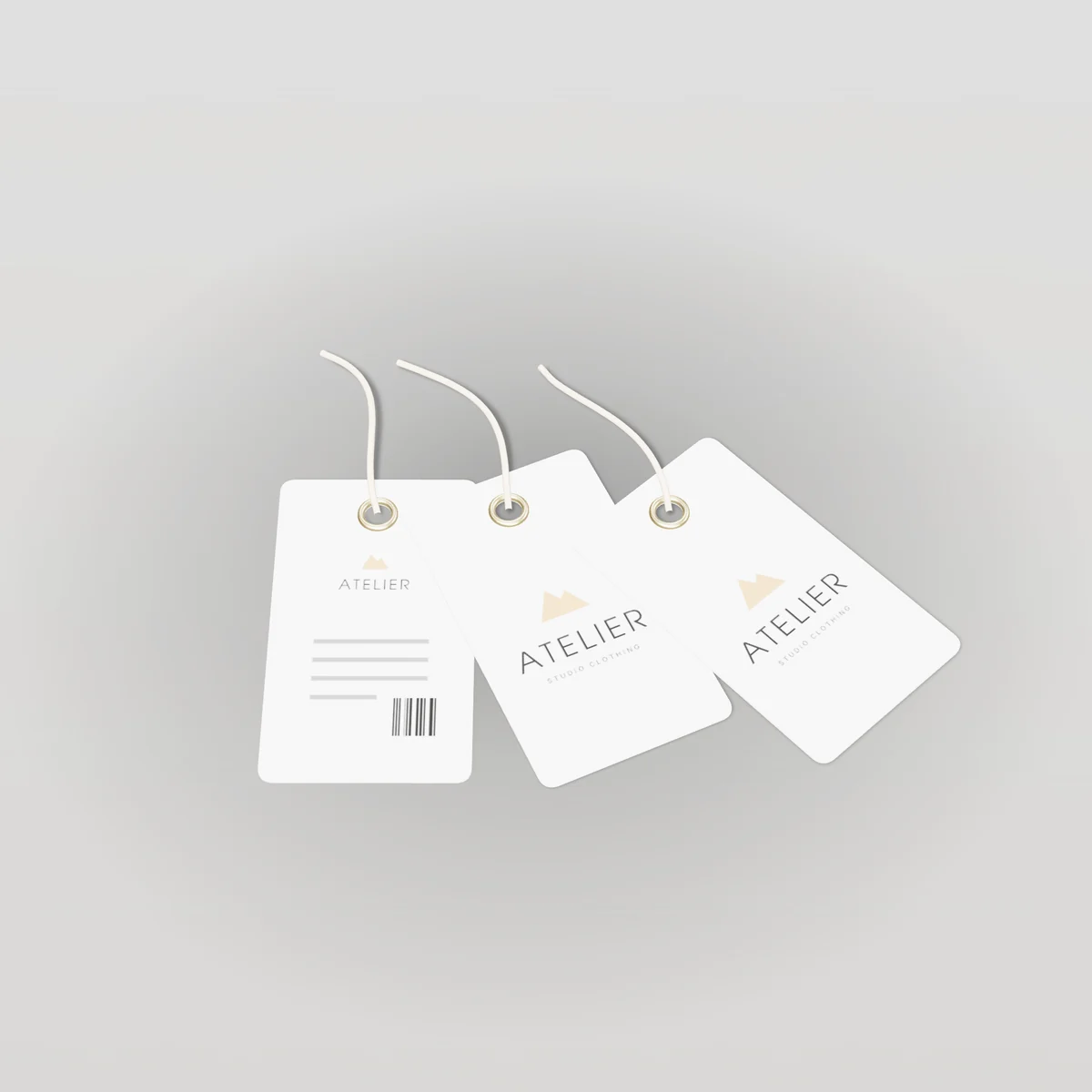
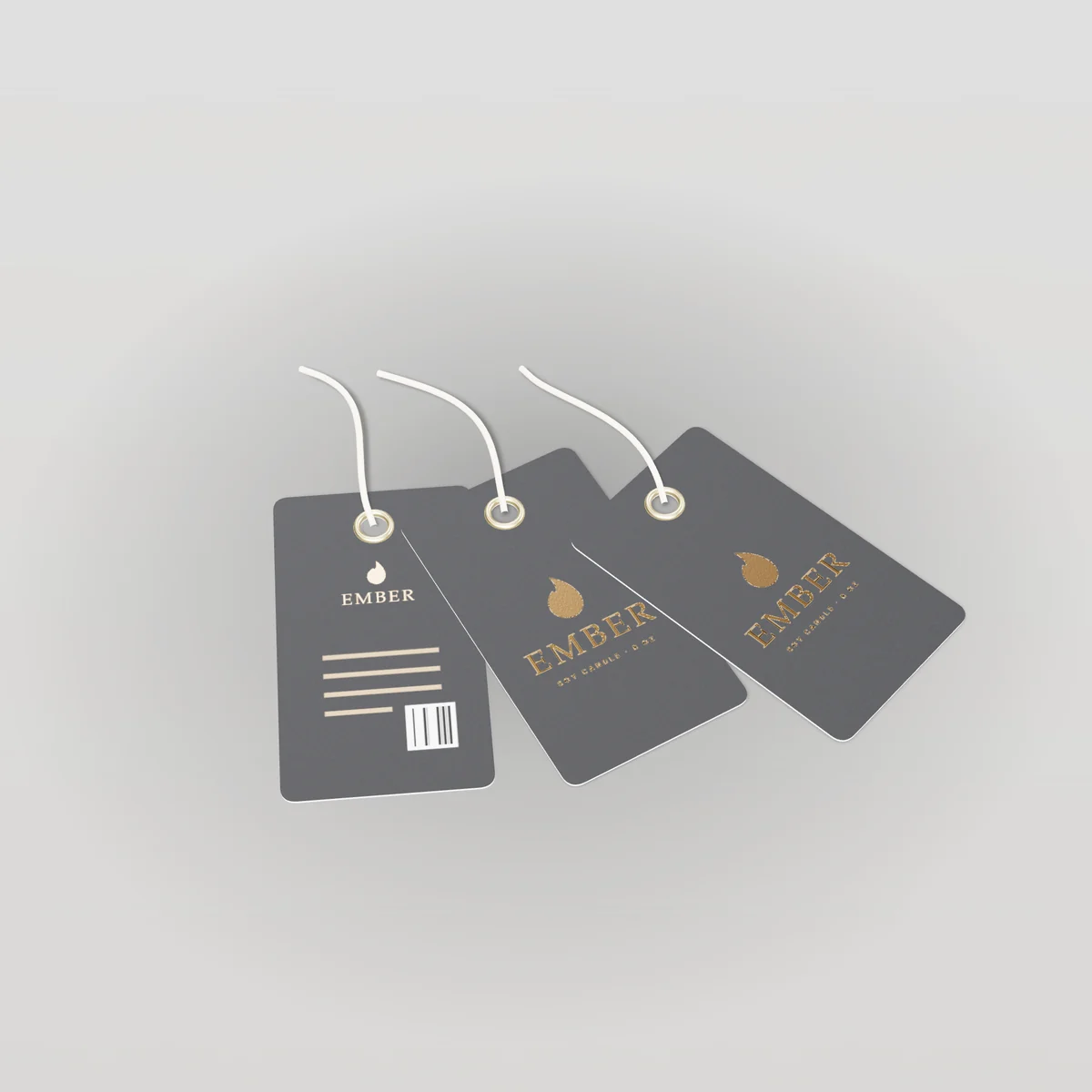
Hang tags (also called swing tags) are printed cards attached to products with a string, ribbon, loop pin or safety pin. They carry your brand, product name, price, size, care information and story. In apparel, they are essential retail tools; on candles, gifts and accessories, they add a handmade, premium touch.
Options
| Option | Details |
|---|---|
| Stocks | Heavy uncoated, coated, kraft, textured, cotton papers |
| Thickness | Typically 16–32pt for a sturdy feel |
| Shapes | Rectangle, rounded corners, custom die-cuts |
| Holes | Punched, reinforced or with metal grommets |
| Attachments | Cotton string, twine, ribbon, loop pins, safety pins |
| Finishes | Foil, embossing, spot UV, edge painting |
| One or both sides, variable data for sizes or prices |
What to put on a hang tag
- Brand logo
- Product name and style number
- Size and color
- Price or barcode (or a space for a price sticker)
- Care instructions or a short story
- Social handle or QR code
Tip: Use a sturdy stock and a reinforced hole for heavier garments; thin tags can tear when shoppers pull them.
Why hang tags still matter
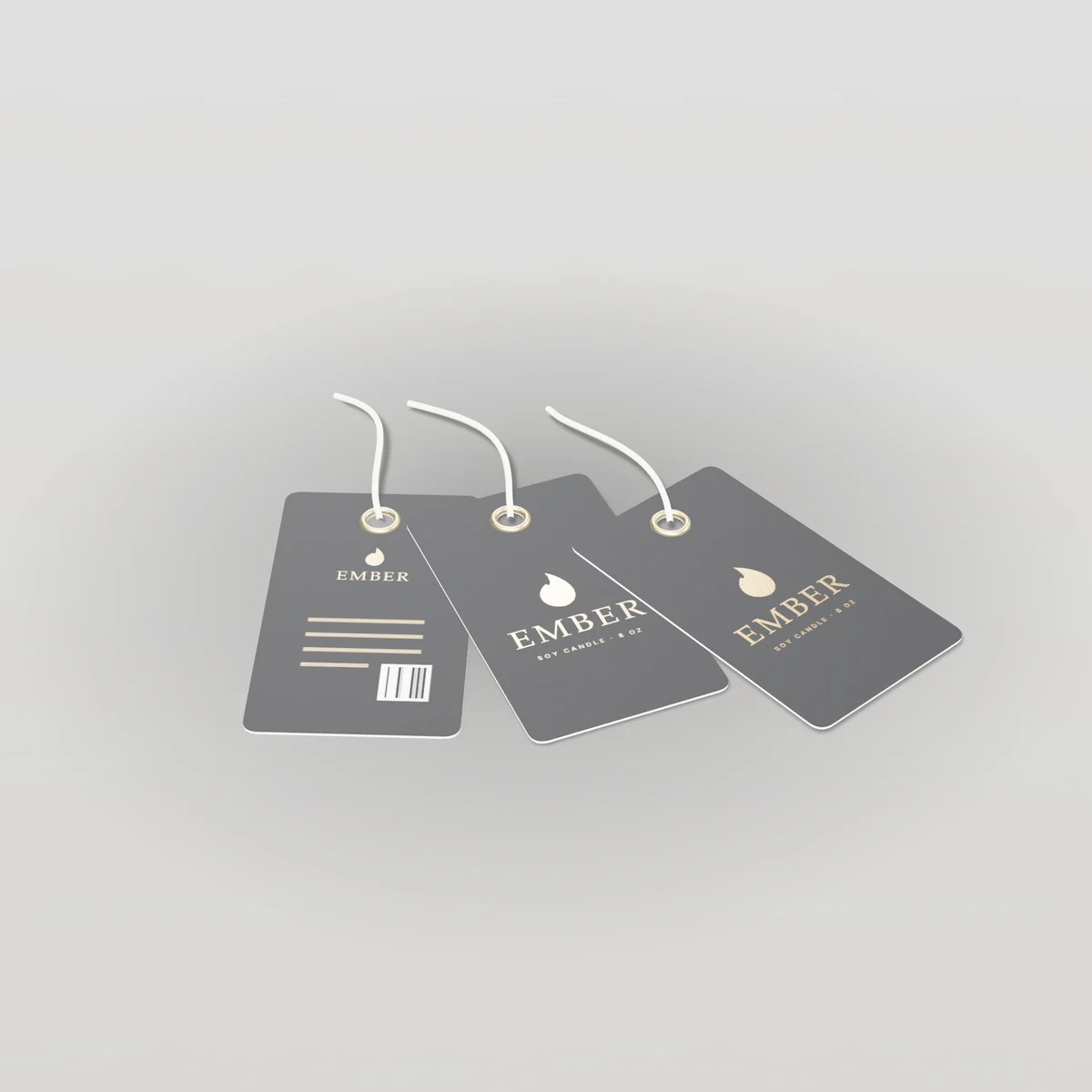
A hang tag is often the first thing a shopper touches and the last thing they remove before using a product. It does three jobs at once: it identifies the brand, it informs (price, size, materials, care) and it sells (story, values, quality cues). For apparel, accessories, candles, gifts and handmade goods, a well-designed tag can make a product feel more considered and justify a higher price.
Hang tags also travel: customers often keep them as bookmarks, gift labels or mementos, and they appear in photos of new purchases.
Tag stocks and thickness
| Stock | Thickness | Feel | Best for |
|---|---|---|---|
| Standard coated card | 14–16pt | Smooth, bright | Everyday apparel |
| Heavy uncoated card | 18–24pt | Natural, premium | Boutique and lifestyle brands |
| Kraft card | 14–24pt | Rustic, natural | Handmade, organic |
| Duplexed (two sheets bonded) | 32pt+ | Very thick, luxurious | Premium fashion, gifts |
| Recycled card | 14–24pt | Slightly textured | Sustainability-focused brands |
| Colored-through card | 16–24pt | Color on edges | Distinctive premium look |
| Synthetic (tear-resistant) | Varies | Durable, water-resistant | Outdoor and swimwear |
Tag stock communicates quality before anyone reads a word: a thick, rigid tag feels substantial, while a thin, flexible one feels inexpensive.
Thicker tags feel more premium and survive handling better. Duplexed tags can have different colors on each side and visible colored edges.
Shapes and holes
Shapes: rectangles, rounded corners, circles, arches, tickets with notched corners and fully custom die-cut outlines.
Holes: standard round holes (about 1/8–1/4 in), with optional metal or colored eyelets (grommets) to reinforce them.
Designing a hang tag
Front: brand logo, perhaps a pattern; keep it clean and recognizable.
Back: product name, size, materials, care information, price (or a space for a price sticker), barcode if required, website or social handle, a short story line.
Design tips:
- Hierarchy: brand first, product second, details last.
- Readable type: at least 6–7 pt.
- Space for variable info: sizes and prices often change; a blank area or sticker spot keeps one tag design working across products.
- Barcode area: clear quiet zones, dark bars on a light background.
- Hole position: keep text at least 1/4 in from the hole.
Tags are small, so every element must earn its place.
Typography: keep body text at a readable size and avoid very thin fonts that break up on textured stock.
Contrast: dark text on light stock or light text on dark stock; avoid mid-tones that blend together.
Hole placement: leave clear space around the hole, so it does not cut through text or logos. Mark the hole position on your artwork.
Bleed and safe area: like any printed piece, add bleed and keep important elements inside the safe area.
Back side: design the back as carefully as the front. Barcode, price and care information should be organized and easy to scan.
Hang tags and compliance
For textiles and apparel sold in the US, certain information (fiber content, country of origin, manufacturer identity, care instructions) is generally required on permanent labels sewn into garments; hang tags are additional and can repeat or extend that information. Requirements are set by regulations such as the FTC's Textile and Wool rules and Care Labeling Rule. Check the rules for your products.
Hang tags as a selling tool
On a rack of similar garments, a hang tag is often the first thing a shopper touches. It can explain what makes the product different in a few words: the fabric, the fit, the craft behind it or the brand story. A clear, attractive tag answers questions a shopper might not ask a salesperson, and it reassures online customers when they open their order that the product is genuine and cared for.
Good tags have a clear hierarchy. The brand comes first, recognizable at a glance. The product name or style follows, then a short benefit or story line. Practical information, such as size, price, care instructions and barcode, usually sits on the back. Resist the urge to fill every surface; white space signals quality.
Tag sizes and proportions
Hang tags come in many sizes, from small luggage-style tags to tall, narrow tags that hang along a garment. Common shapes include rectangles with rounded or square corners, tall narrow tags, small squares and custom die-cut shapes.
| Tag type | Approximate size range | Typical use |
|---|---|---|
| Small rectangle | About 2 × 3.5 in | Apparel, accessories, candles |
| Tall narrow | About 1.5–2 × 4–5 in | Denim, outerwear, premium garments |
| Square | About 2 × 2 to 3 × 3 in | Jewelry, gifts, small goods |
| Folded tag | Folds to small rectangle | Brand story, care details |
| Custom shape | Varies | Distinctive brands, gifts |
Choose a size that suits the product. A large tag on a delicate necklace overwhelms it; a tiny tag on a heavy coat gets lost. Folded tags add space for more information without increasing the visible size.
Attachments in detail
How a tag attaches affects both appearance and practicality:
- Strings and cords. Cotton, jute, waxed cotton, elastic or satin ribbon. Natural strings suit organic brands; satin suits luxury and gifts.
- Safety pins. Simple and reusable, often used on knitwear or delicate garments where tag fasteners could damage fabric.
- Plastic tag fasteners. Fast to apply with a tagging gun; common in high-volume apparel. They pierce the fabric, so place them in seams or labels.
- Metal ball chains. Sturdy and reusable; suit denim, leather and accessories.
- Seal tags and lock tags. Secure loops that cannot be removed without cutting; used for tamper evidence and returns control.
- Pre-strung tags. Tags supplied with string already attached, which saves labor at packing.
Reinforced holes, using metal or colored eyelets or a reinforcing patch, prevent strings from tearing through thinner stocks.
Hang tags for returns control
Some brands use tamper-evident or "return tags" placed in a visible spot. Customers can try the garment on, but removing the tag signals the item has been worn and may affect eligibility for return. If you use return tags, explain the policy clearly on your website and on the tag itself so customers know what to expect.
Finishes for premium tags
Finishes make tags feel special. Foil stamping adds metallic logos; embossing and debossing add texture that invites touch; spot UV adds subtle shine on matte stocks; edge painting colors the edges of thick tags; and letterpress presses the design into soft cotton papers for a crafted feel. Use one or two finishes rather than all of them, and match them to your brand. A minimalist brand might choose a blind deboss on thick uncoated board; a playful brand might choose a bright edge color and a glossy logo.
Tags beyond apparel
Hang tags work for many products: candles with a tag around the jar neck telling the scent story, gift baskets with a tag naming the contents and giver, bottles and jars with a neck tag carrying recipes or pairing ideas, plants with care instructions, handmade goods with the maker's story, pet products with a tag on a leash or toy, and furniture or homeware with materials and care information. For non-apparel products, tags often carry information that would clutter the main label, such as recipes, stories or instructions.
Sustainability and hang tags
Most hang tags are thrown away after purchase, so sustainability matters. Choose recycled or responsibly sourced paper stocks, natural strings or reusable attachments, and avoid plastic laminations unless the tag needs them. Some brands print tags on seed paper that can be planted, or design tags that customers keep as bookmarks or postcards. If you make claims about your tags, keep them specific and accurate.
Planning tags for a product range
If you sell many styles, colors and sizes, plan tags as a system. Keep one master design with fixed positions for the brand, product name, size and barcode. Vary only the information that changes, using variable data printing where possible. Use color coding for collections or product lines to help staff and shoppers find items quickly. Print the shared front design in one run and add variable information on the back. A consistent system looks professional and keeps costs under control, because many versions can be produced together.
Barcodes and price information on tags
Retail tags often carry barcodes and prices. Keep the barcode on the back, at a size that scans reliably, with clear space around it. If prices change by retailer or region, consider leaving the price off the printed tag and using a small price sticker, which avoids reprinting tags. For wholesale, ask your retail partners whether they require their own price tickets or specific barcode formats.
Writing tag copy
Tag copy should be short and specific. A few approaches work well. Lead with the material story ("Organic cotton, grown without synthetic pesticides" is more convincing than "eco-friendly"), the craft ("Hand-finished in small batches"), the fit or use ("Relaxed fit, made for layering") or the brand promise ("Designed to last, guaranteed to be repaired"). Whatever you say, make sure it is true and supportable, especially for claims about materials and sustainability.
How tags are produced
Tags are typically printed on sheets, then cut to shape, drilled or punched for holes, and finished with eyelets, strings or other attachments. Digital printing suits short runs and many versions; offset printing suits longer runs with consistent color. Finishes such as foil, embossing and edge painting are added in separate steps. Production time depends on quantity and finishing; simple tags are quicker than duplexed tags with foil and pre-strung attachments.
Common hang tag mistakes
Tags too thin. Flimsy tags bend, tear and feel cheap. Choose a stock that holds its shape.
Holes too close to the edge. Strings tear through. Keep holes away from edges and reinforce when needed.
Too much text. Shoppers glance at tags for seconds. Keep the front simple and move details to the back.
Hard-to-remove fasteners. Fasteners that damage fabric frustrate customers. Attach through labels or seams.
Forgetting the back. The back is valuable space for care, barcode and story. Use it thoughtfully.
Ignoring required labels. Hang tags usually do not replace permanent labels required for textiles.
Hang tags and the online unboxing
For online orders, the hang tag is part of the unboxing moment. A well-designed tag on a neatly folded garment, wrapped in tissue, reassures customers that they received a genuine, carefully packed product. Some brands add a small message on the tag for online customers, such as a link to care videos or a note about how to style the item. Tags can also carry QR codes linking to size guides, product care or the story of how the item was made.
Ordering hang tags
Before ordering, confirm size and shape, stock and thickness, print sides and colors, finishes, hole size and position, attachment type, quantity per design and any variable data such as sizes, barcodes or prices. Supply artwork with bleed, safe areas and hole position marked. Approve a proof carefully and, for large orders, ask for a physical sample to check thickness and finish.
Hang tags by industry
Fashion and apparel. Tags carry the brand, style name, size, price and barcode, often with a story line about fabric or fit. Premium labels favor thick, uncoated or duplexed stock with a single foil or debossed logo.
Denim. Tall tags, often in kraft or leather-look stocks, describe the wash, fit and fabric weight. Many denim brands use ball chains or heavy cords that customers keep.
Knitwear. Tags attached with safety pins or loops through labels avoid snagging delicate yarns. Copy often explains fiber origin and care.
Jewelry. Very small tags or cards hold earrings and pendants and carry the brand, material and price. Cards that double as displays keep pieces organized.
Candles and home fragrance. Tags around the jar neck describe scent notes, burn time guidance and safety reminders, keeping the main label clean.
Gifts and hampers. Tags name contents and leave space for a handwritten message, turning a product into a personal present.
Food and drink. Neck tags on bottles share pairings, recipes or tasting notes. Tags on baked goods and preserves can carry ingredient information, but required food labeling usually belongs on the main label.
Tags and brand storytelling
A tag is one of the few places where a brand can tell a short story at the moment a shopper is deciding. Consider a folded tag with the main brand on the outside and a short story inside about the person who designed the product, the place where the material came from or the small details that make it special. Stories make products memorable and help justify a higher price. Keep stories short, sincere and specific. "Each piece is cut and sewn by our small team" is more meaningful than "crafted with passion".
Personalization and variable tags
Variable data printing can personalize tags in ways that were once impractical. Brands use it for sequential numbering on limited editions ("No. 47 of 300"), customer names on made-to-order products, unique QR codes linking to an item's own care page or warranty registration, and different sizes, colors or prices on one shared design. If you plan variable tags, prepare data in a spreadsheet and confirm the layout with your printer before artwork is finalized.
Matching tags with the rest of your packaging
Tags work best as part of a consistent packaging system. Coordinate colors and typography with your labels, tissue, bags and boxes. If your boxes are kraft with black print, a kraft tag with a black logo and natural string keeps the look consistent. If your packaging is white with gold foil, a white tag with a small gold foil logo ties everything together. Order tags and other printed accessories at the same time where possible. Matching colors across different materials is easier when the jobs are planned together.
Caring for tags in storage and packing
Store tags flat in boxes, away from moisture and sunlight, to prevent curling and fading. Pre-strung tags can tangle; ask for them to be bundled or packed in a way that makes them easy to use. Train packing teams to attach tags in the same position on every product so the presentation is consistent in stores and in online orders.
Choosing between hang tags, labels and printed packaging
Not every product needs a hang tag. A quick way to decide:
| Need | Best option |
|---|---|
| Required fiber, origin and care information on textiles | Permanent sewn-in or printed label |
| Brand story, price and barcode on apparel in stores | Hang tag |
| Product information on boxed goods | Printed packaging or a product label |
| Scent, recipe or story on jars and bottles | Neck tag |
| Gift message | Gift tag or card |
| Tamper evidence for returns | Seal or lock tag |
Many brands use a combination: a permanent label for required information, a hang tag for brand and price, and packaging that protects the product and completes the experience.
Cost factors for hang tags
Tag pricing depends on size, stock, number of colors and sides, finishes, shape, hole and attachment, quantity and versions. Simple single-sided tags on standard stock are economical, especially in larger quantities. Duplexed stock, foil, embossing, custom shapes and pre-strung attachments add cost but can transform how a product feels in the hand. If budget is tight, focus on stock thickness and a clean design; a thick tag with a simple one-color print can feel more premium than a thin tag with many effects.
Testing tags before a full run
Before ordering thousands of tags, test a few with real products. Attach tags in the planned position and check how they hang. Look at them on a rack, on a table and in a shipping box. Check that strings or fasteners do not damage fabric and that customers can remove tags easily. Scan barcodes. Show the tag to a few people who have not seen it before and ask what they notice first. These small checks catch problems early and help you refine the design.
Hang tags as collectibles and keepsakes
Some tags are designed to be kept. Thick tags with beautiful illustration, a short poem or a useful feature, such as a bookmark shape, a recipe or a care card, often stay with customers long after the product is unpacked. A tag that customers keep keeps your brand in their home. Design keepsake tags with durable stock and timeless artwork, and give customers a reason to hold onto them.
Working with us on hang tags
Share your product, the look you want and your quantity, and we will recommend stock, size, finish and attachments. We provide a proof showing hole position and both sides of the tag. For premium tags, we can send a physical sample before production. Tags can be produced alongside your boxes, labels and tissue so colors and finishes match across your packaging.
Questions to ask before you design
Before starting artwork, answer a few practical questions. Where will the tag be attached, and how will it hang? What information must appear, and what is optional? Will the tag be seen mostly in stores, online unboxing or both? How many versions do you need for sizes, colors or collections? Will customers remove it at the till, at home or not at all? What is your budget per tag at your expected quantity? Clear answers make it easier to choose size, stock and finishes, and they help your designer create a tag that works hard in a small space. Share them with us when you request a quote, and we can suggest options that match your goals and budget.
Hang tags in product photography
Tags appear in product photos on your website, marketplaces and social media. A clean, well-designed tag can strengthen brand recognition in every photo, while a crumpled or crooked tag distracts. Photograph products with tags attached consistently, or remove them for lifestyle shots and show the tag in a detail photo. For flat-lay and Pinterest-style images, a beautifully finished tag on a folded garment can become the hero of the shot.
Worked example: a denim brand's tag system
A denim brand replaced thin printed tags with a tall duplexed kraft tag. The front carried a debossed logo; the back listed fit, fabric weight, wash and a barcode in a fixed layout, with the size and fit printed by variable data. A natural cotton string was pre-attached so tags could be looped through belt loops without piercing fabric. The tags looked consistent across every style and size, and the brand ordered one shared design for the whole collection instead of separate tags for each style.
Specification checklist for hang tags
- Size, shape and thickness.
- Stock and color; duplexing if desired.
- Print sides and colors; finishes such as foil or deboss.
- Hole size, position and reinforcement.
- Attachment type, pre-strung or separate.
- Variable data: sizes, prices, barcodes.
- Quantity per version.
Quick decision guide for hang tags
| If you need… | Choose… | Because… |
|---|---|---|
| Everyday apparel | Coated card, printed both sides | Economical and clear |
| Premium fashion | Duplexed board with foil or deboss | Substantial feel |
| Natural brands | Kraft or recycled board with cotton string | Organic look |
| Outdoor or swimwear | Synthetic tear-resistant stock | Survives water |
| Many sizes and prices | Shared design with variable data | One design, many versions |
| Returns control | Seal or lock tags | Shows if items were worn |
How to brief us on hang tags
Tags have many small options, so a quick brief helps:
- Products and attachment points. Where and how the tag will hang.
- Information on each side. Brand, story, size, price, care and barcode.
- Stock, thickness and finish. Coated, uncoated, kraft or duplexed, plus foil or deboss.
- Attachments. String, pins or fasteners, pre-strung or separate.
- Versions and quantities. Sizes, colors or prices that change.
- Artwork. Vector files with the hole position marked.
Send what you have, even if some answers are rough. Our specialists reply within one business day with recommendations, a price estimate and next steps, and every order includes free design help and a 3D proof before anything goes to production.
Hang tags in one paragraph
A hang tag introduces your brand at the moment a shopper touches the product. Choose a stock that feels substantial, keep the front simple and the back organized, attach it without damaging the product, and remember that required textile information belongs on permanent labels. A well-made tag can sell, inform and even become a keepsake.
Ordering
Our minimum is 500 pieces. Request pricing above.
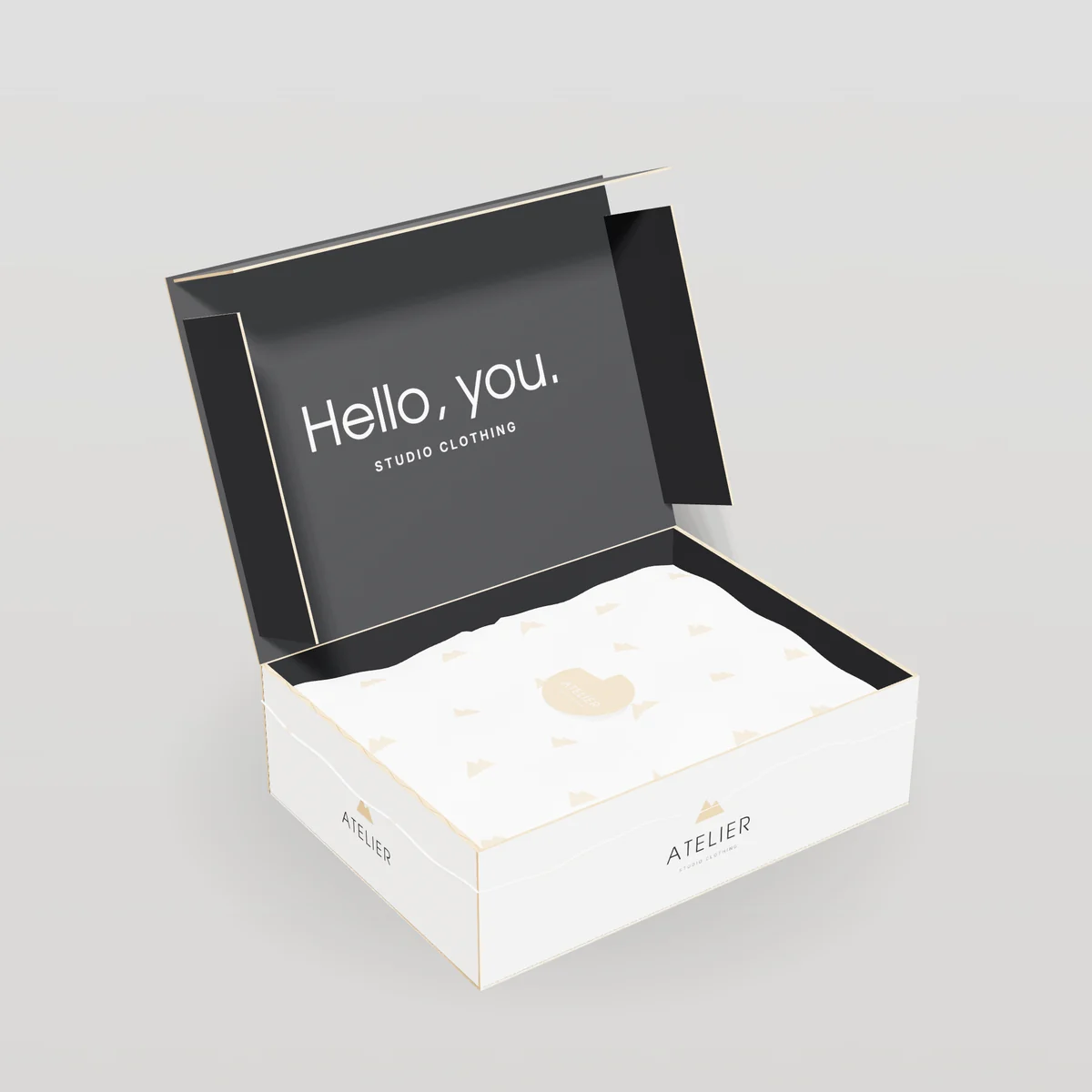 IndustriesApparel BoxesMailers, lid-and-base boxes and poly mailers for clothing, from tees to outerwear.
 AccessoriesCustom Paper BagsPrinted kraft and white shopping bags with rope, twisted or die-cut handles.
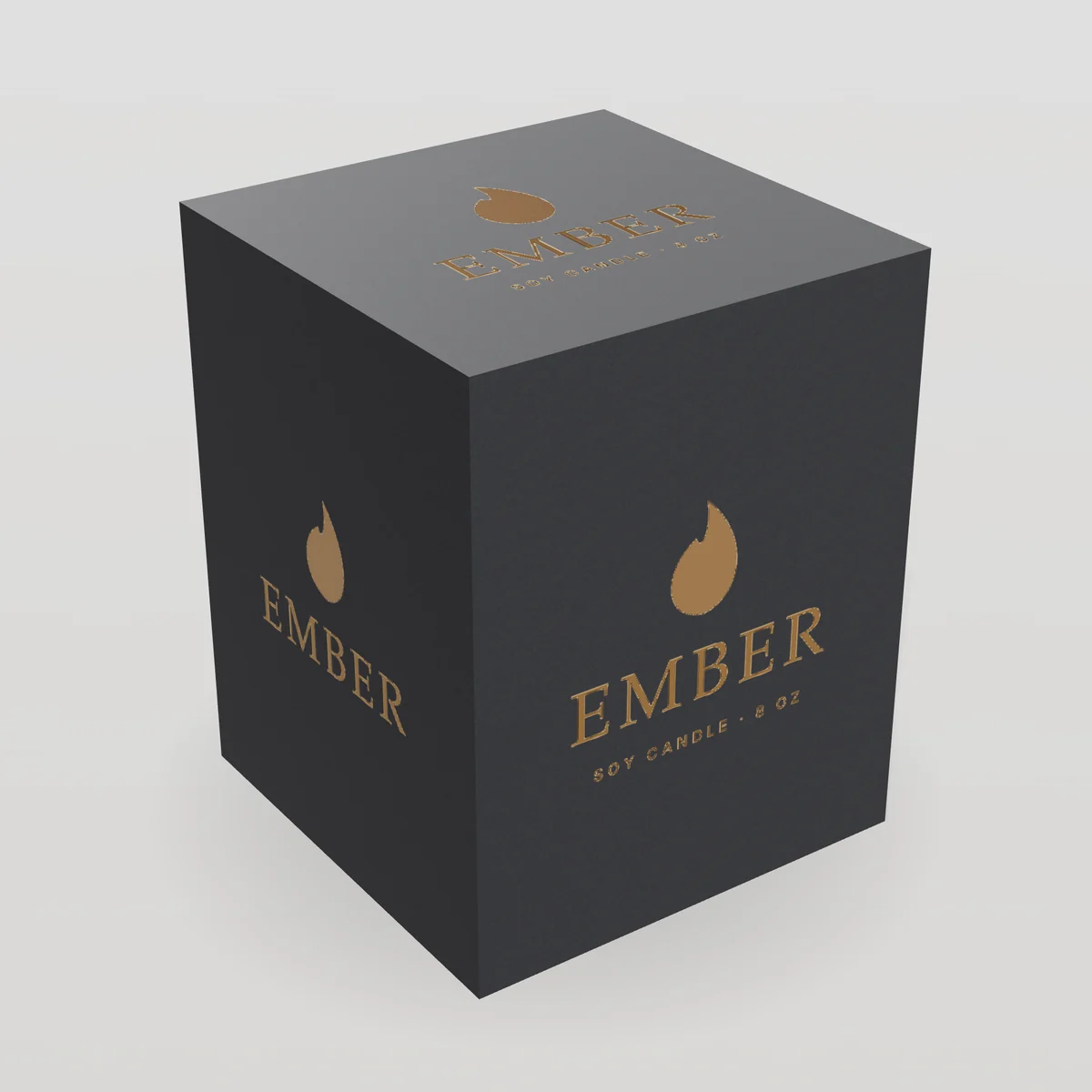 IndustriesCandle BoxesJar and tin candle packaging with inserts that protect glass in transit.
 IndustriesGift BoxesRigid, magnetic and lid-and-base gift boxes for corporate gifting, holidays and retail.
How to order custom hang tags
- 1Request a quote
Tell us the style, size, quantity and artwork you have. Use the form or the live estimator.
- 2Free design & dieline
We send a dieline for your exact size, check your artwork and help with layout at no charge.
- 3Approve your proof
Review a digital 3D proof (and an optional physical sample) before anything is printed.
- 4Production & QC
Your boxes are printed, finished, die-cut and inspected against the approved proof.
- 5Delivered to your door
Shipped flat-packed with tracking to any address in the contiguous US.
Key terms on this page
- Kraft
- Paper or board made from unbleached wood pulp, naturally brown and strong.
- Embossing
- Raising part of the board surface into a relief using matched dies, often combined with foil or ink.
- Spot UV
- A clear, glossy UV-cured varnish applied to selected areas to create contrast with a matte background.
- Artwork
- The final graphic files (logos, images, text and colors) placed on a dieline and used to make printing plates or digital print files.
- Bleed
- Artwork that extends beyond the cut line, normally 1/8 inch (3 mm), so that no unprinted edge appears if cutting shifts slightly.
- Tamper evidence
- Features that show if a package has been opened, such as seals, tear strips or shrink bands.
- Foil stamping
- Applying metallic or pigmented foil to packaging with heat and pressure using a metal die.
- Debossing
- Pressing a design into the board so it sits below the surface. The opposite of embossing.
- Board
- A general term for thick paper materials used in packaging, including paperboard, corrugated board and greyboard.
- Variable data printing
- Printing unique information (names, codes, numbers) on each package, made possible by digital printing.
- Digital printing
- Printing directly from a digital file without plates. Ideal for short runs, multiple designs and fast changes.
- Offset printing
- Lithographic printing that transfers ink from metal plates to a rubber blanket and then to the sheet. Sharp detail and consistent color for larger runs.
- Proof
- A preview of the final package (digital PDF, 3D render or physical sample) that the customer approves before production.
- Finish
- Any treatment applied after printing to change appearance or protect the surface, such as coatings, laminations, foil, embossing or spot UV.
- Registration
- The alignment of printed colors and finishes with each other and with the dieline.
More definitions in our packaging glossary.
Customer reviews
Reviews come only from verified customers. Ordered custom hang tags from us? Share your experience.
Discussed on Quora & X
Custom Hang Tags FAQ
What is the minimum order for hang tags?
Our minimum is 500 pieces.
Can hang tags include barcodes?
Yes, or a blank area for price stickers.
What thickness is best?
16–32pt stocks feel substantial; thicker stocks feel more premium.
Do you attach strings?
We can supply tags with strings or ribbons attached, or loose.
What size should a hang tag be?
Common sizes are 2 × 3.5 in (business card size), 2 × 4 in and 3 × 5 in. Choose based on product size and how much information you need.
Can hang tags be printed on both sides?
Yes. Most hang tags are printed front and back.
What is a duplexed hang tag?
A tag made from two sheets of card bonded together, creating a very thick tag that can have different colors on each side.
What is the best thickness for a hang tag?
Many apparel brands choose a thick board that feels rigid in the hand. Thinner stocks suit small accessories, while duplexed board suits premium products. Ask for samples to compare.
Do hang tags replace care labels?
Usually not. For many textile products, care and other information must appear on permanently attached labels. Hang tags can repeat it and add marketing content.
Can I order hang tags with strings attached?
Yes. Tags can be supplied pre-strung with cotton, jute, elastic or ribbon, which saves time when tagging products.
Are hang tags recyclable?
Paper tags without plastic laminations or metal parts are generally recyclable with paper. Remove metal eyelets or chains where possible.
How do I attach a tag without damaging fabric?
Attach through a label, seam or existing loop, use a safety pin for delicate items, or tie tags around buttons or hangers rather than piercing fabric.
What size hole should a hang tag have?
Common hole sizes are around 1/8 to 1/4 inch. Choose a size that fits your string or fastener, and reinforce the hole for thinner stocks or heavy products.
Can hang tags be made from recycled or plantable paper?
Yes. Recycled stocks are widely available, and plantable seed paper tags are possible for brands that want a tag customers can grow.
How long does hang tag production take?
Simple printed tags are usually quick to produce after proof approval. Duplexed stocks, foil, embossing and pre-strung attachments add time.
Can hang tags be die-cut into custom shapes?
Yes. Custom shapes are cut with a die and can echo your logo or product.
Can tags have different designs on each side?
Yes. Most tags are printed differently on the front and back.
Do you print barcodes on tags?
Yes. Barcodes are printed in a clear area on the back, sized and spaced to scan reliably.